langchain-huggingface 1.2.3 Released: Dependency Updates and Security Fixes Explained

langchain-huggingface 1.2.3 fixes API token leakage and upgrades core dependencies including torch 2.13.
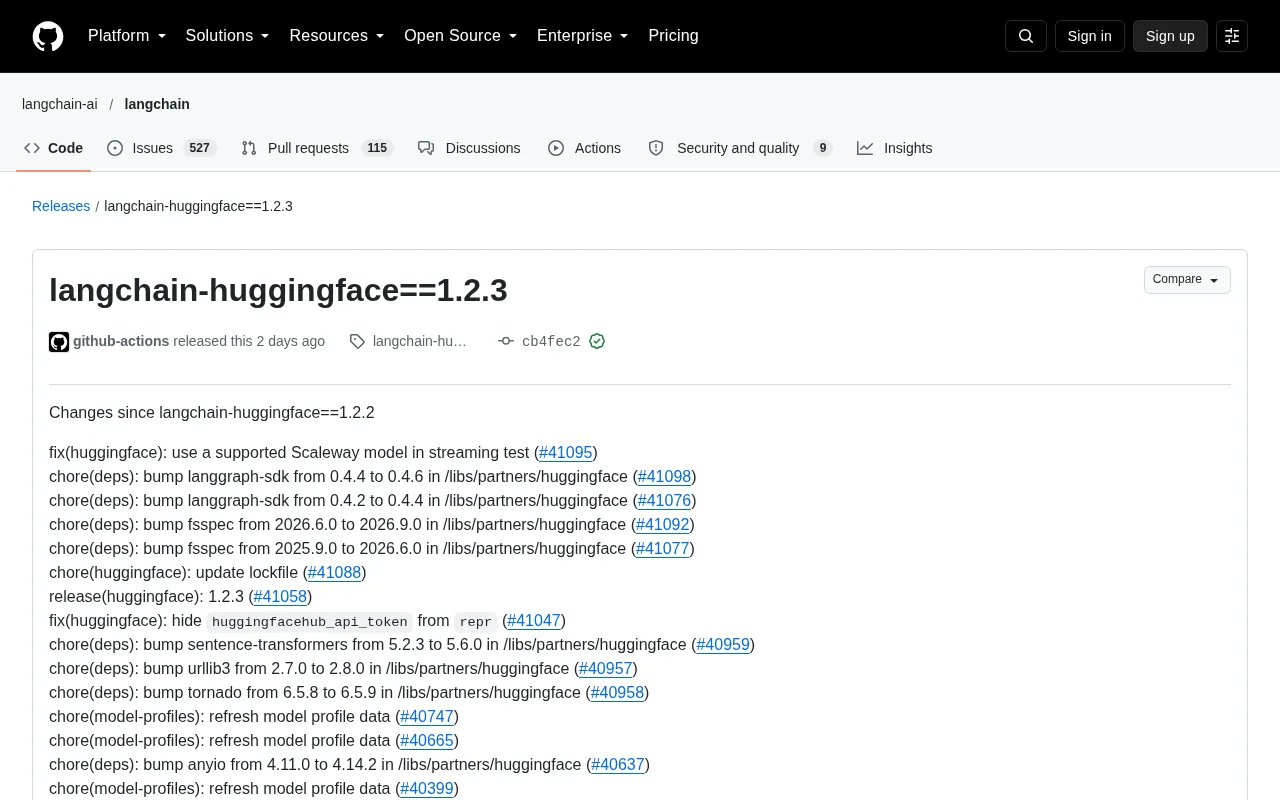
The official LangChain Hugging Face integration package `langchain-huggingface` releases version 1.2.3, a maintenance-focused iteration. Key changes include: a security fix hiding API tokens from object `repr` output; adopting PyTorch's `torch.accelerator` unified interface for hardware-agnostic device detection; and removing the retired IPEX backend. Dependencies updated include `transformers` to 5.10.1, `torch` to 2.13.0, and `sentence-transformers` to 5.6.0. Production users should validate compatibility with new `torch` and `transformers` versions before upgrading.
The official LangChain integration package for Hugging Face, langchain-huggingface, has released version 1.2.3. This is a maintenance-focused minor release centered around dependency upgrades, device detection improvements, and one notable security fix. For developers using LangChain to call Hugging Face models in production, this version introduces no major new features — but several changes are still worth paying attention to.
Release Profile: Maintenance-Focused
Looking at the changelog, the vast majority of changes in 1.2.3 relative to 1.2.2 fall under the chore(deps) category — routine dependency version bumps. These updates typically don't change API behavior, but they're critical for keeping the dependency supply chain healthy and patching upstream vulnerabilities.
Core dependencies that were upgraded include: transformers (from 5.5.0 to 5.10.1), torch (incrementally upgraded from 2.9.0 all the way to 2.13.0), sentence-transformers (5.2.3 to 5.6.0), and a range of foundational libraries such as langsmith, aiohttp, urllib3, and fsspec. The frequent model-profiles data refreshes also indicate that this integration is continuously syncing model metadata from the Hugging Face Hub.
Three Substantive Changes Worth Noting
Hiding the API Token to Prevent Leakage
The most security-relevant change is fix(huggingface): hide huggingfacehub_api_token from repr (#41047). Prior to this fix, when an object was printed or logged, its repr representation could expose the Hugging Face Hub API Token in plaintext. Sensitive credentials appearing in logs, stack traces, or debug output carry a real risk of accidental recording and leakage. This fix hides the token from the object's string representation — a small but meaningful security hardening.
Device Detection Becomes Hardware-Agnostic
Another noteworthy change is feat(huggingface): use torch.accelerator for device-agnostic device count detection (#39640). This switches to PyTorch's newer torch.accelerator interface for detecting the number of accelerator devices, decoupling the code from any specific hardware backend (such as CUDA-only detection). As the AI hardware ecosystem grows increasingly diverse, this kind of hardware-agnostic abstraction helps maintain consistent runtime behavior across different accelerator platforms.
torch.accelerator is a unified accelerator abstraction interface introduced in recent versions of PyTorch, designed to abstract away underlying hardware differences. Previously, PyTorch code typically relied on CUDA-specific APIs like torch.cuda.device_count() or torch.cuda.is_available() to detect hardware resources — meaning that running on AMD ROCm, Apple MPS (Metal Performance Shaders), Intel XPU, or other accelerators often required developers to write manual conditional branches. torch.accelerator provides unified interfaces such as torch.accelerator.current_accelerator() and torch.accelerator.device_count(), automatically adapting to the currently available hardware backend at runtime without requiring changes to application-level code. For an integration library like langchain-huggingface that needs to run across diverse deployment environments, adopting this interface means users get consistent device-aware behavior whether they're running on an NVIDIA GPU, Apple Silicon, or an Intel discrete GPU.
Removing the Retired IPEX Backend
fix(huggingface): remove retired IPEX backend (#39649) cleans up code paths related to IPEX (Intel Extension for PyTorch), which is no longer actively maintained. Removing retired components reduces maintenance burden and prevents developers from accidentally using an unsupported backend.
IPEX (Intel Extension for PyTorch) is an extension library developed by Intel to optimize PyTorch inference and training performance on its CPU and GPU hardware, and was previously integrated into several AI frameworks as an Intel hardware acceleration backend. However, as Intel's hardware and software stack has evolved, parts of the older IPEX interface have been discontinued. Keeping those code paths alive not only increases maintenance costs but can also cause runtime errors when deprecated interfaces are called. Removing retired backends is a common technical debt cleanup action in large open-source projects — it helps keep the codebase lean and maintainable, while guiding users toward currently supported Intel hardware acceleration paths (such as through the torch.accelerator unified interface or the latest version of Intel Extension for PyTorch).
What This Means for Developers
If you're currently using langchain-huggingface, upgrading to 1.2.3 offers three main benefits: compatibility with the new transformers 5.x and torch 2.13; a patch for the potential API token leakage risk; and more robust device detection in multi-accelerator environments.
One thing to be aware of: given the significant version jumps in the underlying torch and transformers libraries, users who depend on these packages should verify that their training/inference code is compatible with the new versions before upgrading, and validate in a test environment first if necessary. Additionally, the fix for Scaleway streaming models in tests (#41095) further demonstrates that this integration continues to polish the stability of streaming output.
Summary
langchain-huggingface==1.2.3 is a classic healthy maintenance release — no groundbreaking new features, but through dense dependency upgrades, the security fix for token hiding, and a modernized device detection approach, this official LangChain Hugging Face integration becomes more engineering-reliable. For production users prioritizing stability and security, these seemingly unremarkable minor releases are exactly the kind of updates worth tracking promptly.
Related articles

Cursor Pro Discontinued, Claude Code Cost Savings, and Five Major AI Coding Developments
Cursor cancels its $20 Pro tier and folds into X subscriptions, Anthropic builds its own version control, Claude Code auto-compresses context, GitHub Copilot orchestrates multiple models, and Alibaba Qoder opens agent teams to individuals—five major AI coding developments reveal a shared thread of pricing restructuring and cost optimization.

Cursor Official Plugin Swapped: Claude Code Extension Hid an SSH Backdoor
A Claude Code plugin in Cursor's official extension marketplace was swapped for a malicious version, planting an SSH backdoor for about 11 hours and affecting up to 5,000 developers.

Tencent WorkBuddy Hands-On: How AI Agents Crush Traditional Chat Assistants
WorkBuddy vs Doubao tested: how AI Agents directly operate computers to convert PPT to PDF, archive files and more. Analysis of WorkBuddy's low barrier, domestic ecosystem, pricing and plugin marketplace, plus AI Agent selection advice.