LangChain-OpenAI 1.6.6 Released: Streaming Error Handling Fix

langchain-openai 1.6.6 fixes silently swallowed error events in streaming calls, improving production robustness.
LangChain released `langchain-openai==1.6.6`, a patch update focused on stability. The key fix addresses streaming OpenAI calls where server-side error events could be silently ignored, causing callers to falsely believe a request succeeded while receiving incomplete output — and leaving the issue nearly impossible to debug. Version 1.6.6 ensures error events are explicitly raised as Python exceptions. As a SemVer patch release, it involves no API changes, making it a safe, backward-compatible upgrade for teams using streaming.
Release Overview
LangChain has recently released langchain-openai==1.6.6, a minor maintenance update following version 1.6.5. As the core component connecting LangChain to OpenAI models, every iteration of langchain-openai directly impacts a large number of production-grade applications built on the OpenAI API.
To date, the LangChain main repository has accumulated approximately 147,000 stars and 24,700 forks on GitHub, making it one of the most influential open-source frameworks in the LLM application development space. This release was published automatically via GitHub Actions, with integrity guaranteed through GitHub's verified signature (GPG key ID: B5690EEEBB952194).
What's Changed
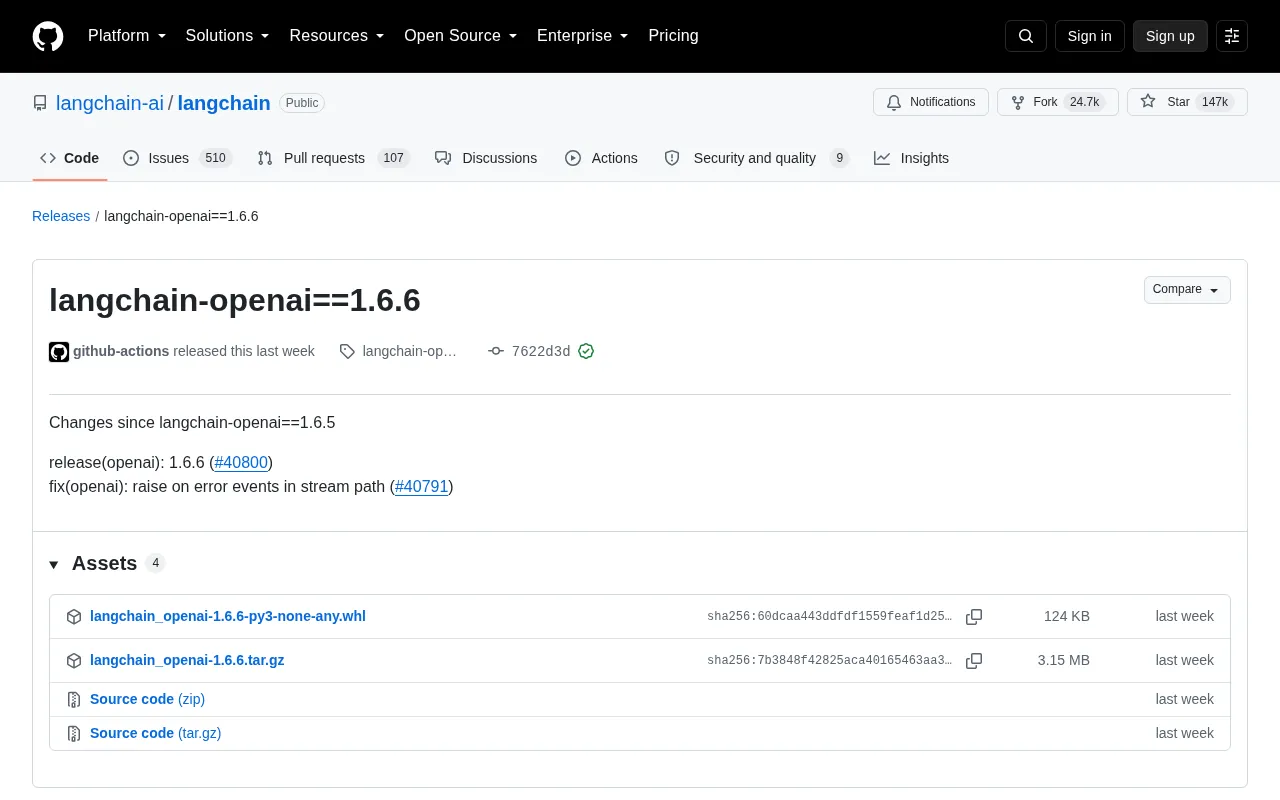
According to the official Release Notes, 1.6.6 includes two changes compared to 1.6.5:
Error Event Handling in the Streaming Path
The core fix is fix(openai): raise on error events in stream path (#40791). In previous versions, when calling the OpenAI API in streaming mode, if the server returned error events within the data stream, the client might fail to raise them as exceptions — causing errors to be silently swallowed or the program to enter an unpredictable state.
For applications that rely on streaming output to build real-time conversations or token-by-token rendering interfaces, this is a critical robustness improvement. After the fix, error events encountered in the streaming path will be explicitly raised, allowing developers to handle these failure scenarios through standard exception-catching mechanisms and preventing issues from being amplified further downstream.
Streaming refers to the pattern where a client progressively receives response content via a continuous data stream, rather than waiting for the complete result to be returned all at once. In OpenAI's API implementation, streaming is based on the Server-Sent Events (SSE) protocol, where the server continuously pushes token fragments in
data: {...}format until adata: [DONE]signal is received. However, when the server encounters an error mid-stream — such as rate limiting, context length exceeded, or content moderation blocks — it inserts an error event into the stream. If the client doesn't specifically detect and handle these events, it silently skips them, leading the caller to believe the request "completed successfully" while actually receiving incomplete or empty output. This is extremely difficult to debug in production environments, as there is no exception stack trace and logs show no obvious errors. This fix ensures that such error events are explicitly converted into Python exceptions and propagated upward, enabling standard exception-handling mechanisms liketry/exceptto properly catch and respond to them.
Version Release Commit
The other change is a routine release commit release(openai): 1.6.6 (#40800), used to tag and package this version.
What This Means for Developers
Although 1.6.6 is a patch-level release, the streaming error handling fix addresses exactly the kind of hidden risk that is easily overlooked in production environments. Streaming calls offer clear advantages for user experience, but also mean that errors can appear intermittently during transmission. A streaming implementation that cannot properly propagate errors makes diagnosing live issues exceptionally difficult.
For teams currently using langchain-openai's streaming capabilities, it is recommended to evaluate upgrading to 1.6.6 for more predictable exception behavior. Since this version only addresses error handling logic rather than API changes, the upgrade risk is low and backward compatibility is guaranteed.
Under Semantic Versioning (SemVer), version numbers consist of three segments: MAJOR.MINOR.PATCH. The PATCH version is specifically reserved for backward-compatible bug fixes, introducing no new features or breaking changes. This means upgrading from
1.6.5to1.6.6requires no code changes whatsoever — your existing code benefits from the improved error handling immediately, with no risk of interface signature changes or behavioral semantic adjustments. For production projects with pinned dependencies, the upgrade can be completed by simply modifying the version constraint inrequirements.txtorpyproject.tomland redeploying.
Summary
langchain-openai==1.6.6 is a stability-focused maintenance update whose core value lies in making error handling in streaming calls more reliable. For developers building real-time LLM applications, fixes like this — seemingly minor on the surface — can significantly reduce hidden risks in production environments. Staying on top of LangChain's official release updates and promptly adopting patch versions is a pragmatic approach to ensuring long-term application stability.
Related articles

world2vec: Building Mechanistic World Models with Latent Dynamics Learning
world2vec proposes a reward-free method for learning mechanistic world models via latent dynamics, faithfully reproducing systems over long horizons with at least an order of magnitude fewer parameters than DreamerV3, TD-MPC2, and LeWM, and achieving accurate system identification on 71 attractor benchmarks.

A New KL-DRO Paradigm: Adaptive Scenario Generation Around a Learned Density Model
KL-DRO research proposes centering the KL ball on a learned density model instead of the empirical distribution, with adaptive scenario generation guiding sampling toward the worst case. Experiments show lower cost under distribution shift when records are scarce and the model can extrapolate, with comparable in-distribution cost.

ODE Samplers for Discrete Diffusion Models: Exponential Residual Flows Accelerate Generation
Discrete diffusion models lack deterministic ODE sampling? This article introduces Exponential Residual Flows (ERFs), which introduce continuous residual variables per token to construct piecewise ODEs for deterministic sampling and support consistency distillation acceleration. Superior to prior methods on code and text generation tasks.