Lee Chang-dong's New Film "Possible Love": Camera Ethics and Class Trauma

Lee Chang-dong's new film *Possible Love* mirrors the 2009 layoff tragedy to interrogate the ethics of representing suffering through the lens.
Lee Chang-dong's seventh feature, *Possible Love*, draws on the real 2009 event in which a major South Korean corporation laid off 2,600 employees and many died by suicide. The film continues his class and labor narrative but pushes the "camera" itself to the foreground of ethical interrogation: how can a director make deaths visible without consuming suffering? Does filming itself constitute secondary harm? The article traces the financial crisis and labor flexibilization background, analyzes the ethical responsibility suggested by the title "Possible Love," and notes that Lee makes image production itself part of the class problem—who has the right to film, who is filmed, and to whom suffering is shown. Multiple reviews corroborate the film's restrained visual style and indirect handling of suicide scenes, avoiding sentimentality.
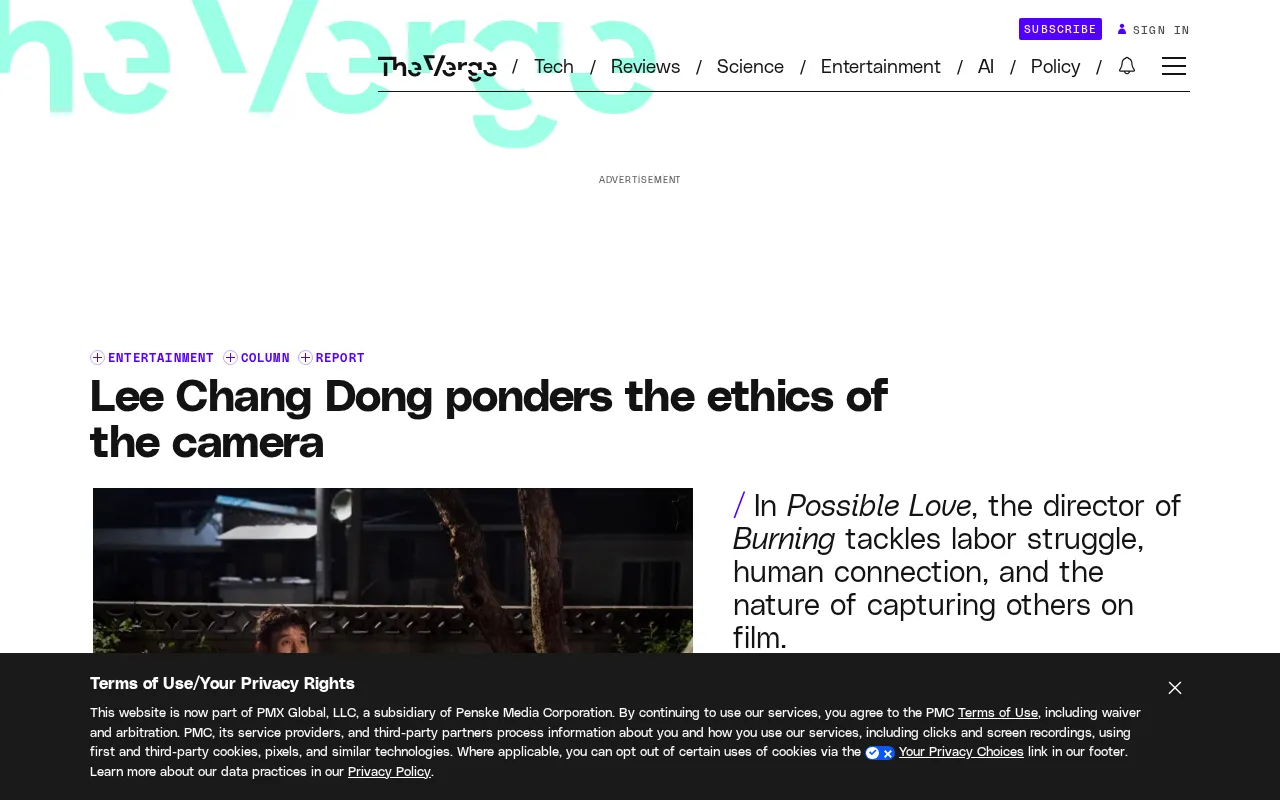
Lee Chang-dong's seventh feature film, Possible Love, turns its lens on a real event: in 2009, a major South Korean corporation laid off one-third of its workforce—2,600 people—after which many died by suicide. The film continues the class and labor themes that run throughout Lee's work, but more intriguingly, it pushes the "camera" itself to the forefront of ethical interrogation.
When the Lens Turns to Trauma: The Ethical Dilemma of Representation
Lee Chang-dong's films have never shied away from social wounds. Peppermint Candy, Oasis, and Poetry all ask how individuals survive under structural violence. But what sets Possible Love apart is that the event it draws from itself contains a great deal of death—suicide. This raises a sharp ethical question: how can a director make these deaths visible without consuming suffering?
According to the original report, Lee Chang-dong repeatedly mentioned "the ethics of the camera" when discussing this film. This is no empty talk. When the lens turns to the families of those who died by suicide, to the laid-off workers, the director must answer: does the act of filming itself constitute secondary harm? Does representation necessarily mean exploitation? This self-reflexive questioning elevates the film from social realism to a critique of the image medium itself.
The 2009 Layoffs: The People Behind the Numbers
2,600 laid off, multiple suicides—when these two figures are placed side by side, the former is easily overshadowed by the latter. Lee Chang-dong's creative habit is to approach abstract structures through specific people. The 2009 layoffs were not an isolated event; they occurred in the aftermath of the global financial crisis, against the backdrop of an accelerating flexibilization of South Korea's labor market. The one-third of employees who were cut were not denominators on a statistical report, but concrete individuals with families, debts, and dignity.
The film's choice of "Possible Love" as its title suggests the possibility of finding connection in despair. This love is not a romanticized redemption, but something closer to an ethical responsibility—to see the other, to acknowledge the other. In Poetry, Lee had an elderly woman with Alzheimer's learn to write poetry, capturing beauty amid forgetting; this time he turns the camera toward death, asking whether images can bear justice.
In 2008 the global financial crisis (triggered by the U.S. subprime mortgage crisis) dealt a severe blow to South Korea's export-oriented economy. In 2009, South Korea's GDP growth plummeted to around 0.7%, and unemployment climbed. South Korea's labor market has long had a "regular worker–irregular worker" dual structure. After the crisis, corporations accelerated "structural adjustment," widely adopting dispatch, outsourcing, and other flexible employment forms and laying off regular employees to cut costs. This flexibilization trend began with labor market reforms under IMF bailout conditions after the 1997 Asian financial crisis, giving large-scale layoffs the institutional soil they needed in 2009. Laid-off workers often faced difficulties finding reemployment, ruptured household debt, and gaps in social security—this structural background is key to understanding the suicide tragedies in this event.
Where Class Narrative Meets Image Politics
From Green Fish to Burning, Lee Chang-dong has consistently focused on the classes crushed within South Korean society. In Burning, the class confrontation between Ben and Jong-su ultimately ends in an ambiguous killing, and the audience can never be certain of the truth—this ambiguity is itself a metaphor for the invisibility of class.
Possible Love seems to go further. It no longer merely tells a story of class conflict, but makes image production itself part of the class problem: who has the right to film? Who is filmed? To whom is suffering shown? These questions are common in documentary ethics discussions, but they are not frequent in the creative statements of narrative film directors. Lee Chang-dong's thinking touches a core contradiction: social realist cinema inherently depends on the representation of suffering, and this representation may slide toward spectacle.
The concept of "spectacle" originates from French thinker Guy Debord's The Society of the Spectacle, referring to the transformation of real social relations and suffering into consumable image spectacles, in which people substitute viewing for direct participation and critique. In discussions of documentary and realist cinema, spectacle critique points to a risk: when suffering is packaged into impactful images for audience consumption, the images may instead dissolve the political nature of suffering, leaving audiences without the will to act after emotional release. Lee Chang-dong's self-reflexive questioning of whether representation necessarily exploits is precisely a conscious response to this risk, and it brings his creative ethics into dialogue with contemporary image politics criticism.
The Creative Lineage Under Multi-Source Corroboration
According to cross-verification from multiple film review sources, in Possible Love Lee Chang-dong continues his collaboration with long-time cinematographer and production designer, with a visual style leaning toward restraint and negative space, avoiding sentimentalized treatment. This is consistent with his heavy use of natural light and long takes in Poetry. Some analyses point out that the film handles suicide scenes indirectly—through empty environmental shots and sound suggestion rather than direct depiction.
A unique viewpoint from a single source mentions that on set this time, Lee Chang-dong repeatedly discussed with actors the question of "the consent of the filmed," especially in scenes involving the families of real-event victims. Although this detail has not been widely confirmed, it is highly consistent with the film's publicly stated ethical concerns.
"The consent of the filmed" is a core issue in documentary ethics, typically requiring filmmakers to fully inform subjects before filming about the film's purpose, scope of distribution, and possible consequences, and to obtain informed consent. For subjects involving trauma victims and their families, ethical discussion goes further: can consent ever be truly "freely" given under power asymmetry (director–subject, economic resources–vulnerable groups)? Can subjects withdraw consent afterward? These difficulties are especially complex when narrative films borrow from real events, because there is a double representational relationship between actors' performances and real-life prototypes. Lee Chang-dong's on-set discussions on this point echo the ongoing debates in image ethics scholarship over "informed consent" and "protection of vulnerability."
Conclusion: The Lens as Ethical Practice
Lee Chang-dong's new film reminds us that the value of socially engaged cinema lies not only in "what is filmed" but in "how it is filmed." When the camera turns to the survivors of the 2009 layoff tragedy, the director's ethical choices—camera position, distance, editing rhythm—are themselves an expression of stance. Whether Possible Love can find a balance between art and ethics will be the most noteworthy dimension after its release.
Related articles

Type-Safe Keep Rules in R8 and DEX Optimization in Practice
Google Play requires over 25% DEX optimization. This article explains the R8 configuration analyzer, Jetpack Keep type-safe annotations, and the Android CLI validation tool to help Android developers narrow keep rules, improve shrinking/optimization/obfuscation, and reduce ANRs.

Why Are Old Buildings More Beautiful Than New Ones? Pulitzer Prize-Winning Author Reveals an Overlooked Economic Truth
Pulitzer Prize-winning author Robert Caro found that poorer countries built more beautiful buildings. He reveals how cheap skilled craftsmen created the intricate details of old New York architecture, and how rising labor costs changed architectural aesthetics.

The Truth About AI Coding: Code Output Soars, So Why Is Delivery Still Hard to Speed Up?
Engineering leaders from Databricks, Uber, and Google Maps discuss AI coding's real impact: code output soars but delivery bottlenecks shift, code review faces rethinking, and enterprises begin fine-grained token governance.