Legora: Building an Agentic Operating System for Legal Work with AI

Legora builds a legal agentic operating system on OpenAI models, shifting lawyers from mechanical review to high-value work.
Legora is building an "agentic operating system" for legal work, combining OpenAI foundation models, ChatGPT, and Codex to handle legal text understanding, natural language interaction, and rule-based process execution. Its core scenario is expanding contract analysis, compressing mechanical review time through clause extraction, risk annotation, and cross-version comparison, reallocating lawyers' time to high-value work like negotiation strategy and complex transaction design. The article argues this "agentic execution" positioning marks legal AI's shift from assisted Q&A to workflow automation, with competitive focus moving to workflow orchestration, industry data access, and compliance auditing.
The legal industry is undergoing an AI-driven productivity transformation. Legora is building an "agentic operating system" for legal work, leveraging OpenAI's models, ChatGPT, and Codex to accelerate legal workflows, expand contract analysis capabilities, and free lawyers from repetitive labor so they can focus on higher-value work.
Pain Points in Legal Work and AI's Entry Point
The legal industry has long faced a structural contradiction: the time of highly educated lawyers is consumed by repetitive tasks such as contract review, clause comparison, and due diligence. These tasks are not without a need for professional judgment, but the mechanical components—reading through line by line, cross-document comparison, searching for precedents—drain energy that could otherwise be invested in strategic thinking.
Legora's positioning targets exactly this contradiction. It is not a simple legal Q&A bot, but rather an attempt to build an "agentic operating system" where AI does not just answer questions but proactively executes specific tasks within legal workflows. This positioning aligns closely with the current trend of AI applications moving from "conversation" to "agentic execution."
How Legora Builds Legal Workflows on OpenAI Models
According to official descriptions, Legora's technical foundation is built on OpenAI models, combined with the capabilities of ChatGPT and Codex. The division of labor in this combination is worth unpacking:
- OpenAI foundation models handle the understanding and generation of legal text, including semantic parsing of contract clauses and identification and summarization of risk points;
- ChatGPT serves as the interaction entry point, allowing lawyers to initiate tasks, follow up on details, and adjust analytical angles using natural language;
- Codex points toward more structured work—translating rule-based steps in legal analysis into executable processing flows, expanding the scale and consistency of contract analysis.
The value of this layered design lies in the fact that legal work requires both flexible language understanding and repeatable, auditable process execution. A single model struggles to satisfy both ends simultaneously, while an agentic architecture can connect the two.
Codex is a series of code generation models released by OpenAI, whose core capability is translating natural language descriptions into executable code or structured instructions. In legal scenarios, Codex's value is not in writing code itself, but in converting rule-based processing logic (such as "extract all clauses containing liability caps and compare differences") into repeatable automated workflows. This approach of "codifying rules" transforms legal analysis from one-off manual operations into batch-capable, auditable pipelines, particularly suited for tasks requiring consistency such as bulk contract review and due diligence checklist verification.
Agent in the AI context refers to a system capable of autonomously planning steps, invoking tools, and executing multi-step tasks rather than just single-turn responses. Unlike chatbots, agents can decompose goals, select tools, execute iteratively, and adjust strategies based on intermediate results. Legal workflows naturally have multi-step characteristics (retrieval—comparison—annotation—memo generation), so agentic architecture is more aligned with actual business chains than simple Q&A models—this is also the technical reason Legora emphasizes "operating system" rather than "assistant."
From Contract Analysis to Higher-Value Work
The application scenario Legora explicitly mentions is "expand contract analysis." Contract review is the most standardized link in legal business and the one most easily enhanced by AI: a contract can run dozens of pages, and manual line-by-line verification is time-consuming and error-prone. AI can complete clause extraction, risk annotation, and cross-version difference comparison in a short time, and lawyers then make final judgments on that basis.
More noteworthy is the narrative focus—"free lawyers to focus on higher-value work." This is not about replacing lawyers but redistributing their time. When mechanical review is compressed, lawyers can invest more in negotiation strategy, client communication, complex transaction structure design, and other work that truly reflects professional value. This positioning is highly persuasive to law firm managers and corporate legal department heads.
Industry Significance of an Agentic Operating System
Calling Legora an "agentic operating system for legal work" is an ambitious product positioning. An operating system implies it is not a point tool but a platform layer that hosts multiple workflows, connects multiple data sources, and orchestrates multiple capabilities.
If this vision materializes, the competitive focus of legal AI will shift from "whose model understands law better" to "who can better orchestrate legal workflows." Model capabilities will gradually become commoditized, while workflow integration, industry data access, and compliance audit capabilities will be the real barriers. By choosing OpenAI models as its foundation, Legora is essentially borrowing external capabilities at the model layer and focusing its own R&D on workflows and product experience.
Of course, the legal industry has extremely high requirements for accuracy and traceability. Whether every step of an agent's task execution is explainable and whether outputs are auditable will determine whether such products can truly enter the core business processes of law firms. What Legora currently demonstrates is direction and a capability framework; the specific depth of implementation and customer validation still await more practical data.
Workflow Orchestration refers to the system capability of chaining multiple model calls, data processing steps, and human review nodes according to business logic. In legal AI, the orchestration layer determines whether the system can automatically run through a chain like "read contract—find risks—write summary—send for review" rather than having lawyers manually switch tools at each step. The stronger the orchestration capability, the harder the product is to replace with a single model, because barriers accumulate in process design, exception handling, and audit logs rather than in model parameters.
Auditability carries special weight in the legal industry: lawyers owe a duty of diligence to clients, and every conclusion output by AI needs to be traceable to original text evidence and reasoning paths. This means legal agents must not only provide answers but also retain complete records of "which paragraphs were read, which rules were relied upon, and what comparisons were made." Auditability directly affects whether products can pass law firm risk and compliance reviews, and it is also one of the main thresholds for legal AI implementation today.
Conclusion
Legora's case illustrates that legal AI is moving from "assisted Q&A" toward "agentic execution." With OpenAI models, ChatGPT, and Codex as its technology combination, it is building an agentic operating system for legal workflows. Its core value lies not in replacing lawyers but in freeing lawyers' time from mechanical review. For those watching AI application implementation, this is an industry sample worth continued observation.
One-line Summary
Legora builds a legal agentic operating system on OpenAI models, shifting lawyers from mechanical review to high-value work.
Paragraph Summary
Legora is building an "agentic operating system" for legal work, with a technical foundation combining OpenAI foundation models, ChatGPT, and Codex to handle legal text understanding, natural language interaction, and rule-based process execution respectively. The product's core scenario is expanding contract analysis, compressing mechanical review time through clause extraction, risk annotation, and cross-version comparison, thereby reallocating lawyers' time to high-value work such as negotiation strategy, client communication, and complex transaction design. The article argues that this "agentic execution" positioning marks legal AI's shift from assisted Q&A toward workflow automation, with competitive focus moving from model capability to workflow orchestration, industry data access, and compliance audit capabilities—though implementation depth still requires practical validation.
Related articles

Why Does Self-Play AI Always Get Crushed by Cheap Units? An RTS Developer's Account of the Dilemma
An independent developer trained an RTS commander AI with pure self-play, only to find it dominated historical versions but was crushed by human players using cheap tier-1 units. This article analyzes the causes of self-play strategy collapse, explores solutions such as exploiters, diversity rewards, and reward design, and introduces the open Bot Kit and AI league plan.
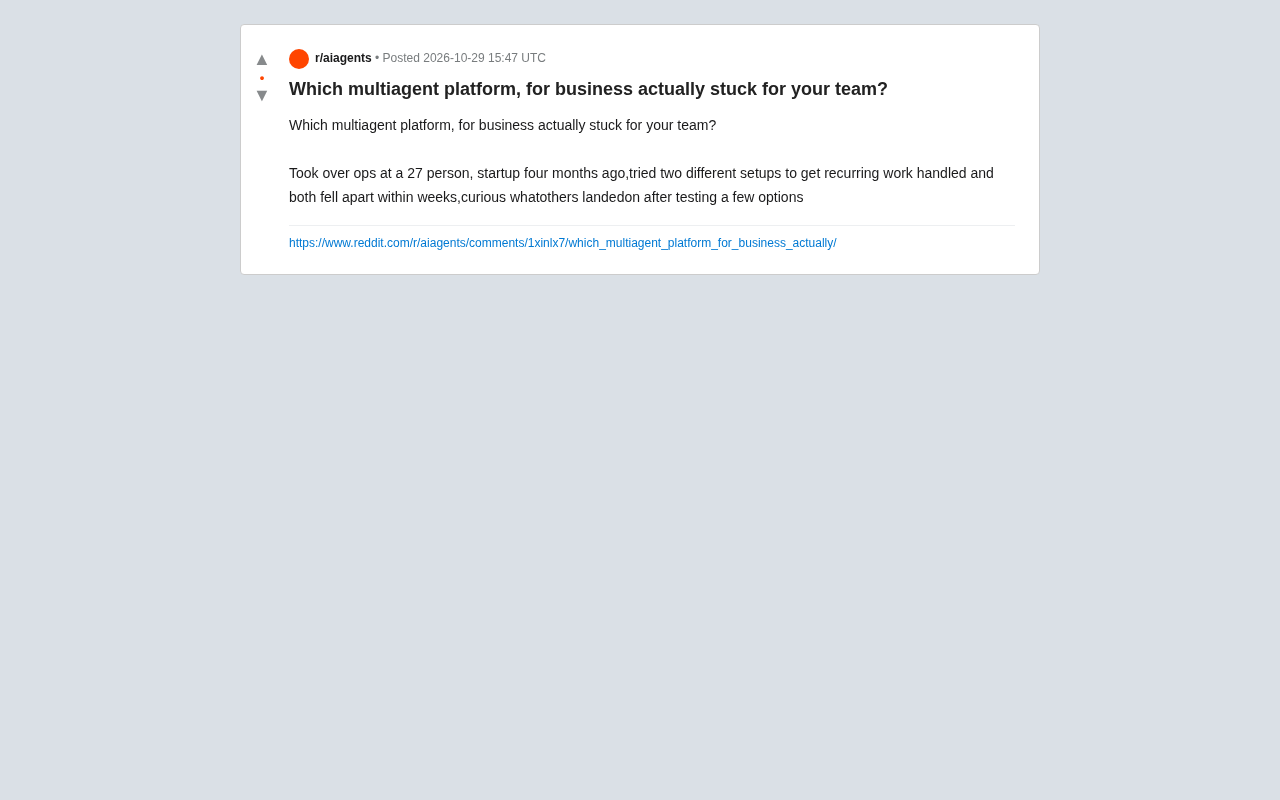
Which Multi-Agent Platform Wins? A Small Team's Battle Scars and Selection Considerations
A 27-person startup's ops lead tried two multi-agent platforms in four months and both failed. This article analyzes why small-team deployments break down, and offers selection guidance on integration depth, observability, and progressive rollout.

Thrive Holdings Takes ADT Private in $7.6 Billion Deal
Thrive Holdings acquires ADT for $7.6 billion in an all-cash take-private deal expected to close in Q1 2027. Analysis of the deal structure, ADT's asset value, and impact on the smart home security industry.