Legora CEO: How AI Is Reshaping Legal Work and Unlocking Lawyer Productivity

Legal AI company Legora uses model capability to close the legal services supply-demand gap and reshape how lawyers work.
Legora co-founder and CEO Max Junestrand argues the legal industry is fundamentally supply-constrained, with demand far outpacing supply and large volumes of contracts and due diligence going uncovered. Positioned as a "legal work operating system," Legora uses AI to handle standardized first-pass work like contract review and due diligence so lawyers can focus on judgment-intensive tasks. The idea began in the BERT era but only truly worked once GPT-3.5 arrived—what Junestrand calls "the internet moment of our generation." He stresses that trust matters more than the billable hour in legal scenarios, and advocates a "building sandcastles" AI-native strategy: not chasing permanence, but continuously moving through the model capability frontier. One Fortune 100 customer cut contract turnaround by 90%, saved over $20 million, and freed 9.5 hours per lawyer per week.
The legal industry has long faced a structural contradiction: demand far exceeds supply. In an interview, Legora co-founder and CEO Max Junestrand stated plainly that demand for legal services significantly outpaces current supply, which means not every contract gets reviewed, and not every injustice makes it to litigation. The company, positioned as a "legal work operating system," is trying to close that gap with AI.
The Legal Industry's Supply Bottleneck and Where AI Breaks Through
Junestrand's read on the legal industry is direct: it is a field fundamentally constrained by supply. The gap between demand and supply means large numbers of contracts sit on the shelf, and asset due diligence can only be done after the fact. He noted that the world needs and demands more legal services and legal intelligence, and Legora hopes to make those capabilities available "on demand."
This supply constraint isn't because lawyers aren't working hard—it's that the working model itself limits output. When every contract needs to be reviewed line by line by a human, and every M&A project depends on a team doing due diligence by hand, the capacity ceiling is obvious. AI's entry point is precisely to take over this repetitive, standardized first-pass screening work, letting legal teams focus their energy on the parts that truly require judgment.

From BERT to GPT-3.5: A Startup Decision Born of an "Internet Moment"
Legora's starting point is earlier than many people imagine. Junestrand revealed that the initial idea was born during the period when Google's early model BERT was openly accessible, but the early use cases were too difficult, and it only truly worked once GPT-3.5 appeared.
That turning point directly led to his decision to leave university. He calls GPT-3.5 "the internet moment of our generation," and says plainly: without OpenAI, there might be no Legora. This experience shows that the viability of legal AI products depends heavily on leaps in underlying model capability—it wasn't that the product idea was bad, but that earlier models couldn't handle the accuracy and depth of reasoning that legal scenarios demand.

BERT (Bidirectional Encoder Representations from Transformers) is an open-source pretrained language model released by Google in 2018. Its key innovation is "bidirectional" encoding: when understanding a word, it uses context from both sides simultaneously, rather than reading only left to right as earlier unidirectional models did. This feature let BERT dramatically raise the bar on understanding-oriented tasks such as text classification, question answering, and named entity recognition. However, BERT is essentially an encoder architecture—good at "understanding" rather than "generating"—and struggles with tasks that require long-form reasoning and output, such as drafting legal documents or explaining contract comparisons. This is precisely the technical root of why Legora's early BERT-based explorations had use cases that were too difficult.
GPT-3.5 is a series of generative models from OpenAI built on a decoder architecture and trained with large-scale instruction fine-tuning and reinforcement learning from human feedback (RLHF); the model behind ChatGPT belongs to this series. Compared with BERT, it has coherent multi-turn dialogue, long-text generation, and a degree of chain-of-thought reasoning, making tasks like "have AI read through a contract and suggest revisions" feasible for the first time. Junestrand's description of it as an "internet moment" emphasizes exactly how decisive this capability leap was for product form.
Trust Is the Hard Currency of the Legal Industry
In the legal field, trust matters even more than the billable hour. Junestrand stresses that clients cannot feel any "second-guessing" or "compromise" about the tool. This determines the design logic of legal AI products: not chasing flashiness, but ensuring reliable output and traceable processes.
He used a metaphor: Legora is like a very fast F1 race car, but a race car needs a powerful engine, and the new models OpenAI keeps releasing are the continuously upgraded engine. This dependency also brings challenges—the product must keep pace with model iteration to maintain its performance edge.

The billable hour is a long-standing billing model in the legal services industry: law firms charge clients based on the hours lawyers put in, usually with a minimum unit of six minutes. This model has long been criticized because it ties firm revenue to time spent rather than value delivered, objectively incentivizing inefficiency. With AI, the time required for first-pass screening and review is drastically compressed, directly shaking the foundation of hourly billing and pushing the industry toward fixed fees, subscriptions, or value-based billing. This also explains why Junestrand emphasizes trust over the billable hour—when the tool itself changes the revenue model, clients' demands for output reliability only grow higher. Related to this is the requirement for traceability: legal work often needs to demonstrate to regulators, opposing counsel, or courts the source and reasoning path behind a conclusion, so legal AI products typically need to provide citation pinpointing, side-by-side comparison with the original text, and operation logs, rather than just delivering an answer.
The "Building Sandcastles" Philosophy: Product Cadence at an AI-Native Company
As the company scales rapidly, what Junestrand cares about most is preserving its AI-native character. His method is to keep a low ego—not treating the product as a monument meant to withstand the test of time, but continuously moving through the frontier of AI capability.
He describes this strategy as "building sandcastles": the underlying technology changes too fast, and the product must always be ready to use the best available capabilities, even if that means constantly tearing down and rebuilding. For a track like legal AI that depends heavily on model capability, this stance may be more pragmatic than pursuing a stable architecture—because stability itself is an illusion in a cycle of rapid model iteration.

AI-native companies differ fundamentally from traditional companies that are "AI-enabled": the former design business processes and interaction models from day one with model capability as a core product building block, rather than layering an intelligent button onto existing software. This means the product architecture needs to be organized around the input-output characteristics of models—for example, using natural-language tasks rather than fixed forms as the primary interface. The cost is deep coupling: when the underlying model upgrades, prompt strategy, context window management, and output validation logic may all need to be redone. Junestrand's "building sandcastles" metaphor targets exactly this coupling: treat the product as a temporary structure that can be quickly rebuilt, not a fixed asset requiring long-term maintenance, so that after each round of model iteration, new capabilities can be converted into user experience at the first opportunity.
Quantifiable Value: A Fortune 100 Customer Case
The most persuasive part of the interview is Legora's results with a Fortune 100 customer. According to Junestrand, the customer cut contract turnaround time by 90%, saved more than $20 million in external and litigation and due diligence costs, and gave each lawyer back 9.5 hours per week for higher-value work.
These numbers point to the same conclusion: the value of AI in legal scenarios isn't just "faster"—it redistributes lawyers' time budget. When first-pass screening, review, and due diligence are handled by AI agents on the first pass, legal teams can apply their judgment to deal progression and risk decisions. Junestrand's ambition follows from this—he wants every piece of legal work to run on Legora.
The role of legal teams is being redefined: not just protecting the company, but pushing it forward. In Junestrand's view, now is the best time in history to be a lawyer. If this is done right, what individuals can achieve with technology will make any previous wave of technology seem insignificant.
Related articles

Why Does Self-Play AI Always Get Crushed by Cheap Units? An RTS Developer's Account of the Dilemma
An independent developer trained an RTS commander AI with pure self-play, only to find it dominated historical versions but was crushed by human players using cheap tier-1 units. This article analyzes the causes of self-play strategy collapse, explores solutions such as exploiters, diversity rewards, and reward design, and introduces the open Bot Kit and AI league plan.
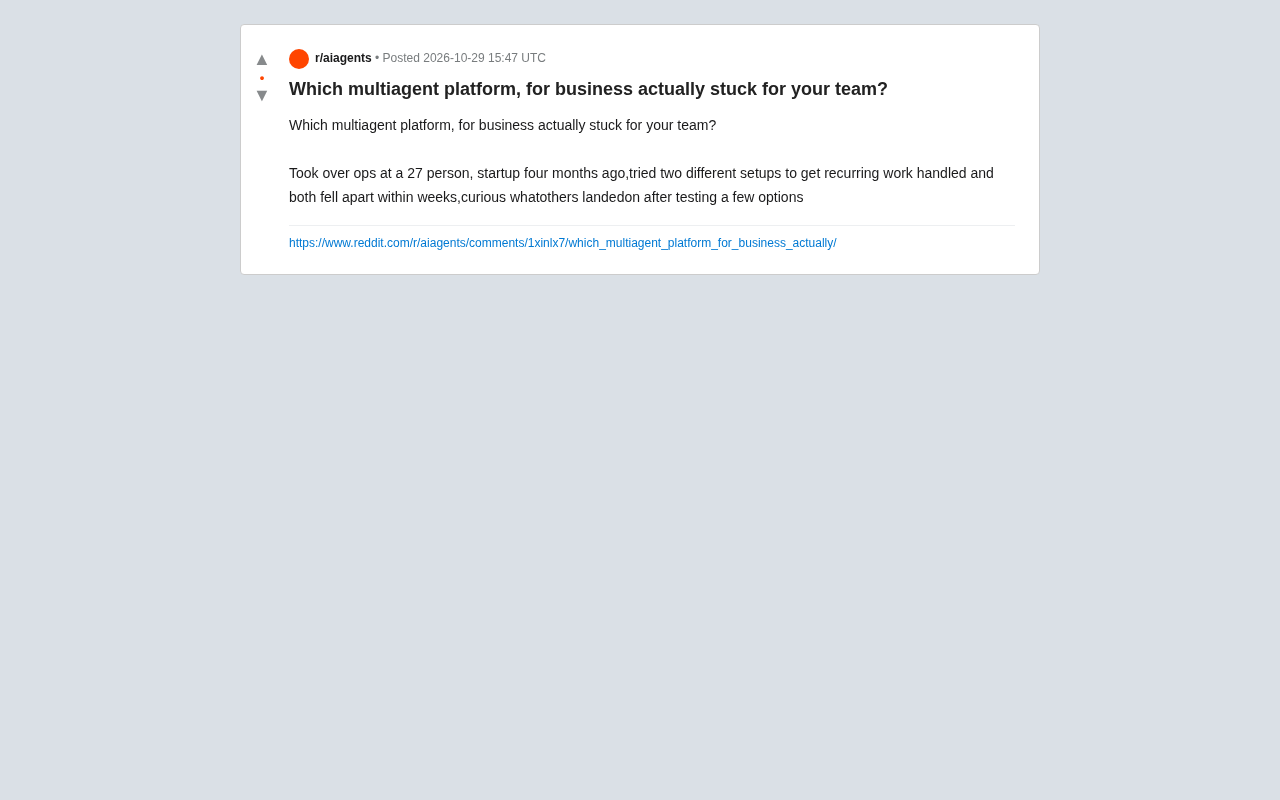
Which Multi-Agent Platform Wins? A Small Team's Battle Scars and Selection Considerations
A 27-person startup's ops lead tried two multi-agent platforms in four months and both failed. This article analyzes why small-team deployments break down, and offers selection guidance on integration depth, observability, and progressive rollout.

Thrive Holdings Takes ADT Private in $7.6 Billion Deal
Thrive Holdings acquires ADT for $7.6 billion in an all-cash take-private deal expected to close in Q1 2027. Analysis of the deal structure, ADT's asset value, and impact on the smart home security industry.