LinkedEmbed: Turn LinkedIn Content Into Website Social Proof — No Code Required

LinkedEmbed embeds LinkedIn content into websites with no code and tracks performance, but it's early-stage with data compliance risks.
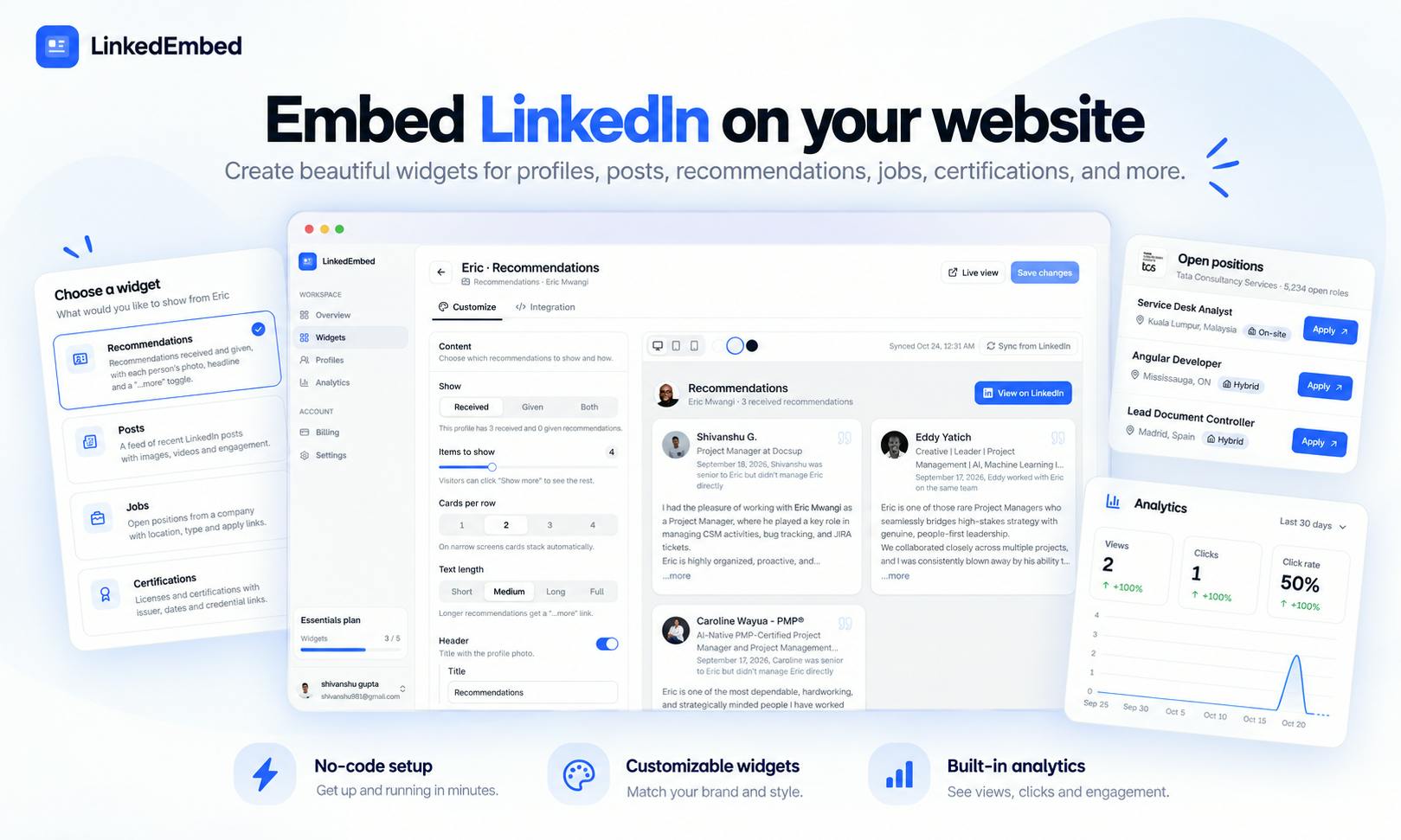
LinkedEmbed is a no-code LinkedIn widget builder on Product Hunt that embeds seven types of public LinkedIn content — feeds, posts, profiles, testimonials, job listings, projects, and certifications — into websites. It supports WordPress, Webflow, Wix, Shopify, and Squarespace, and offers centralized tracking of views, clicks, and engagement, turning social proof into a measurable marketing asset. It suits freelancers, B2B marketing teams, and recruiters, but is extremely early-stage, unvalidated at scale, and dependent on LinkedIn data access, raising long-term compliance and availability concerns.
Your professional presence on LinkedIn often stops at LinkedIn's own walls. If you want your profile, testimonials, or company job listings to appear on your own website, you typically need developer involvement or manual screenshot updates. A new product on Product Hunt, LinkedEmbed, aims to solve this pain point: a no-code LinkedIn widget builder.
What Problem Does It Solve
For freelancers, consultants, B2B marketing teams, and recruiters, LinkedIn testimonials, project experience, and job listings are themselves the most powerful social proof. But this content is scattered inside the LinkedIn platform, requiring visitors to navigate away to see it, which lengthens the conversion path.
LinkedEmbed's approach is straightforward: embed existing public LinkedIn content into any website as customizable widgets. Supported content types include feeds, single posts, profiles, testimonials, company job listings, projects, and certifications.
"Social proof" is a concept from behavioral economics and marketing psychology, referring to how people, when uncertain about decisions, look to others' behavior or evaluations to guide their choices. In B2B and freelance contexts, client testimonials, credentials, project case studies, and job updates are all typical social proof material. Moving this content from within LinkedIn to your own website essentially shortens the trust-building path for visitors — visitors can see third-party endorsements without navigating to an external platform, thereby reducing drop-off in the conversion funnel. Understanding this logic helps assess LinkedEmbed's value proposition: what it sells isn't the embedding technology itself, but the portability and measurability of social proof.
Core Features Breakdown
Seven Content Types Covering Common Display Scenarios
Based on the product description, LinkedEmbed covers the main forms of public content on LinkedIn. Testimonials and certifications suit personal brand pages, job listings suit corporate recruitment pages, and feeds and posts suit content marketing scenarios. This combination means it's not just a single-purpose embedding tool, but an attempt to become a distribution layer for LinkedIn content.
Zero-Code Integration with Mainstream Website Builders
The official listing explicitly names WordPress, Webflow, Wix, Shopify, and Squarespace. For small teams without development resources, this is crucial — the technical barrier to embedding LinkedIn content drops from "find an engineer" to "copy and paste a snippet of code."
"No-code" refers to a tool philosophy that allows users to build websites or applications through visual interfaces, drag-and-drop components, and configuration options, with representative platforms including Webflow, Wix, and Squarespace. Unlike traditional development requiring HTML/CSS/JavaScript, no-code tools encapsulate technical implementation into configurable modules — users simply copy an embed code or paste a URL to complete integration. The core value of such tools lies in lowering technical barriers, shortening launch cycles, and enabling marketers, designers, and independent entrepreneurs to iterate pages without relying on engineering resources. LinkedEmbed positioning itself as a widget builder for these platforms is precisely leveraging the widespread adoption of the no-code ecosystem to turn LinkedIn content embedding from a development task into an operational action.
Data Tracking
LinkedEmbed provides views, clicks, and engagement data for widgets, consolidated in a single dashboard. This turns social proof from "decoration" into a measurable marketing asset: you can see which testimonial module actually drives clicks.
Two Details Worth Noting
First, the product emphasizes "customizable." LinkedIn's built-in embed code has fixed styling that often clashes with a website's design language. If LinkedEmbed offers sufficient flexibility in color schemes, layout, and sizing, its practical value would be significantly higher than using the official embed directly.
Second, the data tracking feature suggests the product positioning isn't just a display tool but a marketing analytics tool. For B2B marketers, being able to quantify "how much website engagement LinkedIn social proof drives" is a compelling selling point.
Things to Watch Out For
Currently, this product has only 5 votes and 2 comments on Product Hunt, ranking 20th — an extremely early stage. This means two things: first, product maturity and stability haven't been validated at scale; second, it relies on LinkedIn's public data APIs or page scraping, and LinkedIn has always been strict about third-party access, creating uncertainty around long-term availability.
Another practical issue is that the public visibility of LinkedIn content varies by user settings. If the target user's profile or testimonials are set to connections-only visibility, embedded widgets may fail to render properly.
LinkedIn imposes strict restrictions on third-party access to its data, primarily controlled through tiered permissions of its official API and user authorization mechanisms. Developers wanting to read user profiles, posts, or testimonials via the API typically need to apply for the corresponding product permissions and pass review, with a limited range of accessible fields. Unauthorized page scraping may violate LinkedIn's user agreement, risking IP bans, legal notices, or technical anti-scraping countermeasures. Therefore, the long-term availability of embedding tools that rely on public data APIs or page parsing depends on changes in LinkedIn's API policies and the strength of its anti-scraping strategies — a compliance risk that should be a key consideration when evaluating such products.
Who Is It For
Freelancers and small service agencies can use it to place client testimonials directly on service pages; B2B SaaS companies can embed live job listings on recruitment pages; content creators can sync LinkedIn feeds to personal websites, reducing manual maintenance costs. If you've already built valuable content on LinkedIn but your website's social proof is still stuck at static screenshots, this type of tool is worth adding to your evaluation list.
My Assessment
LinkedEmbed taps into a real but underestimated need: the spillover value of LinkedIn content. Most users treat LinkedIn as a closed platform to operate within, overlooking the conversion potential of this content on their own websites. The product direction is sound, and the no-code and tracking features are pluses. But the stability of an early-stage product, the compliance of LinkedIn data access, and long-term sustainability are the key variables determining whether it can evolve from a "Product Hunt gadget" into "long-term usable marketing infrastructure." Before deploying it in a production environment, I recommend using free credits or a trial version to verify the actual rendering of your target content types.
One-line Summary
LinkedEmbed embeds LinkedIn content into websites with no code and tracks performance, but the product is still early-stage with data compliance risks.
Paragraph Summary
LinkedEmbed is a no-code LinkedIn widget builder launched on Product Hunt, designed to embed seven types of public LinkedIn content — feeds, posts, profiles, testimonials, job listings, projects, and certifications — into your own website. It supports mainstream website builders like WordPress, Webflow, Wix, Shopify, and Squarespace, and provides centralized tracking of views, clicks, and engagement data, transforming social proof from static display into a measurable marketing asset. The product addresses a real need — the underestimated spillover value of LinkedIn content — and suits freelancers, B2B marketing teams, and recruiters. However, it's currently at an extremely early stage with few votes, its stability hasn't been validated at scale, and it depends on LinkedIn data access methods, creating uncertainty around long-term compliance and availability.
Related articles

Vaani Developer Platform: Build Human-Like Voice AI Agents with Zero Code
Vaani Developer Platform tops Product Hunt with 175 upvotes, offering zero-code construction of human-like voice AI agents with flow design, tool and knowledge base connections, real phone deployment, and structured call data output.

Knocket AI: A Lightweight Tool That Lets Visitors Chat with Zero Friction
Knocket AI is a lightweight tool that lets visitors start real-time chats via a website or link without registering, targeting founders, creators, and small teams.

XWiki Launches Open-Source MCP Server: Let AI Read Your Wiki
XWiki's open-source MCP Server extension connects your Wiki knowledge base to AI agents like Claude Code and GitHub Copilot, supporting Q&A, page editing, and structured data—self-hosted to keep data control.