llama.cpp Release Fixes Metal Unary Crash: Compatibility Patch for Older macOS

llama.cpp v0.40.13-rc1 fixes a crash caused by Metal unary library compile failure on older macOS with a temporary patch.
llama.cpp releases v0.40.13-rc1, whose core change is a temporary compatibility patch for the Metal backend that fixes a crash caused by `ggml_metal_library_compile_all: failed to build 'unary' library` on older macOS. The issue is a regression triggered only on older macOS and easily missed in routine testing. The maintainers explicitly label it a temporary workaround intended to restore usability rather than fix the root cause. After upgrading, Metal inference on older macOS should start normally again. The article also notes that the patch targets Metal only, not similar compile errors on CUDA or Vulkan, and that later stable releases may replace it with a more thorough fix.
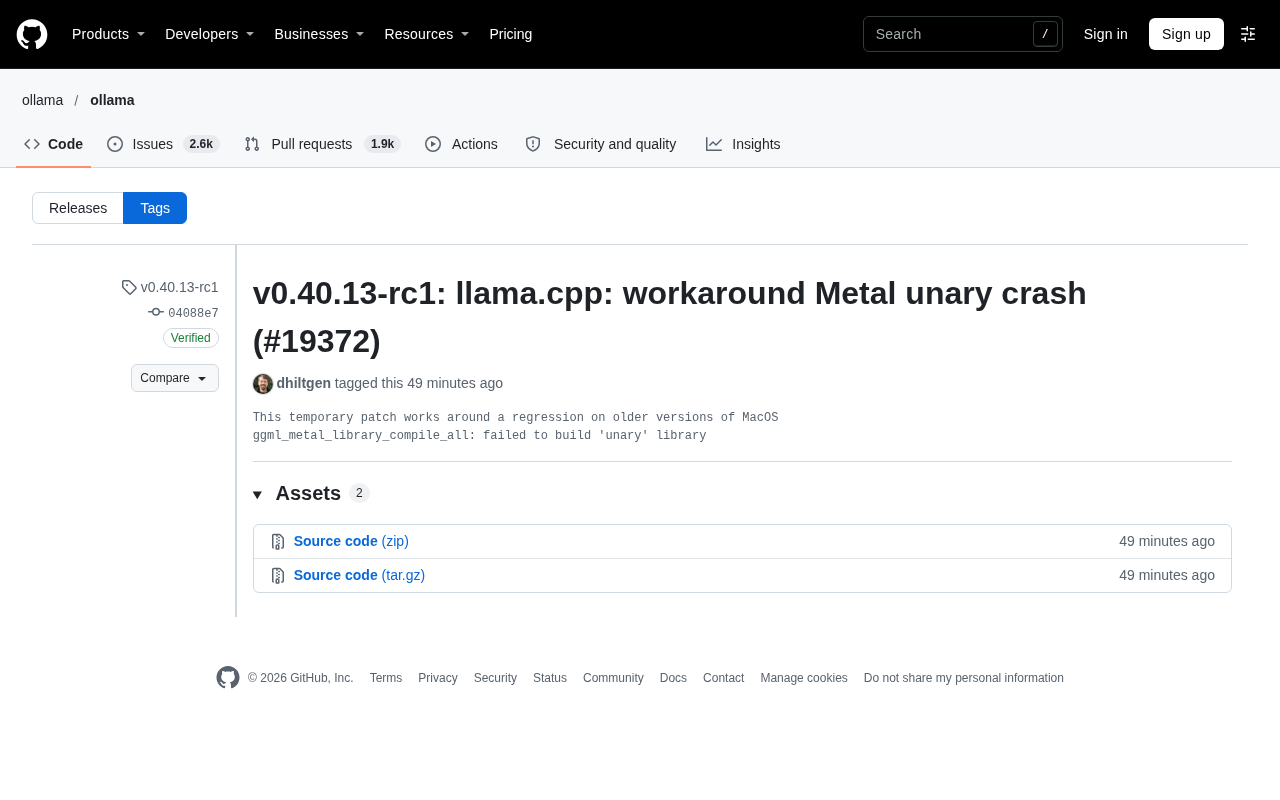
llama.cpp has released v0.40.13-rc1, and the core change is a temporary compatibility patch for the Metal backend: it fixes a crash caused by failure to compile the unary library on older versions of macOS. This kind of change may look minor, but it directly affects whether Mac users can successfully run local inference.
Where the crash comes from: Metal's unary library fails to compile
According to the commit notes, the problem manifests as ggml_metal_library_compile_all: failed to build 'unary' library. In other words, when ggml initializes the Metal backend and batch-compiles the Metal compute libraries, the unary library build fails, which in turn triggers a crash.
This regression only affects older versions of macOS. New systems do not trigger the condition, so the issue is easy to miss in routine testing and was only pinpointed after users on older systems reported it. For developers who rely on llama.cpp for local deployment, Mac is a fairly common inference platform, and this kind of backend crash directly blocks the startup process.
Metal backend and ggml: Metal is Apple's graphics and compute API for its own GPUs. Through the Metal backend of ggml, a tensor computation library, llama.cpp offloads inference workloads such as matrix operations to the Mac's GPU. At runtime, ggml dynamically compiles Metal compute kernels, provided as source strings, into libraries that the GPU can call; this mechanism is called runtime compilation. The so-called unary library refers to a collection of kernels that handle elementwise unary operations such as negation, absolute value, and exponentiation. When these kernel sources call syntax or functions unavailable in the Metal compiler on older macOS versions, compilation fails, which interrupts backend initialization and crashes the entire process.
The patch's positioning: a workaround, not a root fix
The commit title uses the word "workaround", indicating that the maintainers know this is not the final fix. The patch is explicitly labeled a "temporary patch", and its purpose is to bypass the crash on older macOS so that the Metal backend can complete library compilation normally, rather than changing how the unary library is built at the root.
This approach is common in fast-moving open-source projects: restore usability first and leave systemic refactoring for later versions. The practical implication for users is that after upgrading to v0.40.13-rc1, Metal inference on older macOS should work normally again, without needing to roll back to an earlier version or manually apply a patch.
The meaning of workaround and regression: In software engineering, a regression refers to functionality that previously worked failing because of a code change; a workaround is a temporary means of bypassing a failure without modifying the root cause. The distinction matters: a workaround usually patches specific conditions (here, older macOS), at the cost of leaving conditional branches in the code that may become invalid in later refactoring. By contrast, a root cause fix corrects the unary kernel source or the build process itself so that it compiles on all supported macOS versions. The article title uses workaround, meaning the maintainers have identified the root cause but deferred addressing it.
Usage recommendations and what to watch next
- Users still on older macOS versions who rely on the Metal backend are advised to upgrade to this release candidate and verify whether the startup crash is resolved.
- Because this is a temporary patch, later stable releases may replace it with a more thorough fix. When upgrading, pay attention to notes about the Metal backend in the release notes.
- If you encounter similar library compilation errors on other platforms (such as the CUDA or Vulkan backends), note that this patch targets Metal only and is not a general solution.
Summary
v0.40.13-rc1 is a typical minor maintenance release: narrow in scope, but it hits a regression that blocks users on older macOS. It reminds us that the compatibility cost of cross-platform inference frameworks often concentrates in backend compilation, and the pace of fixing such issues directly affects the stability of local deployments.
Related articles

The Truth Behind Titanic's Sinking: Key Decisions and Communication Failures in the National Geographic Documentary
National Geographic's The Unsinkable Ship uses survivor testimony to reconstruct Titanic's fatal decisions—from the missing MSG telegram prefix and the broken boiler-room-to-bridge link to how 'unsinkable' thinking delayed damage control and evacuation.

74M-Parameter Open-Source Model Partially Outperforms Jev AI in Testing
Fastino AI's Glider 2.5 models, with just 74M–300M parameters, reportedly outperform Jev AI in some guardrail benchmarks per YouTube testing, run on consumer hardware, and even play Doom. We analyze small models' competitiveness and deployment value on specific tasks.

Gemini 4 Argon Hands-On: Aggressive Pricing, 3D Capabilities Need Coaching
Gemini 4 Argon hands-on: limited-time $2/$10 pricing, million-token output, strong 3D and reverse-engineering work, but weak front-end aesthetics and zero-shot ability need coaching.