Lucid Motors' New CEO Cuts 18% of Workforce Immediately, Reduces Production Capacity Amid Demand Challenges

Lucid Motors' new CEO cuts 18% of staff and reduces production as the EV maker confronts a demand crisis.
Lucid Motors' new CEO has announced an 18% workforce reduction and the elimination of one production shift at its Arizona factory to align output with weak demand. The moves reflect deeper challenges including intense competition, limited premium market size, and low brand awareness. Backed by Saudi Arabia's PIF, Lucid pins its hopes on the upcoming Gravity SUV to expand its market reach and move toward profitability.
New CEO Takes Drastic Action: Lucid Motors Lays Off 18%
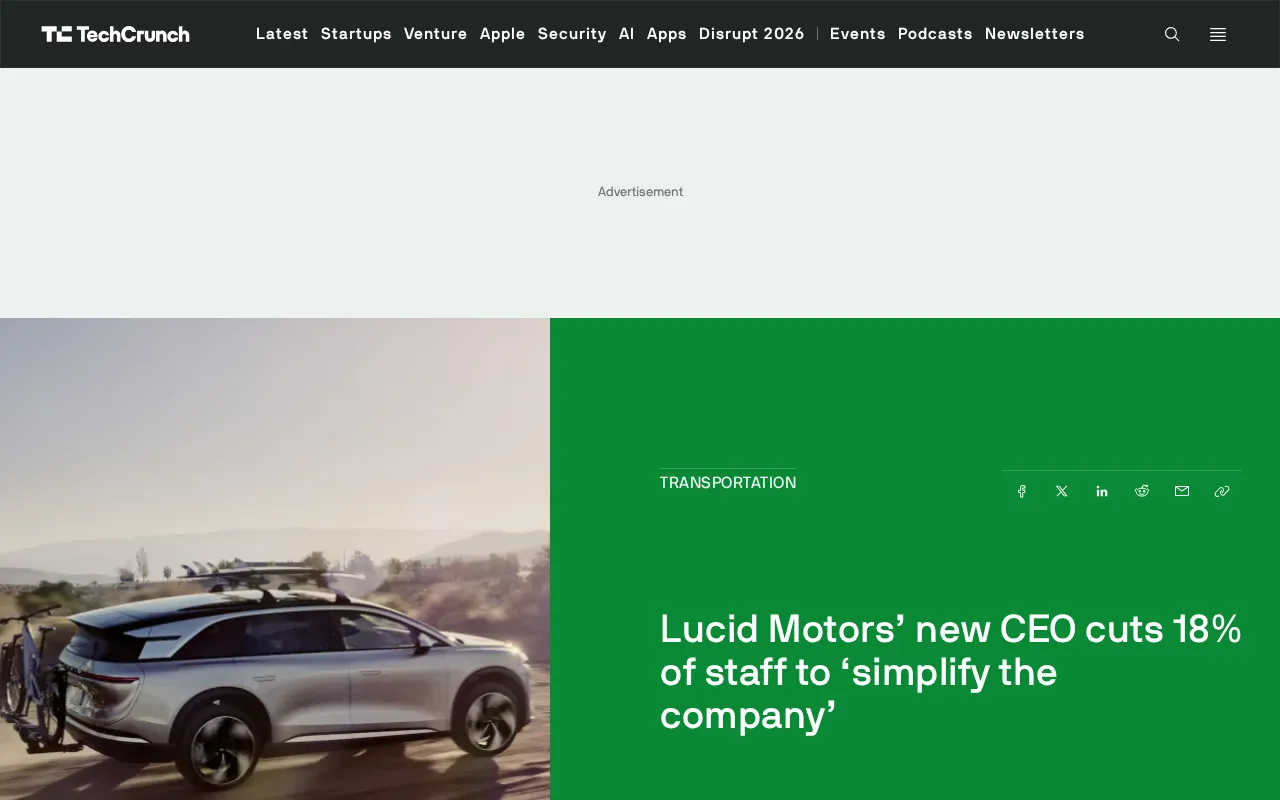
Lucid Motors' new CEO moved quickly after taking office, announcing aggressive restructuring measures that will cut 18% of the company's workforce, with the goal of "simplifying the company's" operational structure. This decision marks a profound strategic transformation for the electric vehicle manufacturer.
The new CEO replaced company founder and former CEO Peter Rawlinson. In the EV industry, CEO transitions often signal fundamental shifts in company strategy. An 18% workforce reduction represents a major restructuring by automotive industry standards, typically only undertaken when a company faces severe financial pressure or needs to fundamentally change its operating model. The phrase "simplifying the company" in management terms usually means reducing organizational layers, consolidating overlapping functional departments, and cutting non-core business lines — all aimed at improving decision-making efficiency and reducing fixed cost expenditures.
Production Cuts: Eliminating One Shift at Arizona Factory
Beyond the mass layoffs, Lucid also announced it would eliminate one production shift at its Arizona factory. The company stated this move was to align "production schedules with anticipated demand." This language implies Lucid currently faces severe demand-side challenges — overcapacity means market demand for its vehicles has not met previous expectations.
Lucid's factory in Casa Grande, Arizona (AMP-1) is the company's only vehicle assembly plant, with a designed annual capacity of approximately 34,000 units, though actual production has been far below this figure. Automotive factories typically operate on multi-shift production schedules — generally two or three shifts, each lasting 8-12 hours. Eliminating one production shift means the factory's effective capacity will be directly reduced by one-third to one-half. In 2024, Lucid delivered only about 10,000 vehicles for the entire year, far below the factory's design capacity, indicating extremely low capacity utilization that makes maintaining multiple production shifts economically unjustifiable.
The Deeper Causes of Lucid's Demand Problem
For a brand like Lucid that positions itself in the premium luxury EV market, insufficient demand likely stems from multiple factors:
- Intensifying competition: Tesla's continued price cuts and traditional luxury brands (Mercedes-Benz, BMW) constantly launching new EV models are squeezing Lucid's market space
- Limited premium market capacity: The Lucid Air's high starting price means its target customer base is inherently narrow
- Insufficient brand awareness: Compared to established brands like Tesla, Lucid still has a significant gap in consumer recognition
Contraction Signals Across the EV Industry: Lucid Is Not Alone
Lucid's layoffs are not an isolated event. Multiple EV companies have recently undergone varying degrees of contraction and adjustment, as the entire industry transitions from a period of frenzied expansion into a phase of rational correction.
Between 2020 and 2022, stimulated by policy subsidies, ESG investment trends, and Tesla's soaring stock price, massive capital flowed into the EV sector, spawning numerous startups including Rivian, Fisker, and Lordstown. However, entering 2023-2025, the industry entered a brutal elimination phase: Fisker filed for bankruptcy, Lordstown was delisted, and even the relatively successful Rivian continues to struggle amid persistent losses. The high interest rate environment has increased consumer vehicle purchase costs, while uncertainty around EV subsidy policies (especially given changes in the U.S. political landscape) has further suppressed demand. The entire industry is experiencing a paradigm shift from "storytelling for fundraising" to "letting the numbers speak."
From Cash-Burning Expansion to Lean Operations
The new CEO's choice of "simplifying the company" as the core strategic direction sends a clear signal: in the current market environment, EV startups need to shift from pursuing scale growth to pursuing operational efficiency and financial sustainability. An 18% reduction is quite substantial, suggesting the company previously had significant staffing redundancy.
What Lies Ahead for Lucid Motors
Despite facing challenges, Lucid still possesses some unique advantages: its battery technology and energy efficiency performance are industry-leading, and continued support from Saudi Arabia's Public Investment Fund (PIF) provides a degree of financial cushion.
The Public Investment Fund (PIF) is one of the world's largest sovereign wealth funds, managing assets exceeding $900 billion, and serves as the core executing body of Saudi Arabia's "Vision 2030" economic diversification strategy. PIF holds approximately 60% of Lucid's shares, making it the absolute controlling shareholder. This relationship is both Lucid's lifeline — PIF has repeatedly helped Lucid through cash flow crises via capital injections — and means Lucid's strategic decisions are influenced to some degree by Saudi national strategy. Saudi Arabia plans to build Lucid's second factory domestically as part of its effort to develop local high-end manufacturing. However, even a sovereign fund's patience is not unlimited, and continued massive losses will eventually test the strength of this relationship.
Nevertheless, layoffs and production cuts can only address short-term cost issues. The real test is whether Lucid can find a sustainable growth path within its streamlined organizational structure. The upcoming mid-size SUV Gravity is seen as the key product for Lucid's market expansion, and its market performance will largely determine the company's future direction.
The Lucid Gravity is positioned as a mid-to-large luxury all-electric SUV with an expected starting price of approximately $80,000. The SUV market accounts for more than half of new vehicle sales in the United States, forming a stark contrast with the luxury sedan segment where the Lucid Air competes — a much smaller market by volume. The Gravity launch is essentially Lucid's critical leap from a niche market to the mainstream premium market. If Gravity can achieve monthly sales of several thousand units, it would significantly improve Lucid's economies of scale, spread fixed costs per vehicle, and shorten the path to profitability. But competition in the SUV market is equally fierce, with the Tesla Model X, Mercedes EQS SUV, BMW iX, and others as direct competitors.
For the entire EV industry, Lucid's predicament proves once again: having good technology and products alone is far from enough. How to build a brand, control costs, and achieve profitable scale in fierce competition is the core question every EV company must answer.
Key Takeaways
Related articles

Replit at Web Summit Lisbon: AI Coding Platform Accelerates European Expansion
Replit participated in Web Summit Lisbon 2026 Day 1 as Replit Live. This article examines its transition from an online IDE to an AI app-building platform and analyzes its European market opportunities and compliance challenges.

Codex Integrates with Zotero: Batch Literature Review and Deep-Read Tools Tested
Hands-on testing of two new Codex functions for Zotero: batch literature reviews by collection and screening key papers for deep reading. Covers comparison tables, citation verification, the three-layer method and experiment analysis, plus a complete workflow.

Codex + Obsidian + Zotero: An AI-Powered Automated Paper Reading Workflow
A Codex + Obsidian + Zotero paper management and retrieval workflow: Zotero manages references, Codex calls GPT for close reading and notes, Obsidian with DataView builds indexes, enabling Q&A with your paper library and quick literature review material — includes close-reading template and two Skill setup steps.