Maine Data Center Protests: The Key Battle That Could Decide Senate Control

Maine debate protests show AI data center disputes are becoming an election issue that could decide Senate control.
The article uses a voter protest at a Maine Senate debate over AI data centers harming climate and water to analyze how the data center controversy has become a national political force. Lacking natural partisan affiliation, it fuels a "fear vote" both parties court. For AI, political permission is now a key siting variable, and the industry must address local concerns with transparent data.
Why a Local Protest Could Tip the Senate
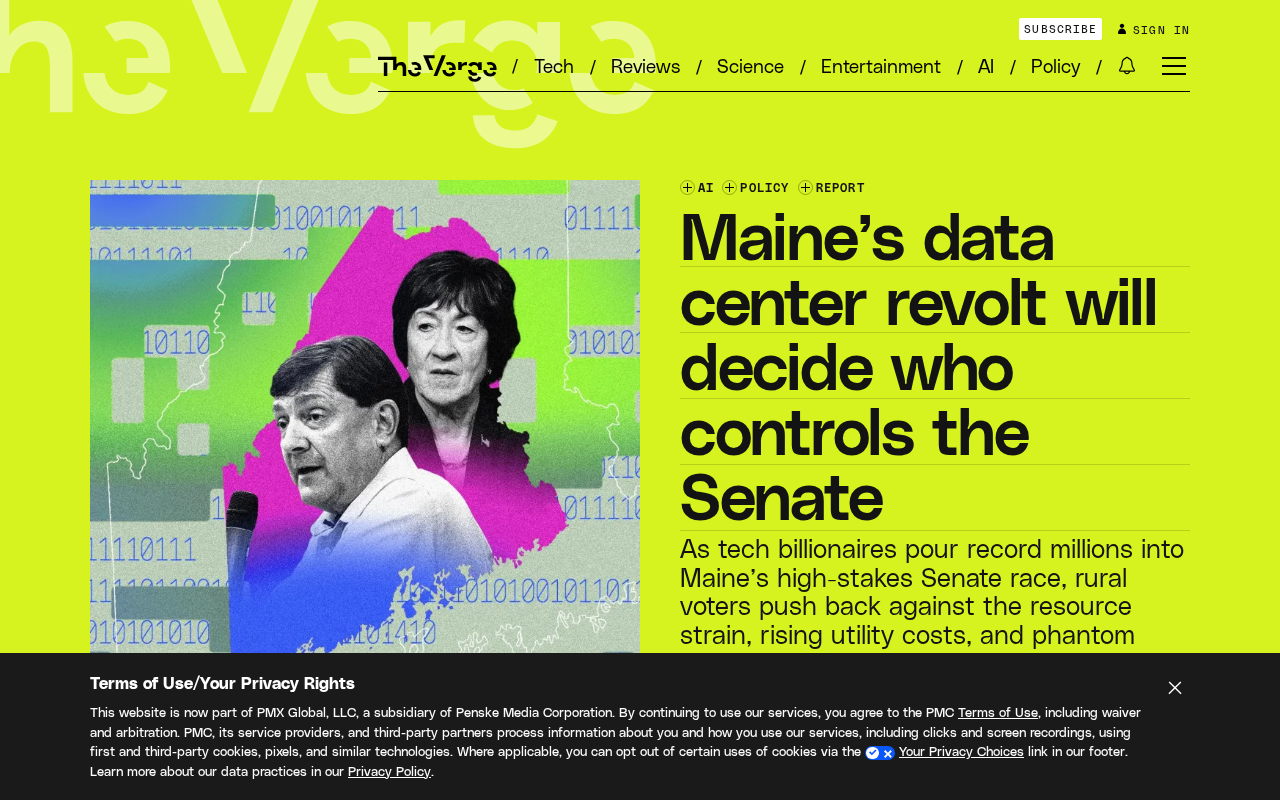
During the final debate of the midterm elections, Maine Republican Senator Susan Collins was defending her record when an audience member suddenly interrupted her: "I'm scared," he shouted. "AI data centers are destroying our climate. They're poisoning our water." Collins did not address the substance of his complaint; instead, she linked the man to her Democratic challenger.
This seemingly incidental moment reflects a new issue that is gathering force in American politics: the rapid expansion of AI data centers is evolving from an environmental controversy within the tech world into a national political force capable of swaying election outcomes. Maine, a northeastern state traditionally known for fishing and forestry, has unexpectedly become the front line of this contest.
According to the original report, Collins's move to tie the protester to her opponent in itself shows that the data center issue is no longer a fringe environmental topic — both parties now see it as a channel into voter sentiment that must be contested. When a voter shouts "I'm scared" on live television, he speaks not just for his own anxiety but for a group of ordinary residents uneasy about the expansion of AI infrastructure.
How the Data Center Controversy Became an Election Issue
A Concentrated Outburst of Environmental Anxiety
The energy and water consumption of AI data centers has in recent years sparked community resistance in multiple states. Supporters stress the tax revenue and jobs data centers bring; opponents worry about the water consumed by cooling systems, emissions from backup generators, and the added strain on the power grid. In Maine, this tension has been amplified by electoral politics — voters are no longer concerned only with broad policy, but are directly asking candidates: are you on the side of the data centers, or on the side of our water?
This localized environmental demand is precisely the kind of easily overlooked yet highly mobilizing variable in a Senate race. A candidate's stance on data centers may sway swing voters more than abstract party positions.
AI data centers' energy and water consumption are often underestimated. In a typical large data center, IT equipment and cooling systems together can draw tens of megawatts — equivalent to the electricity use of tens of thousands of homes; cooling towers' evaporative heat rejection continuously consumes local water, which is especially sensitive in water-scarce regions. At the same time, to ensure reliable power supply, data centers often install diesel backup generators, whose emissions and noise also become a focus of community complaints. These physical impacts are the technical basis behind the "climate" and "water" demands.
The "Fear Vote" Both Parties Are Courting
Collins's linking of the protester to her Democratic opponent is a classic electoral tactic: attributing a spontaneous protest to mobilization by the rival camp. But it also exposes a reality — the data center controversy has no natural partisan affiliation. Voters opposed to data center expansion may come from the environmental left, or from conservative rural communities concerned about land and resources. Whoever can consolidate this diffuse discontent into votes will gain an edge in the fight for Senate control.
The original report did not disclose the specific response of Collins's opponent, but what is certain is that the data center issue has entered the center of the debate stage. In a state where a single Senate seat could determine which party holds the majority, any issue capable of moving a few percentage points of voter sentiment has strategic value.
"Fear vote" is not a strict political science term; it refers to a strategy in which candidates mobilize votes by amplifying voters' anxiety about a specific risk. Unlike traditional partisan mobilization, the fear vote often crosses party lines, drawing in voters who are highly sensitive to particular local issues but whose overall political participation is low. In the data center controversy, this anxiety may stem from environmentalists' concerns about carbon emissions, or from rural residents' desire to protect land, water, and landscapes — which is why neither party can fully address it with ready-made partisan rhetoric.
Deeper Implications for the AI Industry
The Political Cost of Infrastructure Expansion Is Rising
In the past, the siting and construction of AI data centers mainly weighed electricity prices, land, and network conditions. The Maine case suggests that political permission is becoming an equally important variable. When community protests can enter a Senate debate and be used as a weapon by candidates, data center operators face not only environmental review processes but also the reputational risks brought by election cycles.
This has a direct impact on the pace of AI industry expansion. Computing demand drives data center construction, but the speed of construction depends on local political acceptance. A controversy amplified in an election can extend project approval timelines, raise compliance costs, and even force companies to reassess their siting strategies.
In the United States, data center projects typically must go through multiple procedures, including local zoning approval, environmental assessment, and grid interconnection permits. These procedures were originally centered on technical compliance, but in recent years they have increasingly become channels for communities to express opposition. Once a controversy enters election debates, project developers must not only deal with regulators but also face public questioning from candidates seeking votes — making political permission as important a siting variable as electricity prices and land.
The Tech Narrative Needs to Respond to Local Demands
The AI industry is accustomed to arguing for the necessity of data centers in terms of "innovation," "efficiency," and "national competitiveness," but the Maine protesters shouted "climate" and "water." There is a clear mismatch between these two discourses. If the industry cannot provide transparent data and credible commitments on water consumption, emissions, and community benefits, similar protests will only multiply — and will be more easily absorbed by political forces.
You may not have noticed that this controversy took place live during a midterm election debate, meaning it received national exposure. For AI companies rapidly laying down computing infrastructure, this is a signal: local community acceptance may become a harder-to-predict variable than technical bottlenecks.
Who Stands to Benefit
From an electoral standpoint, the data center controversy gives challengers ready-made ammunition to attack incumbents, and creates a difficult problem for incumbents who must respond carefully. Collins chose not to directly discuss the environmental impact of data centers but to shift the topic to her opponent, showing that this issue is equally thorny for Republicans — they must maintain a business-friendly image while not ignoring voters' environmental concerns.
Over a longer cycle, this debate in Maine may become a template: the environmental externalities of AI infrastructure are being absorbed by local political systems and converted into election issues. The fight for Senate control is only the first national stage for this conversion.
For those following the AI industry, this means the story of computing expansion is no longer written only in financial reports and academic papers, but also on ballots and debate stages. Whoever can win the trust of local communities will be the one who can actually get data centers built.
One-line Summary
Voter protests over AI data centers in a Maine debate show environmental controversy is becoming an election issue that could determine Senate control.
Paragraph Summary
The article takes a voter's protest during a Maine Senate debate — that AI data centers are destroying the climate and poisoning water — as its entry point to analyze how the data center controversy has evolved from an environmental topic in the tech world into a national political force. It notes that data centers' water consumption, energy use, and emissions have sparked community resistance, and that this issue has no natural partisan affiliation, with both parties courting the resulting "fear vote." Collins's linking of the protester to her Democratic opponent shows the issue has entered the center of the debate stage. For the AI industry, political permission is becoming as important a siting variable as electricity prices and land; there is a mismatch between the tech narrative and local demands, and the industry needs to offer more transparent data and commitments, or similar protests will only multiply and be absorbed by political forces.
Related articles

Vibe Coding Full-Stack in Practice: AI Programming from Beginner to Enterprise Deployment
From Cursor to Claude Code, this Bilibili AI programming course uses four progressive projects to cover full-stack development, open-source secondary development, and team collaboration. The article analyzes the shock to frontend roles, the efficiency shift from 50 people to 5, and the methodology required for enterprise-grade projects.

David Blaine's Global Quest for Real Magic: From South Africa to Japan and India
David Blaine travels to South Africa, Japan, and India in his Do Not Attempt special, documenting Spinning drivers, black mamba rescuers, iaijutsu masters, and ascetics—exploring the boundary between magic and real human极限 challenges.

Is a Touchscreen MacBook Coming? Vergecast Reveals Apple Executive's Response
Vergecast podcast reveals a conversation between a reporter and Apple executive John Ternus about a touchscreen MacBook and Apple Pencil support. Ternus says iPad is the best device for a stylus, while the reporter bets MacBook will eventually support Apple Pencil.