Making AI Comic Dramas with Codex: A Zero-Basics Fully Automated Production Workflow

A Bilibili tutorial uses Codex AI Agent to connect a five-step workflow, letting zero-basics users make AI comic dramas.
The article introduces a step-by-step Bilibili tutorial on AI comic dramas, with Codex AI Agent as the core tool. Codex acts as "glue," organizing scriptwriting, prompt generation, character design, storyboarding, and AI video generation into a reusable workflow so creators with no programming, drawing, or editing background can run the full chain from zero to finished film. Beginners are advised to run through the whole process once, then optimize each stage. The article notes that public info is mainly a framework, and final quality still depends on script quality, prompt refinement, and each AI tool's performance.
AI comic dramas are emerging as a new hot spot in content creation, but many people get stuck at the very first step: they can't draw, don't know editing, and haven't even touched AI tools. A step-by-step tutorial on Bilibili lays out a complete path from script to finished film — with Codex AI Agent as the core tool.

Why Codex Lowers the Barrier to AI Comic Dramas
Traditional comic drama production involves multiple stages — script, storyboard, illustration, voiceover, editing — each with its own professional threshold. As an AI Agent, Codex's value lies not in replacing any single stage, but in connecting the entire chain together. According to the video, creators need no programming background and don't need to learn drawing or editing first — they can build everything from zero to a finished film by following the workflow step by step.
The logic behind this: the AI Agent plays the role of "glue," organizing the scattered steps of scriptwriting, prompt generation, character design, storyboarding, and AI video generation into a reusable process. For zero-basics users, this is far more realistic than learning five or six separate tools.
AI Agent differs from ordinary AI chat tools in its core "autonomous orchestration capability." A regular chatbot can only passively answer single-turn questions, whereas an Agent can break down goals, invoke tools, and pass context across multiple steps. Codex and similar Agents are valuable because they can remember the script settings from an earlier step and automatically carry them into subsequent prompt generation and character design, sparing creators the repetitive copy-pasting and manual alignment of settings across different tools. This is exactly the technical basis of the "glue" role: it isn't the strongest tool at any single stage, but it lets multiple stages share the same context, reducing information loss as work flows between them.
Breaking Down the Five-Step Workflow: From Script to Finished Film
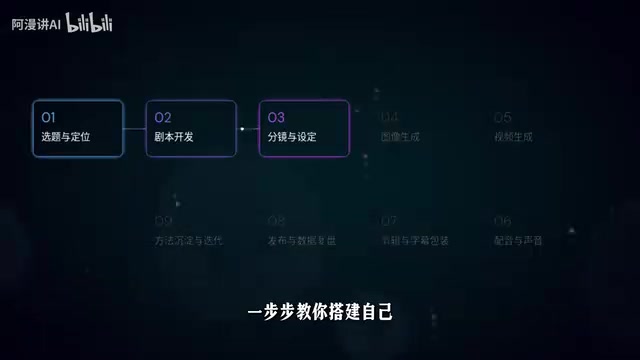
The workflow presented in the video can be split into five key nodes, with Codex connecting each one.
Step One: Scriptwriting
The starting point of a comic drama isn't imagery — it's story. The tutorial recommends using Codex to complete the script first, locking down the core premise, character relationships, and plot direction. This step determines the direction of all subsequent visual work, and it's the one many beginners skip but should least skip.
Step Two: Prompt Generation
Once the script is set, it needs to be converted into prompts that AI can understand. Codex's role here is to break down the natural-language story description into structured prompts for subsequent character design and storyboard image generation. According to the video, this step is the crucial bridge in the workflow — prompt quality directly affects the final result.
Structured prompts refers to breaking a natural-language story into several independently controllable fields — for example, subject description, scene environment, shot framing, lighting and atmosphere, and art style reference. Compared to a vague instruction like "draw a girl in the rain," structured prompts enable AI image models to reliably output images that match expectations, and make it easy to change only a few fields between storyboards to keep the style consistent. This is why the tutorial lists prompt generation as its own step: it is essentially translating literary language into machine-executable parameters, and the quality of that translation determines how controllable the subsequent characters and storyboards will be.
Step Three: Character Design
Character design relies on AI image generation capabilities, but only if there's a consistent character setup. The tutorial incorporates this step into a unified workflow to avoid the common problem of the same character "changing faces" across different storyboards.
Character Consistency is the biggest pain point of AI image generation in narrative content. Diffusion models sample independently each time they generate, so the same character can drift in facial features, hairstyle, and clothing under different prompts — commonly known as "face-swapping." Common countermeasures include fixing character reference images, using character LoRAs, or locking detailed character feature descriptions in prompts combined with image-to-image. The tutorial places character design within a unified workflow precisely to establish a reusable character setup at the source for all subsequent storyboards to draw on.
Step Four: Storyboarding
Storyboarding is the skeleton of a comic drama. The video emphasizes that the Codex Agent can assist with storyboard arrangement, mapping script passages to specific images so that zero-basics users can also produce shot sequences with a sense of rhythm.
Step Five: AI Video Generation
The final step is turning storyboard images into dynamic video. At this point, an automated pipeline from script to finished film is complete. The tutorial positions itself as "fully automated production" — that is, letting Codex flow automatically between stages as much as possible to reduce the cost of manually switching tools.
Image-to-Video is the mainstream approach for AI comic dramas today: an image model first produces still storyboard frames, which are then handed to a video model to create motion, rather than generating video directly from text. The advantage is that composition and character appearance are already determined at the still-frame stage, and the video model only needs to add camera movement and subtle dynamics — far more controllable than pure text-to-video. The trade-off is that motion continuity between storyboards and the visual language of shots still require human oversight, which is one reason "full automation" is hard to achieve completely today.
How Zero-Basics Users Should Get Started
For creators encountering AI for the first time, the video's advice is straightforward: don't try to learn all the tools at once — first run through the entire process once, even if the result is rough. Once you've done that, go back and optimize each stage; it's far more efficient than grinding away at each step individually.

The companion materials are a bonus of this tutorial. According to the video, the materials are pinned in the comment section and can be obtained by leaving a comment. For beginners without a programming background, ready-made workflow templates and prompt examples can significantly shorten the trial-and-error period.
Limitations Worth Noting
The information currently public about this tutorial is still mainly a process framework. The specific tool parameters, prompt template details, and common pitfalls of each stage require the companion materials and the full video to grasp. In addition, the degree of automation depends on the actual performance of the AI tools at each stage, and the quality of the finished film remains strongly tied to script quality and how well the prompts are refined. It's appropriate to treat this as a map — but a map is not the journey itself.
One-line Summary
A Bilibili tutorial uses Codex AI Agent to connect a five-step workflow, enabling zero-basics users to make AI comic dramas.
Paragraph Summary
The article introduces a step-by-step Bilibili tutorial on AI comic dramas, with Codex AI Agent as the core tool. Codex's value isn't in replacing any production stage but in acting as "glue," organizing scriptwriting, prompt generation, character design, storyboarding, and AI video generation into a reusable process — letting creators with no programming, drawing, or editing background run the full chain from zero to finished film. The tutorial advises beginners to first run through the entire process, then optimize each stage, with companion materials available by commenting on the pinned post. The article also notes that the currently public information is mainly a process framework, and final quality still depends on script quality, prompt refinement, and the actual performance of the AI tools at each stage — full automation remains limited.
Related articles

The Truth Behind Titanic's Sinking: Key Decisions and Communication Failures in the National Geographic Documentary
National Geographic's The Unsinkable Ship uses survivor testimony to reconstruct Titanic's fatal decisions—from the missing MSG telegram prefix and the broken boiler-room-to-bridge link to how 'unsinkable' thinking delayed damage control and evacuation.

74M-Parameter Open-Source Model Partially Outperforms Jev AI in Testing
Fastino AI's Glider 2.5 models, with just 74M–300M parameters, reportedly outperform Jev AI in some guardrail benchmarks per YouTube testing, run on consumer hardware, and even play Doom. We analyze small models' competitiveness and deployment value on specific tasks.

Gemini 4 Argon Hands-On: Aggressive Pricing, 3D Capabilities Need Coaching
Gemini 4 Argon hands-on: limited-time $2/$10 pricing, million-token output, strong 3D and reverse-engineering work, but weak front-end aesthetics and zero-shot ability need coaching.