Making Your Blog Readable to AI Agents: A Practical Guide

AI agents are changing how content is consumed; bloggers need to improve AI readability with HTML visibility, semantics, structured data, and stable URLs.
Starting from a blogger's practice on Hacker News, the article explores how blogs can be more readable to AI agents. The author notes that AI agents read differently from search engine crawlers, focusing more on semantic understanding and content structure. Four technical key points are proposed: ensure core content is directly visible in HTML, use semantic HTML, provide Schema.org structured data, and keep URLs and page structure stable. At the content strategy level, it recommends clear subheadings and concise paragraphs to reduce ambiguity. The article stresses that AI crawling rules are still evolving, and individual bloggers can start with basic accessibility and optimize gradually without a major overhaul.
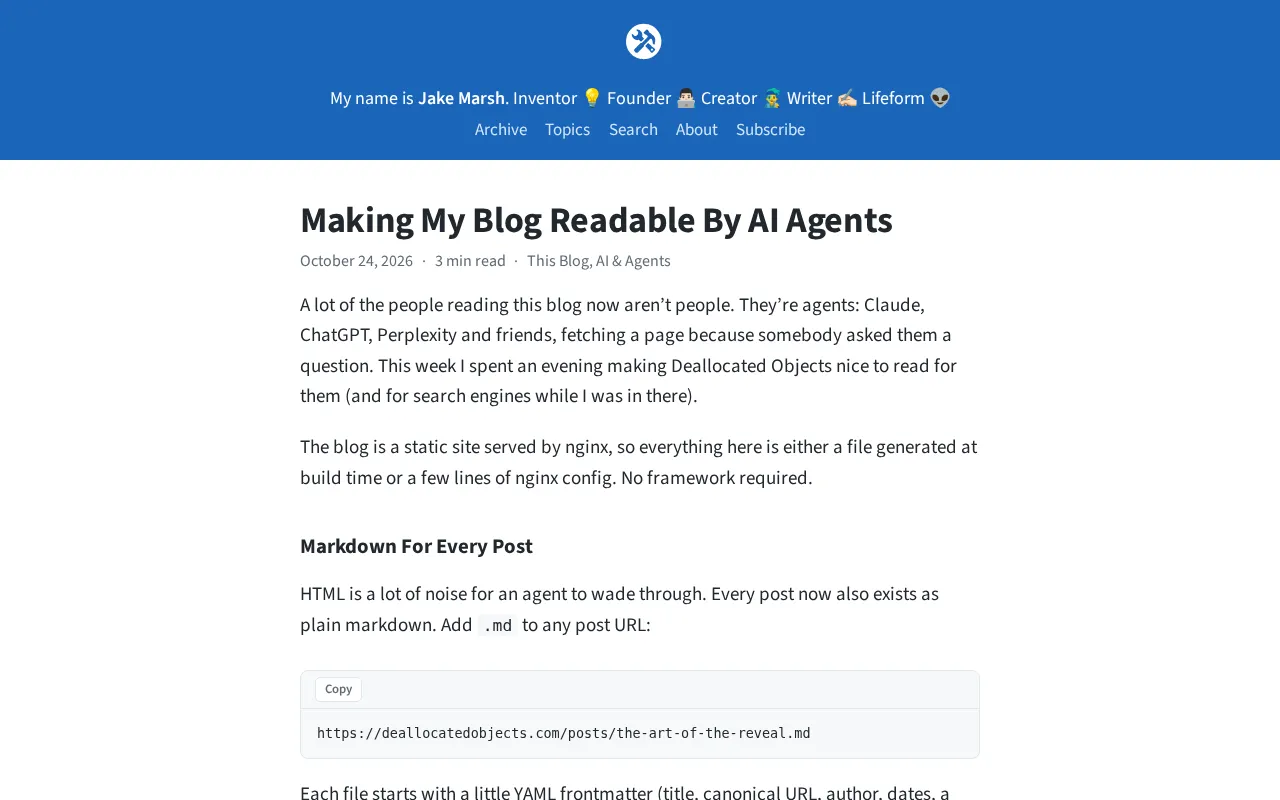
AI agents are changing the way content is consumed—but is your blog actually ready to be read by AI? Recently, a blogger on Hacker News shared their own practice of "making a blog readable to AI agents." Though the discussion didn't gain much traction, it points to a trend worth paying attention to: as more and more AI systems begin crawling, parsing, and citing web content, content creators need to rethink whether their sites are machine-friendly.
Why AI Agent Readability Deserves Attention
Traditional SEO optimization is mainly aimed at search engine crawlers, with the goal of ranking pages higher in search results. But AI agents read in a completely different way—they don't just index keywords; they try to understand semantic structure, extract factual information, and may use content as the basis for answering user questions. This means that if your blog has a messy structure, content hidden behind complex JavaScript, or lacks clear semantic markup, AI agents likely won't be able to make effective use of your content.
According to the blogger's post on Hacker News, they realized that while their blog was friendly to human readers, it posed quite a few obstacles for AI agents. This problem is not an isolated case: a large number of personal blogs and content sites still rely on dynamic rendering, text-as-images, or lack structured data—all of which make AI crawling difficult.
AI agents (AI Agent) generally refer to large language model-driven systems capable of autonomously executing tasks, such as ChatGPT's web browsing, Perplexity's search-based Q&A, and Claude's web page analysis. Their workflow typically includes: crawling the raw HTML of a web page, parsing the main text, extracting semantic snippets, and then generating answers or citations based on those snippets. The biggest difference from traditional crawlers is that AI agents rely more on the "parseability" of content rather than keyword density—they need a clear text flow and structural signals to locate facts. In addition, different AI platforms vary greatly in their support for JavaScript rendering; some only process static HTML, while others execute some scripts but at a higher cost. Therefore, AI-friendly site design is essentially about reducing the cognitive load of machine parsing so that content is easier to extract and cite.
Several Key Points for Making Content AI-Friendly
1. Ensure Core Content Is Directly Visible in HTML
AI agents don't perform complex interactions the way humans do. If the body of an article depends on client-side rendering to display, or if key information is hidden in images and videos, AI will likely see only an empty shell of a page. The blogger recommends outputting core text content directly in HTML to reduce dependence on JavaScript rendering.
2. Use Semantic HTML Structure
Proper use of heading levels (H1/H2/H3), paragraphs, lists, and tables not only improves the human reading experience but also helps AI understand how the content is organized. Semantic tags such as <article>, <section>, and <nav> allow machines to more accurately identify the function of each part of the page.
3. Provide Structured Data
Schema.org markup (such as Article, BlogPosting) can help AI agents quickly obtain meta-information such as author, publication time, and topic. Although AI's use of structured data currently varies, this is a low-cost compatibility investment.
Schema.org is a structured data vocabulary jointly initiated by Google, Microsoft, Yahoo, and others. It is embedded in web pages via JSON-LD, Microdata, or RDFa to describe the type and attributes of page content using standard fields. For example, BlogPosting markup can declare meta-information such as headline, author, datePublished, and image, while Article markup is suitable for more general articles. Search engines have long used these markups to generate rich snippets, and AI agents can likewise quickly obtain trustworthy metadata from them, reducing ambiguity. Implementation cost is low: simply add a JSON-LD script in the page head, and it does not affect the human reading experience. For personal blogs, prioritize marking up BlogPosting or Article types, and ensure that the fields are consistent with the visible content on the page to avoid misleading machines.
4. Keep URLs and Page Structure Stable
Frequently changing URLs or page structure can break the index that AI agents have already established. The blogger mentions that stable links and predictable page paths help AI systems continuously track content updates.
URL stability is a classic principle of web accessibility, but it takes on new meaning in the context of AI agents. After crawling and indexing web pages, AI systems build a mapping between content fingerprints and URLs; if URLs change frequently or page structure is significantly adjusted, the established index may become invalid, causing AI to cite old links or lose content. Permanent redirects (301) can mitigate the impact of URL changes, but it's best to keep links predictable from the source. In addition, semantic page paths (such as /blog/ai-readability rather than /blog/post?id=123) help AI understand the content topic and make sharing easier for humans. For blogs using static site generators, fixing the permalink structure and avoiding meaningless changes to date or category prefixes is a low-cost, high-return practice.
Adjustments at the Content Strategy Level
Beyond technical optimization, the blogger also mentions that how the content itself is written affects AI readability. Clear subheadings, concise paragraphs, and explicit statements of arguments not only make it easier for human readers to digest but also reduce ambiguity when AI extracts information. Conversely, heavy use of metaphors, irony, or expressions that depend on context to be understood may cause AI agents to "misinterpret" what you mean.
Implications for Content Creators
Although this blogger's practice is an individual case, it reflects a larger trend: content distribution channels are expanding from "people finding content" to "AI agents finding content on people's behalf." If you want your blog to be cited by AI assistants and included in intelligent search in the future, now is a good time to check your site's readability.
One detail: AI agents' crawling rules and preferences are still evolving rapidly, and different platforms (such as ChatGPT, Perplexity, Claude, etc.) handle web content differently. In their post, the blogger did not offer a one-size-fits-all "best practice," but emphasized starting with basic accessibility and semantics and staying attentive to new technological changes.
For individual bloggers, this doesn't require a major overhaul—starting by ensuring that article content remains readable when JavaScript is disabled, and gradually adding structured data and semantic tags, is already an important step forward.
One-line Summary
AI agents are changing how content is consumed; bloggers need to improve their blogs' AI readability through HTML visibility, semantics, structured data, and stable URLs.
Paragraph Summary
The article starts from a blogger's practice on Hacker News and explores how blogs can be more readable to AI agents. The author points out that AI agents' reading logic differs from search engine crawlers, focusing more on semantic understanding and content structure. To this end, four technical key points are proposed: ensure core content is directly visible in HTML, use semantic HTML, provide Schema.org structured data, and keep URLs and page structure stable. At the content strategy level, it recommends using clear subheadings and concise paragraphs and reducing ambiguous expressions. The article emphasizes that AI crawling rules are still evolving, and individual bloggers can start with basic accessibility and optimize gradually without a major overhaul.
Related articles

DeepSeek Open-Sources DeepInfer: What Is an Inference Framework Actually For?
DeepSeek open-sources its inference framework DeepInfer under Apache 2.0, supporting DeepSeek V4.1 Flash offline inference. This article explains its request scheduling, FlashMLA/DeepGEMM compute optimization, DSPark speculative verification acceleration, and what it means for developers and ordinary users.

Open-Source AI Learning Agent: A Full Workflow Experience from Topology Graphs to Exam Generation
Explore an open-source AI learning agent: built on DeepSeek API, it constructs knowledge systems via topology graphs, with automatic document generation, notes, super documents, and exams. Learn about its Agent workflow and design highlights.

DeepSeek Whale Girl Open-Source MV Meme: AI Industry Coded Slang About Pivoting to Closed Source
Bilibili's DeepSeek Whale Girl rap MV uses fictional memes to tease the AI open-source vs. closed-source debate, with lyrics full of industry slang. This article explains the meme culture, the Whale Girl symbol, and the open/closed tension.