Mastering AI Agent Development: From Underlying Logic to Enterprise-Level Practice

From prompt engineering and RAG to Agents: why Agents are the real battlefield for enterprise efficiency.
The article addresses the common flaws of jargon-heavy, quick-fix Agent tutorials by outlining a transferable cognitive framework. It argues that prompt engineering and RAG only make models answer better—passive Q&A that can't handle multi-turn, cross-system business processes—while enterprises need Agents that proactively get things done. It covers the four stages of enterprise LLM adoption, the four roles Agents play, and four mainstream Agent types, noting that traditional programmers entering Agent development face a favorable market but must first master the underlying logic.
Tutorials on AI Agents are everywhere, but content that truly explains "what an Agent is, why we need Agents, and how to implement them" is rare. Many tutorials either open with a pile of jargon—tool calling, task planning, memory mechanisms, the ReAct framework—leaving beginners bewildered; or they lean on the "learn Agents in ten minutes" gimmick, where following along with the code seems to work, but the moment you switch to a different business scenario, you're lost. According to the instructor of a systematic Agent实战 course on Bilibili, this "copy the case, skip the underlying logic" approach is precisely why so many people self-studying Agents remain stuck. This article attempts to clarify the value chain, technical evolution, and implementation categories of Agents, helping you build a cognitive framework you can transfer to real projects.
Why prompt engineering and RAG can't solve real enterprise problems
To understand Agents, you first need to understand what gap they fill. Prompt engineering and RAG (Retrieval-Augmented Generation) address the core problem of "making the large model answer questions better"—optimizing instruction structure, hooking up enterprise knowledge bases, making answers more accurate and better grounded. But what enterprises really want is often not a smarter Q&A bot, but "can the large model think proactively and automatically get things done."
Consider a concrete scenario: an interviewer asks a candidate whether they can build an automated intelligent system that handles orders and follows up with customers automatically. Many people freeze on the spot. The reason is simple—prompts and RAG can't do it. They are passive: if you don't ask, they don't answer; you ask one question, they answer one question. But tasks like order processing and customer follow-up require multi-turn operations, real-time data, and cross-system calls—which falls exactly within the capability range of Agents.
This also explains why, when traditional enterprises implement large models, stopping at a Q&A chatbot offers limited help for cost reduction and efficiency gains. The real value lies in running the entire business process—and that is the battlefield of Agents.
The four stages of enterprise large model implementation
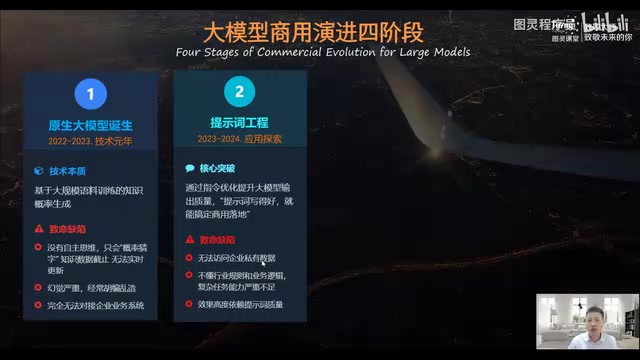
The best way to understand the positioning of Agents is to look at how large model implementation has evolved step by step to where it is today. According to the instructor's analysis, this process roughly divides into four stages, with increasing difficulty.
Stage 1: Native large models
The origin of everything. Trained on massive public internet data, capable of generating conceptual answers—the stunning "knows astronomy and geography" feeling at the time of ChatGPT's explosion came from here. But the limitations are obvious: no autonomous thinking ability, knowledge has a cutoff date (ask it about anything after its training data and it can't answer), prone to severe hallucinations, and unable to connect to existing enterprise business processes. Relying on it for enterprise-level cost reduction and efficiency gains is still far from enough.
Stage 2: Prompt engineering
Improving output quality by optimizing prompt quality. The industry once popularized the notion that "mastering prompts means commercial implementation," and structured instructions, Chain of Thought, and Tree of Thoughts were widely studied. But prompt engineering has three core flaws: unable to access enterprise private data, unable to handle complex business processes, and output quality highly dependent on the level of the person writing prompts. By 2026, prompt engineering has become a basic skill for large model application practitioners—just as using a computer requires typing, but typing doesn't make you an IT engineer.
Stage 3: RAG
Storing an enterprise's fixed, repetitive business data (tables, images, documents) in a knowledge base; before answering, the large model performs relevance retrieval, then delivers the retrieval results to the user. Industries with fixed business data—finance, law, manufacturing—commonly adopt this approach, and the vast majority of knowledge Q&A systems are built with RAG.
But RAG's inherent flaws are equally obvious: it can only passively retrieve information, not think proactively; it cannot handle complex business processes or task decomposition; and it only supports a one-question-one-answer delivery mode. In e-commerce scenarios, the entire flow from user inquiry, order placement, inventory check, to address change cannot be handled by RAG. This is also why many enterprises spend heavily on Q&A systems only to find limited help for the company.
The core idea of RAG (Retrieval-Augmented Generation) is "retrieve first, then answer": split enterprise private data such as documents, tables, and images into chunks, vectorize them, and store them in a vector database. When a user asks a question, the system first retrieves the most relevant chunks by semantic similarity, then stitches these chunks as context into the prompt for the large model to generate an answer. Its value lies in bypassing the large model's knowledge cutoff and hallucination problems, giving answers enterprise-private grounding. But retrieval is essentially a one-off "look up information" action, not involving task decomposition, state maintenance, or external system write operations, so it cannot carry business processes requiring multi-step execution and cross-system calls—this is precisely the watershed between RAG and Agents.
Stage 4: Agents
Equipped with autonomous planning and execution thinking capabilities, upgraded from a Q&A tool to a "digital employee," able to call various tools to complete complex tasks, and supporting multi-agent collaboration to handle enterprise business closed loops. According to the instructor's judgment, this approach has become the mainstream choice for enterprise digital transformation today.
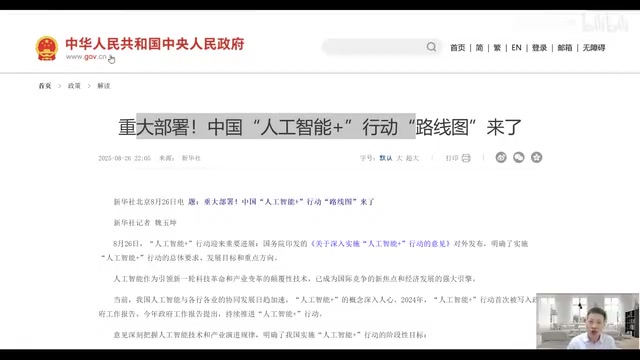
Policy also confirms this direction. The national "AI+" action deployment previously issued covers technology, industry, consumer, livelihood, and other fields; according to relevant planning goals, the penetration rate of next-generation intelligent agents will continue to rise. The instructor draws an analogy between today's "AI+" and the "Internet+" of ten years ago: those who seized the Internet action agenda a decade ago now hold positions in big tech; today's policy wind direction deserves equally serious attention.
ReAct (Reasoning + Acting) is one of the most classic execution paradigms in the Agent field, proposed in 2022 by researchers from Princeton and Google. It makes the large model alternate between "thinking" and "acting": first output a reasoning segment explaining what should be done now; then call a tool (search, calculation, API) to obtain observation results; stitch the observation results back into context and continue the next round of reasoning until a final answer is reached. Compared to one-shot generation, ReAct breaks complex tasks into verifiable small steps and allows the model to correct itself based on real data returned by tools. Subsequent task planning, memory mechanisms, and multi-agent collaboration mostly add engineering capabilities on top of this loop skeleton. Understanding ReAct means understanding the underlying operating mode of Agents' "autonomous thinking and execution."
What four problems do Agents actually solve?
Setting jargon aside, an Agent is the large model's "proxy" in the real world, like a translator between a Chinese speaker and an American. The user poses a question; the Agent understands the need, calls tools, completes complex tasks, and returns the result to the user.
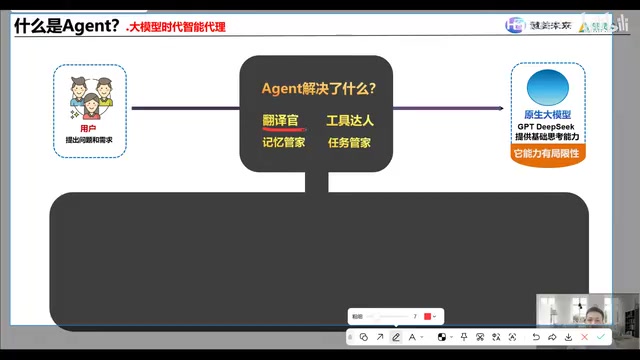
Native large models have several fatal shortcomings: no memory (can't remember context across multi-turn dialogues), knowledge cutoff limits, cannot access the internet for real-time data, and cannot read local files or call tools. Real business scenarios almost always require multi-turn dialogue, multi-step operations, and real-time data—native large models simply can't handle them. Agents fill exactly these gaps:
- Translator: translates natural language needs into instructions the large model can understand, then converts model output into usable results
- Tool expert: helps the large model call APIs, search data online, operate files, and connect to enterprise systems, turning the model from "only able to talk" into "able to act"
- Memory manager: remembers context, user preferences, and historical conversations to support coherent multi-turn processing
- Task manager: breaks complex problems into one-to-three-step small tasks and executes plans, proactively solving problems by invoking solutions
These capabilities are actually used every day. When you send a message to Doubao, behind it Doubao's Agent is calling the native model and processing the result; when programmers use Cursor or Claude Code to write code, these tools remember project structure and call compilers to check errors—relying precisely on Agents' tool-calling and memory capabilities.
Four mainstream Agent types—find your entry point
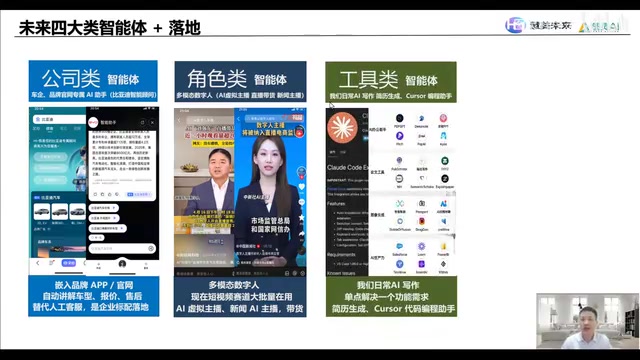
Agents that can make money and run viable business logic on the market basically fall into four categories. For those looking to transition into employment, take on commercial projects, or start personal agent businesses, these four categories are a ready-made positioning map.
Tool-based agents (enterprise customer service)
A typical scenario is an automaker's intelligent customer service: embedded in the brand's app and official website, covering model quotes, configurations, and after-sales, replacing human 24/7 responses. Enterprises of any scale are building or preparing to build such agents—a common lever for traditional enterprise service transformation.
Role-based agents (digital human multimodal)
Digital human anchors and virtual live-stream shopping are the type ordinary people see most when scrolling short videos. Technically, they are a combination of Agent capabilities and digital humans, and short-video and e-commerce companies are already using them in large numbers.
Utility agents (single function)
Do one thing deeply and thoroughly, such as AI writing, resume generation, and various Copilot tools. The barrier is low, suitable for ordinary people to enter by targeting a single functional pain point and monetize through memberships or traffic; traditional enterprises can also use them for internal single-point efficiency gains.
Industry agents (B2B full process)
Aimed at B2B traditional enterprise transformation, and the category the instructor personally favors most with the highest ceiling. Healthcare, finance, e-commerce, logistics, industry, law—any industry can combine with large models for implementation. Take industrial agents: the entire flow from user inquiry to inventory check and order address change can be handled, because it goes deep into the enterprise's full business process rather than single-point Q&A.
Final thoughts
Looking at the timeline: the battle over foundation models was about compute and parameters; then Agents moved from concept to small-scale implementation, in the pioneer trial stage; and now we are entering a period of large-scale explosion of intelligent agents, with central SOEs, state-owned enterprises, large, medium, and small enterprises, and industries like power and logistics all advancing large model implementation. According to industry feedback cited in the video, a certain software company's AI Agent business grew more than double year-over-year this year, and many clients require custom Agents based on their own business needs plus dedicated services.
For traditional programmers, entering Agent development lands right on the风口 of industry-wide transformation—many positions, few people, and enterprises unable to hire are the current reality. But the风口 only rewards those who truly master the underlying logic: first build a complete knowledge system, then take on real projects, running through the entire process from requirements analysis and solution design to deployment and launch—that is the path with fewer detours.
One-line Summary
From prompt engineering and RAG to Agents: why Agents are the real battlefield for enterprise cost reduction and efficiency gains.
Paragraph Summary
The article addresses the common problems of jargon-heavy, quick-fix case-copying Agent tutorials by outlining a transferable cognitive framework. The author points out that prompt engineering and RAG solve "answering questions better" and are essentially passive Q&A, unable to handle business like order processing and customer follow-up that require multi-turn operations and cross-system calls—while what enterprises truly need is "proactively getting things done." This leads to the four stages of enterprise large model implementation: native large models, prompt engineering, RAG, and Agents, each filling the shortcomings of the previous stage. The article further explains that Agents play four roles—translator, tool expert, memory manager, and task manager—and summarizes four mainstream Agent types: tool-based, role-based, utility, and industry, with industry agents going deep into B2B full processes and having the highest ceiling. Finally, it notes that traditional programmers entering Agent development are riding the wind, but must first master the underlying logic before taking on projects.
Related articles

T3 Code: The Open-Source AI Coding Assistant's Comeback Story
T3 Code is an open-source AI coding assistant that unifies subscriptions like Codex and Claude, with powerful remote control and parallel task management.

Never Elected, Yet Ruled New York for 30 Years: The Ultimate Case Study in the Mechanics of Power
Robert Caro's biographies reveal how unelected Robert Moses ruled New York for 30 years through legal drafting and public authorities, and how Lyndon Johnson built leverage as a "powerless" Senate Majority Leader. Unpacking the underlying logic of accumulating and sustaining power.

The CPython 3.10 Recursion Trap and Synthetic Recovery in TokenGuard, an LLM Circuit Breaker
TokenGuard's author recounts a recursion crash caused by OrderedDict.pop in CPython 3.10 and introduces v0.3.0's Loop Nudge synthetic recovery, inline DLP scanning, and other new LLM agent circuit-breaker capabilities.