Matt Pocock Talk: In the AI Era, Code Is the Agent's First Prompt

In the AI era, coding fundamentals are the core lever for driving Agents, with three guardrail layers keeping Agents on track.
Matt Pocock proposes that "code is the Agent's first prompt," arguing that in the AI era code quality isn't obsolete but is the core lever for wielding Agents. He builds a three-layer guardrail system: automated checks (lint, type checking) are cheap and can be stacked infinitely; testing guardrails require designing tests that are hard to fool, avoiding tautologies, over-mocking, and happy-path-only tests; design guardrails advocate "deep modules" that encapsulate complexity behind minimal interfaces and limit the Agent's scope of modification. He also offers four practical recommendations: separate code review rules from AGENTS.md into a dedicated review process; use "leading words" to compress architectural intent into the Agent's thinking terminology; borrow the one-way/two-way door framework to decide review intensity; and use retrospectives to keep the guardrail system evolving. Finally, he suggests newcomers first hone strategic thinking in internal tools before moving to core products.
In an age where AI coding tools are everywhere, a counterintuitive idea is emerging: code quality hasn't become obsolete—it has become the core lever for wielding AI Agents. In a talk, well-known TypeScript community educator Matt Pocock laid out his thinking systematically—code is the Agent's first prompt. He proposes a three-layer system of "automation guardrails, testing guardrails, and design guardrails" to keep AI output on a controlled track.
Why Fundamentals Matter Even More in the AI Era
Matt Pocock opened with a sharp question: when AI can handle a large amount of coding work, what's the point of sitting here learning the fundamentals?
His answer: AI has made code generation cheap, but the "old-school" requirements of maintainability, testability, and readability are precisely the precondition for an Agent to be driven effectively. Pocock states plainly that fundamentals like understanding React haven't depreciated—they're more important than ever, because you need that knowledge to build the frameworks that constrain the Agent, not just to write code yourself.
The underlying logic: an Agent's output ultimately lands in the codebase, and the codebase's structure determines how far the Agent can go. A messy codebase makes the Agent's changes messier, while a well-designed module naturally converges the Agent's output.
The Three Layers of Agent Engineering Guardrails
Pocock breaks down the infrastructure that supports efficient Agent work into three layers, which form the core framework of the entire talk.
Layer 1: Automation Guardrails—Let Machines Stop Machines
Automated checks (lint, type checking, compile-time validation) are the lowest-cost guardrails. They consume CPU time rather than tokens, so they can be stacked infinitely. Pocock notes that as toolchains like TypeScript, Rust, and OXLint get faster, you can now stuff a large number of static check rules into a project with almost no added overhead.
His advice is direct: push teams to make lint rules as strict as possible. For an Agent, every lint rule is an instant correction that catches errors at the code-generation stage rather than leaving them for human review. He shares a detail: he once wrote custom lint rules for colleagues and worried it was overkill, but in the Agent era this practice has become standard—because an Agent won't bypass a rule out of "politeness"; if the rule is hard-coded, it follows it.
Layer 2: Testing Guardrails—Teach the Agent to Self-Verify
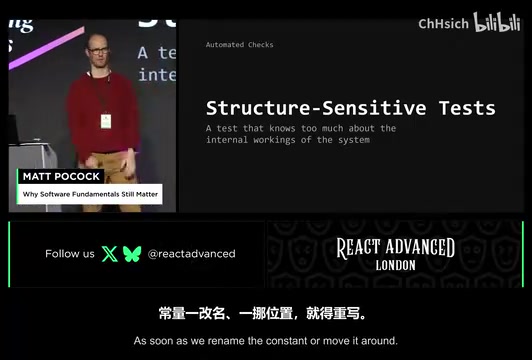
Testing is the hardest of the three layers to get right. Pocock uses several counterexamples to show what kinds of tests are worthless for an Agent:
- Tautological tests: the test merely restates the implementation logic, so the test must change whenever the code changes—it can neither catch problems nor verify behavior.
- Over-mocked tests: mocking away the complex interactions of a real environment, so the test passes but production still crashes.
- Happy-path-only tests: unable to cover the boundary errors an Agent might introduce.
He stresses that Agents haven't made writing tests easier—quite the opposite: generating plausible-looking but poor tests is exactly what AI excels at. So humans need to focus on designing tests that are "hard to fool," making tests a genuine acceptance criterion for the Agent.
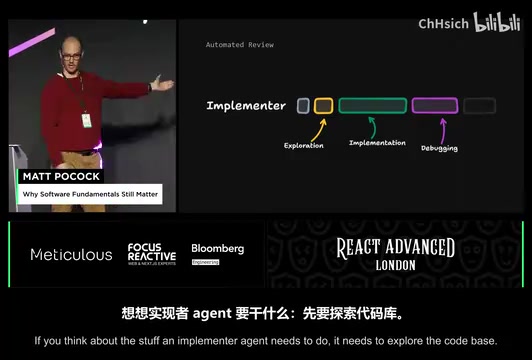
"Deep Module" is a core design principle proposed by John Ousterhout in A Philosophy of Software Design: a module's value depends on the ratio of the complexity it hides to the interface it exposes. A "deep" module encapsulates a large amount of internal implementation detail behind a minimal public interface, so callers can use it correctly without understanding the internal logic; conversely, a "shallow module" has an interface comparable to—or even more complex than—its implementation, causing complexity to leak out. For an Agent, a deep module means it can only see the limited public interface and can't directly touch the internal implementation, structurally limiting the scope of what it can modify; at the same time, tests only need to verify interface behavior rather than implementation details, reducing test maintenance costs.
Layer 3: Design Guardrails—Module Boundaries Are Prompt Boundaries
This is the most insightful part of Pocock's talk. He borrows the "deep module" concept from John Ousterhout's A Philosophy of Software Design: a good module exposes a minimal interface and encapsulates complexity internally.
The significance of this design for an Agent: when a module is "deep" enough, the Agent can only interact with it through the public interface, can't peer into the internal implementation, and therefore can't make a mess inside. Testing benefits too—tests only target interface behavior, not implementation details. Pocock points out that the React ecosystem has long encouraged scattering state and logic across components, which contradicts the "deep module" philosophy and gives the Agent too many openings. He recommends centralizing state management (e.g., using a state management library) so that state becomes an independently testable unit rather than being scattered across the UI layer.
Four Actionable Engineering Practices
Based on the framework above, Pocock offers several concrete recommendations, some supplemented from the live Q&A.
Take Code Review Rules Out of AGENTS.md
Many teams habitually cram all conventions into AGENTS.md, but Pocock believes code review rules shouldn't go there. The reason: AGENTS.md is global context loaded in every session, so if you put review rules in it, the Agent gets "distracted" while writing code—it will consider review comments in advance and end up constrained.
The right approach is to put review rules in a separate review process: after the Agent finishes writing code, a dedicated review Agent reads the diff and the rules file to perform the review. This two-stage design lets writing code and reviewing code each do their own job, and Pocock says it significantly improves the Agent's output quality.
AGENTS.md is a configuration file convention for AI coding agents, akin to an "employee handbook" for the Agent: it is loaded as global context at the start of every session and is used to declare the project's tech stack, coding conventions, directory structure, common commands, and so on. Because it applies to the entire session, its content should focus on "how to write code" rather than "how to review code." If review rules are also crammed into AGENTS.md, the Agent will consider review comments in advance while generating code, leading to distracted reasoning and constraint. Therefore, a more reasonable approach is to store review rules separately, with a dedicated review Agent reading the diff and rules file after code generation to perform the review, achieving a separation of writing and reviewing responsibilities.
Use "Leading Words" to Shape the Agent's Thinking Language
Pocock introduces an interesting concept: leading words. When you define terms like "optimistic update" or "deep module" in your coding conventions, the Agent reuses these words in its internal reasoning, compressing complex architectural intent into a few-token "thinking shortcut."
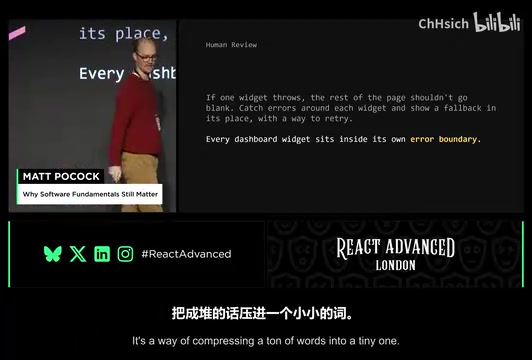
This means the domain terminology a team builds up is itself an efficient form of prompt engineering. The more precise the terminology, the closer the Agent's reasoning path is to a senior engineer's thinking.
The concept of "leading words" is analogous to "Ubiquitous Language" in domain-driven design: forming a precise, shared terminology system within a team to describe business rules and architectural decisions. When these terms are written into coding conventions, the Agent naturally reuses them during reasoning, compressing a lengthy architectural intent into a few-token "thinking shortcut." For example, once the term "optimistic update" is defined, the Agent doesn't need to re-derive the update strategy each time but can directly reference the term as a reasoning anchor. The more precise the terminology and the closer it is to the team's reality, the closer the Agent's reasoning path is to a senior engineer's thought patterns, improving decision quality.
Distinguish One-Way Doors from Two-Way Doors to Decide Review Intensity
Addressing the question "Can AI reviewing AI be trusted?", Pocock borrows Amazon's one-way/two-way door decision framework:
- One-way doors: irreversible or hard-to-roll-back changes (e.g., in sensitive domains like finance or healthcare) must retain human review.
- Two-way doors: changes that can be quickly rolled back (e.g., renaming a variable) can safely be left to the Agent for automatic review and merging.
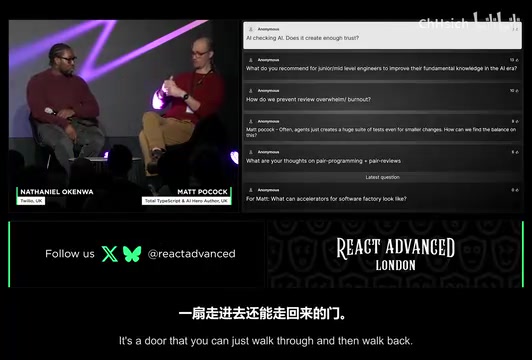
He adds a design-level idea: turn one-way doors into two-way doors through code design—for example, by retaining data and supporting rollback, making originally irreversible operations reversible and thereby expanding the scope the Agent can handle autonomously.
The "one-way door/two-way door" framework comes from Amazon's decision-making methodology: a one-way door is an irreversible or hard-to-roll-back decision that, once passed, cannot be undone and requires careful evaluation, thorough justification, and human review; a two-way door is a decision that can be quickly rolled back, with low trial-and-error cost, and can be delegated to automated processes or frontline staff to move quickly. In Agent engineering, this framework is used to divide review intensity: one-way door changes involving sensitive domains like finance and healthcare must have human involvement, while two-way door changes like renaming a variable can safely be left to the Agent for automatic review and merging. Going further, through code design (such as retaining data and supporting rollback) you can turn originally one-way doors into two-way doors, expanding the scope the Agent can handle autonomously and improving overall efficiency.
Use Retrospectives to Keep the System Evolving
Pocock recommends a "retro" after every Agent session, even if the task went smoothly. A retrospective Agent analyzes the session's efficiency and problems found, and feeds improvement suggestions back into lint rules, test templates, and coding conventions. This mechanism thickens the guardrail system over time through use, rather than configuring it once and leaving it alone.
How Newcomers Can Join the Agent Pipeline
An audience member asked: in a team where AI handles a large amount of foundational work, how do newcomers grow? Pocock's answer: have newcomers first build internal tools rather than participating directly in product development.
The users of internal tools are colleagues, so feedback is fast and risk is low; newcomers can practice strategic thinking in real scenarios—thinking about the long-term evolution of code, not just completing the task at hand. Pocock divides an engineer's growth into a tactical layer and a strategic layer: the tactical layer is completing the task at hand, and the strategic layer is understanding how the system evolves. Agents excel at tactical execution; the core value of humans lies in strategic judgment. Having newcomers hone strategic thinking in low-risk internal tools before gradually transitioning to core products is the more reasonable path.
Conclusion: Fundamentals Are the Road Paved for the Agent
Matt Pocock's entire talk points to one conclusion: AI hasn't lowered the demands on engineers' fundamentals—it has changed their purpose. In the past you wrote code for machines to execute; now you write code, write tests, write conventions, and design modules so that the Agent runs on the right track. Code is the Agent's first prompt—the clearer your codebase, the more reliable your Agent.
Related articles
 Tech Frontiers
MuJoCo: An Analysis of DeepMind's Open-Source General-Purpose Physics Simulator
An in-depth analysis of Google DeepMind's open-source physics simulator MuJoCo: high-performance C++ kernel, MJCF modeling format, contact solving principles, MJX GPU acceleration, and robot reinforcement learning use cases.
 Tech Frontiers
Claude API Quick Start: The Official Quickstarts Project Collection
Anthropic's official claude-quickstarts project collection helps developers quickly build deployable apps with the Claude API. Nearly 20k stars, Python-based, great for beginners and prototyping.
 Tech Frontiers
AI Agents Connecting Directly to APIs: Which Calls Can Be Safely Allowed?
AI agents can call any API, but the real challenge is deciding which calls can be safely allowed. This article analyzes allowance decisions from three dimensions—intent matching, least privilege, and controllable impact—and argues that the control layer should sit outside the agent, combined with audit traceability to build a trustworthy API call governance mechanism.