Meccanoid Robot Server Shutdown: How Can Users Save Themselves?

Meccanoid server shutdown bricks robot, highlighting smart hardware's cloud dependency dilemma.
A Reddit user reports their 4-foot Meccanoid robot is unusable because the manufacturer shut down the companion app's servers, preventing control or programming. The article examines how server shutdowns disable app binding, cloud command parsing, firmware updates, and voice recognition, and outlines three self-rescue paths: finding official offline apps or SDKs, community reverse engineering of Bluetooth protocols, and physical-layer modification with Arduino or Raspberry Pi. It notes such devices are "hardware + ongoing service" bundles, where unilateral service termination can drastically devalue products, and community self-rescue remains a technical minority's privilege. Pre-purchase advice includes confirming local offline control, open APIs, and active communities.
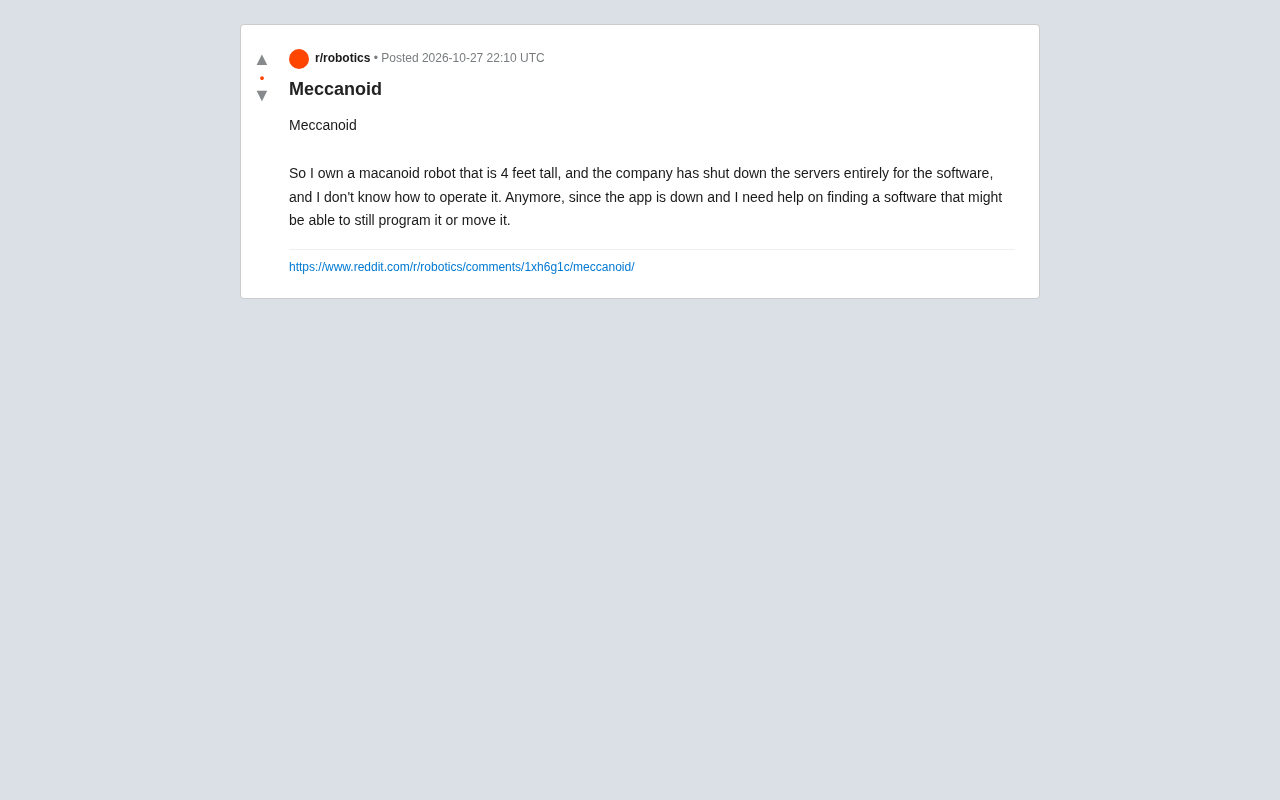
A Reddit user posted for help: they own a 4-foot-tall Meccanoid robot, but the manufacturer has completely shut down the servers for the companion software, rendering the app unusable, and they don't know how to continue operating the robot. They hope to find third-party software to reprogram or control it.
This post may seem like an isolated case, but it reflects an increasingly common problem in the era of smart hardware: when cloud services terminate, does the hardware you bought become a pile of scrap metal?
What a Server Shutdown Means
Meccanoid is a programmable robot kit released by Spin Master, where users control, program, and interact via voice through the official app. According to the Reddit user, the app can no longer connect to the server, meaning all cloud-dependent functions have failed.
For such robots, a server shutdown typically affects several layers: app login and device binding, cloud command parsing, firmware update channels, and potentially cloud-dependent voice recognition services. What remains in the user's hands is a hardware shell equipped with motors and sensors but lacking a "brain entry point."
The so-called "cloud command parsing" refers to the app converting user actions (such as button clicks or drag-and-drop programming blocks) into commands the robot can understand. This process is often not completed locally on the phone but involves uploading commands to the manufacturer's server, which parses them and then sends them to the robot. Once the server is shut down, this chain breaks in the middle; even if the phone and robot can still connect via Bluetooth or Wi-Fi, a complete control cycle cannot be achieved.
The closure of firmware update channels is equally profound. Firmware is the low-level software running on the robot's main control chip, responsible for motor driving, sensor reading, and communication protocol handling. Manufacturers typically push firmware via the cloud to fix defects or add features. After the channel closes, the device will permanently remain at the last version, and any known issues can no longer be corrected.
Three Paths Users Can Try
First, look for official legacy resources. Some manufacturers release offline versions of apps or SDKs before shutting down services, and communities may archive old installation packages. The Reddit poster can try searching archive sites or robot enthusiast forums for offline control solutions for Meccanoid.
Second, leverage community reverse engineering. Meccanoid has had some discussion in enthusiast communities, and developers have analyzed its Bluetooth communication protocol. If protocol documentation or open-source projects can be found, theoretically, generic Bluetooth debugging tools could be used to send commands and achieve basic motion control. This requires a certain technical threshold but is a viable direction for users willing to tinker.
Third, physical-layer modification. A more thorough approach is to bypass the original motherboard and use Arduino or Raspberry Pi to take over the motors and sensors. This is equivalent to giving the robot a new "nervous system"; the workload is significant, but it can completely eliminate dependence on the manufacturer's cloud services.
Reverse engineering here refers to inferring private protocols by observing device behavior and capturing communication packets without access to the source code. For devices like Meccanoid that use Bluetooth Low Energy (BLE) communication, common methods include using phone packet capture tools to record data streams between the app and robot, or using generic BLE debugging tools to probe the read/write permissions of characteristic values one by one, thereby reconstructing the command formats needed to control motors and read sensors. This process requires patience and a foundation in protocol analysis, and results are typically shared in the community as open-source projects or forum posts.
The "Death Booking" Dilemma of Smart Hardware
What makes this Reddit post resonate is that it touches on a structural issue: more and more consumer robots and smart home devices place core functions in the cloud, so what users buy is actually a bundle of "hardware + ongoing service," and the terms of service usually reserve the manufacturer's right to unilaterally terminate.
When manufacturers exit or adjust their business, the devices in users' hands may lose most functions overnight. For robot products with high price tags, this risk is particularly glaring. While community self-rescue is feasible, it remains a privilege of a minority of technical users; ordinary consumers often have no choice but to accept the reality of their devices becoming obsolete.
The term "death booking" borrows from the software industry's "planned obsolescence," but here it emphasizes obsolescence caused by service termination rather than hardware aging. Unlike traditional appliances, the functional boundaries of smart hardware are dynamically defined by cloud services; manufacturers can, through a single server shutdown or API change, strip a product of its core capabilities without touching the physical device. The common clause in terms of service reserving "the right to modify or terminate services at any time" is the legal embodiment of this capability, making the device's lifespan effectively dependent on the manufacturer's business decisions rather than the product's physical longevity.
Pre-Purchase Risk Self-Check
From this help request, several practical suggestions can be distilled: before buying a programmable robot, confirm whether it supports local offline control; check whether the manufacturer provides an open API or SDK; and prioritize products with active developer communities. The heavier the cloud functionality and the higher the degree of closure, the greater the long-term usability risk.
The Reddit user's question currently has no standard answer, but their experience reminds every smart hardware buyer: what you buy is not just the robot, but also the server behind it that could be shut down at any time.
One-line Summary
Meccanoid server shutdown turns robot into a brick, reflecting the cloud dependency dilemma of smart hardware.
Paragraph Summary
A Reddit user sought help, reporting that their 4-foot-tall Meccanoid robot can no longer be controlled or programmed via the official app because the manufacturer shut down the companion software servers, sparking discussion about smart hardware's cloud dependency. The article analyzes how a server shutdown causes failures in app login binding, cloud command parsing, firmware updates, and voice recognition, and proposes three self-rescue paths: finding official legacy offline apps or SDKs, leveraging community reverse engineering to reconstruct Bluetooth communication protocols, and physical-layer modification using Arduino or Raspberry Pi to bypass the original motherboard. It points out that such devices are essentially bundles of "hardware + ongoing service," and unilateral service termination by manufacturers can drastically devalue devices overnight; community self-rescue is a privilege of a minority of technical users. Finally, it offers practical advice such as confirming local offline control capabilities, open APIs, and community activity before purchase.
Related articles

world2vec: Building Mechanistic World Models with Latent Dynamics Learning
world2vec proposes a reward-free method for learning mechanistic world models via latent dynamics, faithfully reproducing systems over long horizons with at least an order of magnitude fewer parameters than DreamerV3, TD-MPC2, and LeWM, and achieving accurate system identification on 71 attractor benchmarks.

A New KL-DRO Paradigm: Adaptive Scenario Generation Around a Learned Density Model
KL-DRO research proposes centering the KL ball on a learned density model instead of the empirical distribution, with adaptive scenario generation guiding sampling toward the worst case. Experiments show lower cost under distribution shift when records are scarce and the model can extrapolate, with comparable in-distribution cost.

ODE Samplers for Discrete Diffusion Models: Exponential Residual Flows Accelerate Generation
Discrete diffusion models lack deterministic ODE sampling? This article introduces Exponential Residual Flows (ERFs), which introduce continuous residual variables per token to construct piecewise ODEs for deterministic sampling and support consistency distillation acceleration. Superior to prior methods on code and text generation tasks.