Meta Launches Its Own Brand of Smart Glasses: Cheaper, More Options, Global Availability
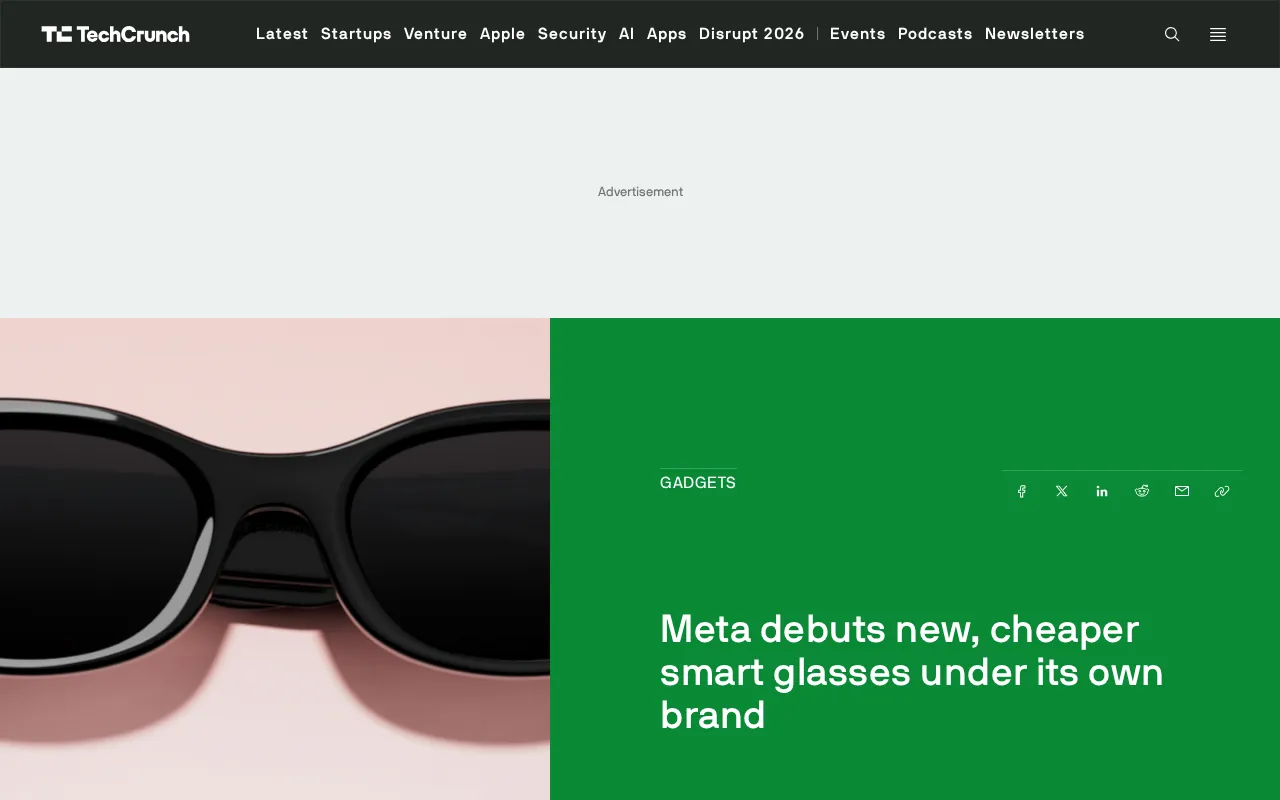
Meta launches affordable own-brand smart glasses globally to accelerate its AI wearable strategy.
Meta has officially launched its own-brand smart glasses, moving beyond its Ray-Ban partnership to offer more affordable, diverse options available simultaneously across multiple countries. The strategy aims to lower the entry barrier for wearable AI devices, expand Meta's user base for AI data collection and ecosystem growth, and position smart glasses as the next major computing platform.
Meta Takes a Critical Step: Launching Its Own Brand of Smart Glasses
Meta has officially unveiled a new product line of smart glasses under its own brand, marking a deeper strategic push into the wearable AI device space. Unlike the premium smart glasses previously co-developed with Ray-Ban, this new product targets a broader consumer base at a more accessible price point and is already available in multiple countries simultaneously.
From Partner Brand to Own Brand: Meta's Strategic Pivot
Breaking Free from Ray-Ban Dependency
Over the past few years, Meta's smart glasses strategy has largely relied on its partnership with Ray-Ban, a brand under Italian eyewear giant EssilorLuxottica. EssilorLuxottica is the world's largest eyewear manufacturer, formed through the 2018 merger of France's Essilor and Italy's Luxottica. The conglomerate owns iconic brands like Ray-Ban, Oakley, and Persol, while controlling the entire value chain from lens manufacturing to retail. Meta's collaboration began with the Ray-Ban Stories in 2021, followed by the upgraded Ray-Ban Meta smart glasses in 2023, priced starting at around $299. While this partnership allowed Meta to leverage Ray-Ban's brand appeal and mature manufacturing expertise for a quick market entry, it also meant Meta was constrained by its partner's influence over pricing, design language, and distribution channels.
Although the Ray-Ban Meta smart glasses earned solid reviews, their pricing and brand positioning inherently limited their reach to a specific consumer segment.
The launch of an own-brand product signals that Meta is building a more complete product matrix, aiming to cover market tiers from premium to mid-range. This strategy mirrors Apple's approach in the headphone market — offering both the high-end AirPods Max and the more affordable AirPods lineup, maximizing market penetration through price tiering.
What a Lower Price Threshold Means
One of the biggest highlights of the new Meta smart glasses is their more accessible pricing. For Meta, lowering the hardware entry barrier is a critical move to expand its AI ecosystem. More users wearing smart glasses means more data feedback, richer use cases, and a stronger foundation for AI model training.
This "volume-for-quality" strategy is a time-tested playbook in the tech industry with deep historical roots. Amazon sold Kindle e-readers at near cost in its early days to build an e-book content ecosystem; Google made Android free for phone manufacturers, capturing the world's largest mobile OS market share. For Meta, hardware profit margins on smart glasses are not the core objective. The real value lies in this: every pair of glasses is an AI data collection terminal and service distribution gateway. The visual data, voice interaction logs, and location information generated while users wear the glasses become invaluable material for training multimodal AI models, while also laying the user foundation for Meta's future monetization in areas like AR advertising and AI subscription services.
Diverse Product Configurations: Balancing Function and Fashion
The new smart glasses come in a variety of colors and lens combinations, reflecting Meta's attention to consumer personalization. As a daily-wear accessory, the diversity of a smart glasses' design directly impacts purchase intent. One key reason many smart glasses products have failed in the past is precisely because they overlooked a fundamental truth: glasses are first and foremost a fashion accessory.
From a product strategy perspective, a rich SKU (Stock Keeping Unit) mix also helps Meta implement differentiated pricing and marketing across different markets. In consumer electronics, a diverse SKU strategy is a double-edged sword: on one hand, it satisfies different consumers' personalization needs and boosts conversion rates; on the other, it increases inventory management complexity and supply chain costs. Meta's decision to offer diverse configurations for its smart glasses reflects the company's transition from an early-stage technology validation phase to a mature consumer product mindset — beginning to prioritize fashion attributes and personal expression like traditional eyewear brands, with targeted offerings tailored to aesthetic preferences in different regions.
Simultaneous Global Launch: Meta's Expansion Ambitions
Interestingly, this product launched simultaneously in multiple countries from day one, rather than following a gradual rollout strategy. This aggressive launch cadence indicates Meta's strong confidence in both its supply chain readiness and market demand.
In the increasingly fierce AI hardware competition, seizing first-mover advantage is crucial. The current competitive landscape in the AI hardware space is exceptionally complex: Snap's Spectacles have iterated to their fifth generation, with the latest version featuring a standalone AR display system, though currently available only to developers via a $99/month subscription model; Google and Samsung are jointly developing Project Moohan, a mixed reality headset based on the Android XR platform expected to integrate Google Gemini AI capabilities; Apple's Vision Pro targets the high end (starting at $3,499), but Apple is widely believed to be developing a lighter, more affordable AR glasses product line; additionally, startup products like Brilliant Labs' Frame AI glasses and Even Realities' G1 continue to emerge. The core of this race isn't just hardware — it's a battle over AI assistant entry points, spatial computing ecosystems, and user attention.
Every major tech giant is vying for the "screen on the user's face." Meta's strategy of rapid distribution and broad coverage is clearly aimed at establishing a user base before competitors can react.
The Deeper Logic of the Smart Glasses Race
Why Smart Glasses Are the Ideal Vehicle for AI
Smart glasses are increasingly viewed by industry observers as the best physical vehicle for AI assistants. This assessment is closely tied to the maturation of multimodal AI technology. Multimodal AI refers to artificial intelligence systems capable of simultaneously processing and understanding multiple forms of information — text, images, voice, video, and more. Meta's own Llama series of large language models already possess powerful multimodal capabilities, and the cameras and microphones on smart glasses provide the most natural multimodal input method.
Compared to smartphones, glasses have three inherent advantages:
- Always present: No need to pull out a device — information is always at hand
- Hands-free: Voice-driven interaction makes operation more natural
- First-person perspective: AI can "see" what the user sees, enabling context-aware services
So-called "First-Person Computing" refers to AI systems that can access information in the user's field of view in real time, enabling highly contextualized services — such as identifying a plant species in front of you, translating foreign text on a menu, or providing real-time informational support during a conversation. This capability is something smartphones struggle to match, since phones require users to actively raise the device to capture a scene.
Meta CEO Mark Zuckerberg has repeatedly stated publicly that smart glasses will become the core form factor of the next-generation computing platform. The generational shift in computing platforms follows a clear evolutionary path: from mainframes to personal computers, from PCs to smartphones — each transition brought computing devices closer to the human body, made interactions more natural, and increased usage frequency. Smart glasses are seen as the next node on this path, as they place computing power directly at the human perceptual interface. Zuckerberg has called this vision a core component of the "metaverse" strategy, but following strategic adjustments in 2022–2023, Meta has shifted its focus from immersive VR experiences to more practical AI-assisted AR experiences. Behind this pivot is a pragmatic market judgment: lightweight smart glasses worn throughout the day are far more likely to gain mass adoption than bulky VR headsets, and AI assistant features address users' immediate needs more effectively than virtual world socializing.
The launch of a cheaper own-brand product is essentially paving the way for this vision — first getting as many people as possible accustomed to wearing smart glasses, then gradually layering on more powerful AI features and AR experiences.
Impact on the Wearable AI Device Industry
Meta's launch of own-brand smart glasses at lower prices could exert pricing pressure across the entire wearable AI device market, forcing competitors to reassess their pricing strategies. At the same time, it provides third-party developers with a larger potential user base, likely catalyzing a richer app ecosystem. Once the user base crosses a certain critical threshold, developers' willingness to build applications for the platform increases significantly, creating a positive flywheel effect of "more users → more apps → more users" — the core mechanism behind every successful computing platform's rise.
Conclusion
Meta's launch of its own-brand smart glasses is more than a simple product line expansion — it's a major milestone in the company's AI + hardware strategy. By lowering the price barrier, enriching product choices, and accelerating global distribution, Meta is paving the way for smart glasses to evolve from a niche gadget for tech enthusiasts into a mainstream consumer product. The race for the "next-generation computing platform" has only just entered its acceleration phase.
Related articles

Replit at Web Summit Lisbon: AI Coding Platform Accelerates European Expansion
Replit participated in Web Summit Lisbon 2026 Day 1 as Replit Live. This article examines its transition from an online IDE to an AI app-building platform and analyzes its European market opportunities and compliance challenges.

Codex Integrates with Zotero: Batch Literature Review and Deep-Read Tools Tested
Hands-on testing of two new Codex functions for Zotero: batch literature reviews by collection and screening key papers for deep reading. Covers comparison tables, citation verification, the three-layer method and experiment analysis, plus a complete workflow.

Codex + Obsidian + Zotero: An AI-Powered Automated Paper Reading Workflow
A Codex + Obsidian + Zotero paper management and retrieval workflow: Zotero manages references, Codex calls GPT for close reading and notes, Obsidian with DataView builds indexes, enabling Q&A with your paper library and quick literature review material — includes close-reading template and two Skill setup steps.