Meta Muse AI Digital Avatar Launches Video Calling, U.S. Users Can Customize Appearance

Meta opens Muse AI avatar video calling to U.S. users and reveals a Tamagotchi-style wearable device.
Meta announced that U.S. users can interact with AI avatar Muse via video call, with customizable appearance. Video calling demands real-time synchronization of speech, lip movements, and expressions—a much higher technical barrier than text or voice, and its availability signals that Meta's real-time generation pipeline is production-ready. Meta also revealed a Tamagotchi-like wearable to bring Muse from screen to everyday carry. Both lines share the same avatar asset: video calling validates the software side, hardware extends it. Customization aims to build ownership and differentiate Meta in a homogenized AI assistant market, though compute costs, privacy, and wearable lifecycle remain open questions.
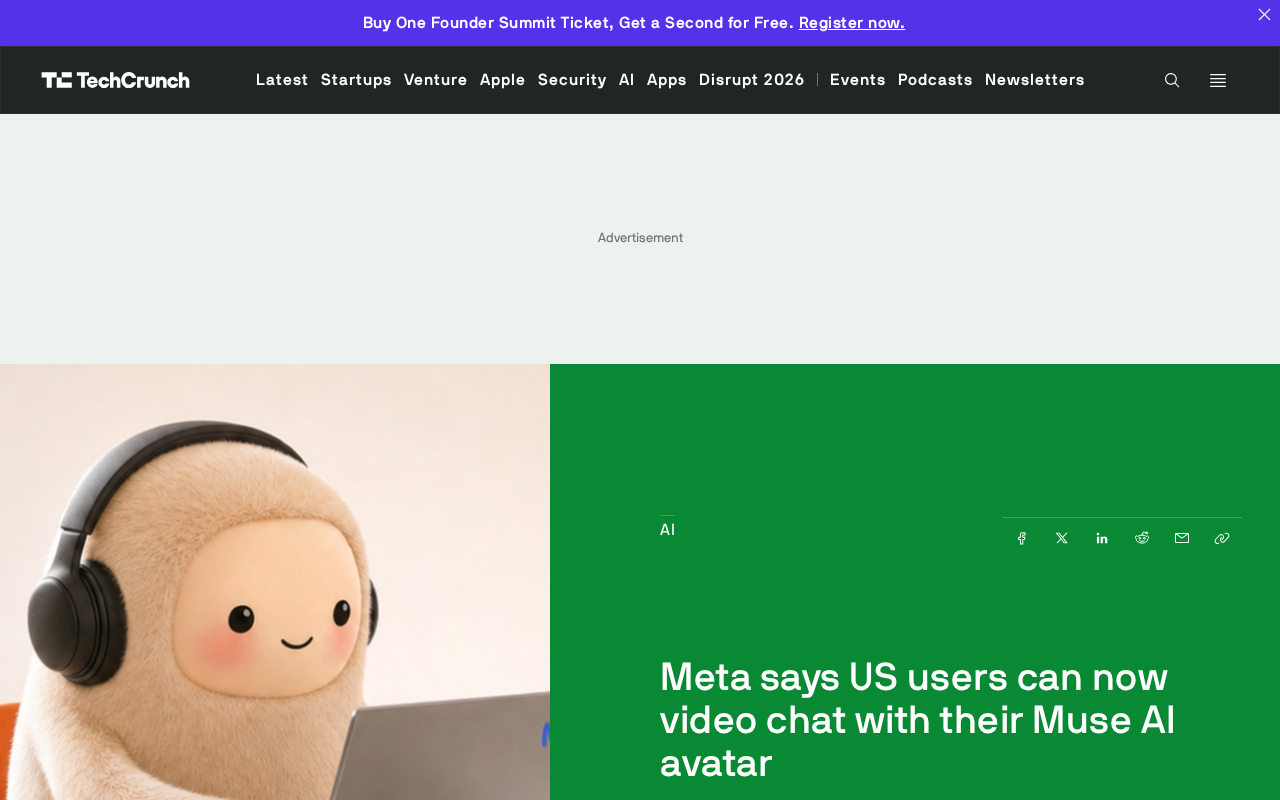
Meta is pulling its AI assistant out of the text box and turning it into a digital being that talks and makes facial expressions. According to an RSS source, Meta has announced that U.S. users can now interact with an AI avatar called Muse via video call, and the avatar supports customization.
The timing of this launch is telling: Meta simultaneously revealed a Tamagotchi-like wearable device aimed at bringing Muse "out" of the screen. The two product lines, one after the other, point in the same direction—the form of AI assistants is shifting from tool to companion.
What Is Muse: From Chatbot to Animated Avatar
Muse is not an entirely new model name, but rather an interactive avatar layer for Meta's AI assistant. In a video call, users see an animated virtual avatar driven by AI for conversation. Compared with pure text or voice interaction, video calling means the system must handle speech recognition, semantic understanding, speech synthesis, and real-time facial animation generation all at once.
Meta describes it as a "customizable animated avatar." The specific customization dimensions were not elaborated officially, but product logic suggests appearance is the most basic layer, potentially extending to voice, expression style, and even personality settings. This direction is directly tied to Meta's years of accumulated expertise in avatars—the Avatar systems in Quest platform and social products provide a ready-made technical foundation for Muse.
The avatar system is a technical asset Meta has built up over years. In the Quest platform and social products, avatars include skeletal rigging, facial expression driving, and lip synchronization modules, typically implemented based on ARKit-compatible facial blendshape standards. When AI needs to generate real-time animation, the system maps the phoneme sequence from speech synthesis output to lip movements, then overlays expression layers, and finally renders a visible avatar. Muse directly reuses this pipeline, meaning Meta doesn't need to build an animation system from scratch—it only needs to connect AI-driven conversation logic to the existing avatar rendering chain. This is the underlying reason Meta can advance quickly on the video call format.
What Video Calling Means
Putting an AI assistant into video calls has a higher barrier than one might imagine. Text conversation can tolerate second-level latency, voice calls can tolerate hundreds of milliseconds of jitter, but video calls require lip movements, expressions, and speech to be synchronized—any misalignment is immediately perceived by users as "fake."
Meta's choice to open the feature at this point indicates that its real-time generation pipeline has reached a usable state. For users, the change lies in the "presence" of interaction: facing an avatar that turns its head, blinks, and changes with the tone of voice noticeably shortens the psychological distance of conversation. This is also the differentiator Meta is trying to establish in the homogenized competition of AI assistants—when model capability gaps narrow across players, interaction form becomes the new battleground.
The technical difficulty of real-time audio-video generation centers on the word "synchronization." Speech synthesis typically outputs audio chunks in a streaming manner, facial animation needs to align lip movements frame by frame according to audio timestamps, and video encoding must keep end-to-end latency within an acceptable range. The common industry approach is to introduce a low-latency audio-driven facial animation model that maps speech features directly to expression parameters, then outputs frames through a lightweight rendering pipeline. Buffering at any stage causes audio-video desynchronization, which users immediately perceive as "fake." Meta opening this feature indicates its streaming pipeline has compressed latency into a usable range.
The Significance of the Tamagotchi-Style Wearable
The "Tamagotchi-like wearable device" mentioned in the report is the key clue to understanding Muse's strategic intent. The core experience of Tamagotchi (virtual pet) is not functionality but companionship: users care for it, it responds to users, forming an emotional connection.
If Meta puts Muse into a portable device, the AI assistant is no longer a service that "exists only when you open the app" but a continuously present entity. This aligns with the current exploration direction of AI hardware, but Meta's differentiation lies in having the interactive avatar Muse as a content layer, with hardware merely being the carrier. In other words, video calling is the software-side validation, and the wearable is the hardware-side extension—both share the same avatar asset.
It should be noted that the wearable device currently has only directional descriptions; Meta has not yet announced form details or launch timeline. From the phrasing "ahead of the launch," video calling is the leading move, with hardware waiting in the wings.
Tamagotchi is a portable virtual pet launched by Bandai in 1996, with a core mechanism of a "care—feedback" loop: users feed, clean, and play with it, and the device responds with animations and state changes, thereby building emotional connection. Its product logic doesn't depend on feature complexity but on continuous presence and low-barrier interaction. Meta borrowing this concept means the wearable's goal is not to replace phones but to give the AI avatar a physical carrier that is always accessible. The challenge for such products is avoiding idleness after novelty fades, typically requiring continuous content updates and conversational capability iteration to maintain stickiness.
Position in the Competitive Landscape
Video-call-format AI avatars are not Meta's invention. Multiple players in the industry are already attempting to give AI assistants a visualized personality presentation, but most remain at the demo or small-scale testing stage. Meta's advantage is distribution scale—U.S. users can use it directly, meaning the feature has passed internal validation and has service capacity.
Another noteworthy point is customization. When users can decide the AI avatar's appearance, the product shifts from "an assistant" to "my assistant," and the retention effect from a sense of ownership has been repeatedly validated in social products. Meta clearly wants to apply the same logic to AI assistants.
Visualized personality presentation for AI assistants is becoming an industry exploration direction. Some players adopt a combination of 3D virtual avatars and voice conversation, while others remain at 2D animation or pre-rendered video stages. The difference mainly lies in real-time performance and customizability: pre-rendered solutions are low-cost but offer weak interactivity, while real-time generation offers better experience but consumes more compute. Meta's advantage is distribution scale—U.S. users can use it directly, indicating the feature has passed internal validation and has service capacity. As underlying model capability gaps narrow across players, interaction form and distribution channels will become new competitive variables.
Open Questions
The feature launch is only the beginning. Video calls consume far more compute and bandwidth than text interaction, and how to control service costs after large-scale rollout is a question Meta needs to answer. There is also room for discussion on privacy: video calls involve camera permissions and real-time audio-video data, and Meta needs to provide clear data processing disclosures.
The wearable device holds even more悬念. The lifecycle of Tamagotchi-style products often depends on novelty, and whether Muse can maintain user stickiness through continuously updated conversational capabilities and avatar content will determine the ceiling of this product line.
From text to voice, from voice to video avatar, and then to portable hardware, Meta's planned path for Muse is clear: give the AI assistant a "sense of presence." Video calling is an intermediate stop on this road; next, we'll see whether that small device can truly bring Muse into daily life.
One-line Summary
Meta opens Muse AI avatar video calling to U.S. users and reveals a Tamagotchi-style wearable device.
Paragraph Summary
Meta announced that U.S. users can interact with AI avatar Muse via video call, with customizable appearance. Video calling requires real-time synchronization of speech, lip movements, and expressions—a significantly higher technical barrier than text or voice interaction. The feature's availability indicates its real-time generation pipeline has reached a usable state. Meta also revealed a Tamagotchi-like wearable device planned to bring Muse from the screen into everyday carry scenarios. Both product lines share the same avatar asset: video calling is the software-side validation, and hardware is the subsequent extension. The article argues that customizable avatars aim to build a sense of ownership and represent Meta's differentiator in the homogenized AI assistant competition, but compute costs, privacy disclosures, and the wearable's lifecycle remain open questions.
Related articles

9 AI Subscription Plans Compared: The Real Cost Per 100M Tokens Revealed
Bilibili creator tests 9 AI subscription plans from Volcano, Alibaba, Tencent, Baidu, Zhipu, Xiaomi, MiniMax and more, converting them all to real cost per 100M tokens, breaking down fixed-quota vs. three-tier coefficient billing and how caching, time-of-day discounts, and window limits affect actual quota.

Vibe Coding for Beginners: Expressing Intent Instead of Handwriting Code
What is Vibe Coding? A 137-episode Bilibili course defines it: the core is expressing intent, not writing code. This article analyzes Vibe Coding's productivity logic, target audience, and entry expectations to help beginners decide if it's worth learning.

LangChain Beginner's Guide: An Agent Development Roadmap from LangGraph to Deep Agents
Clarify the encapsulation relationship among LangChain, LangGraph, and Deep Agents, and master the learning path and selection logic for agent development frameworks—suitable for beginners in large model development.