Meta Muse Launches Voice Mode: A Real-Time Conversational AI Assistant Experience

Meta launches real-time voice conversation for Muse AI assistant; the experience is smooth but still has room for optimization.
Meta CEO Zuckerberg announced that the AI assistant Muse has officially launched a real-time voice conversation feature, now in gray testing with a subset of users. In hands-on testing on the iOS app, voice response speed was impressive, conversation turns basically required no waiting, the synthesized voice sounded natural, and the virtual avatar's lip movements synchronized well with speech rhythm. However, recognition accuracy declined in noisy environments, context was occasionally lost in continuous conversations, and complex emotional expression still looked stiff. The feature involves coordination across multiple technology stacks, including speech recognition, natural language understanding, speech synthesis, and real-time rendering, and Meta has not disclosed technical details. With ChatGPT, Gemini, and others already offering voice modes, Muse's launch keeps Meta in the game, and its potential integration with Meta's social matrix, including WhatsApp and Instagram, is worth watching. On privacy, Meta says it follows existing policies but has not detailed data retention methods, and no date has been set for full availability.
Meta CEO Mark Zuckerberg announced today that the company's AI assistant Muse has officially launched a real-time voice conversation feature. The feature is now available to a subset of users, and I tried it out on the iOS app as soon as it went live.
From Text to Voice: Muse's Interaction Upgrade
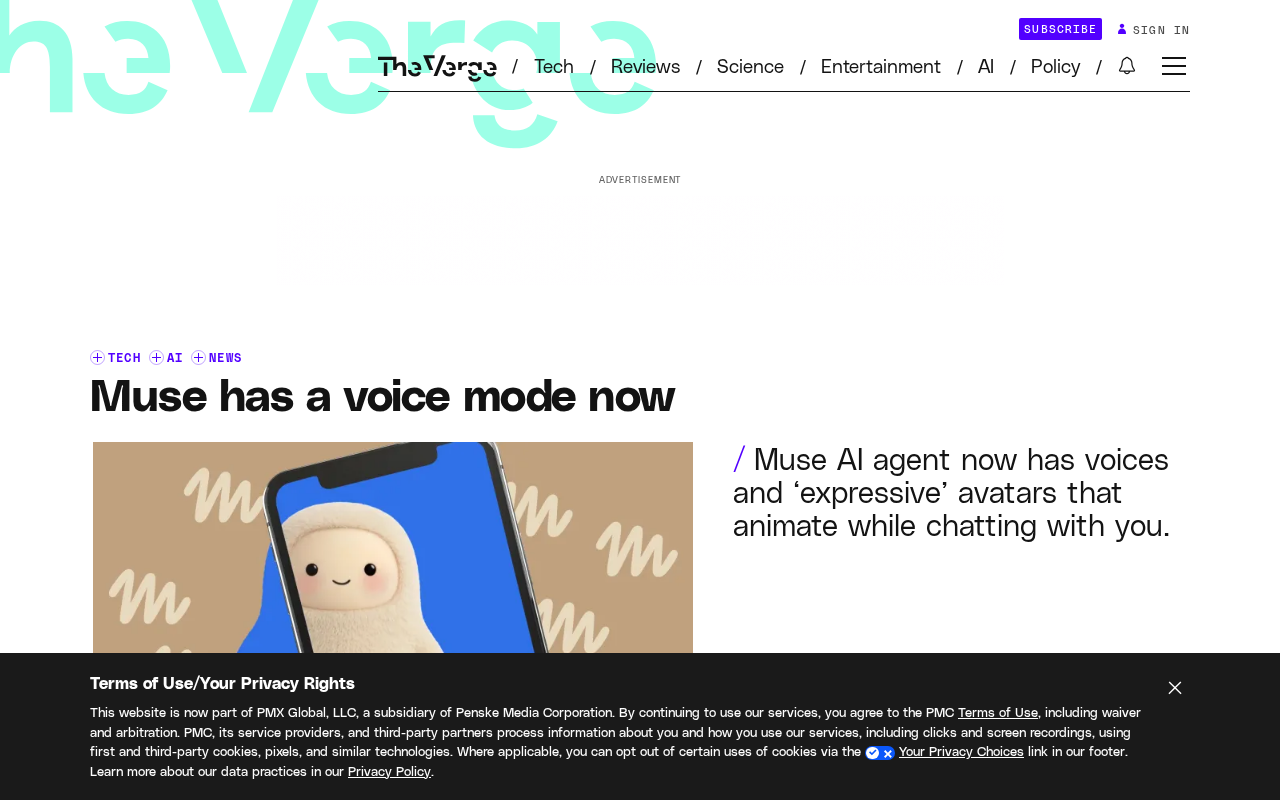
Muse previously interacted with users primarily through text. The addition of voice mode marks a key step forward for Meta in multimodal AI assistant interaction. According to the official description, users can hold real-time voice conversations with the Muse agent, and during the conversation, a virtual avatar at the top of the screen provides synchronized dynamic feedback to enhance the sense of presence.
This change may look simple, but it actually involves the coordination of multiple technology stacks, including speech recognition, natural language understanding, speech synthesis, and real-time rendering. Meta has not disclosed specific technical details, but judging from how smoothly the experience runs, end-to-end latency control has already reached a usable level.
End-to-end latency is a key metric for evaluating real-time voice conversation experiences. It refers to the total time from when the user finishes speaking to when the AI begins responding. In voice assistant scenarios, this latency is typically produced by a chain of components: automatic speech recognition (ASR), natural language understanding (NLU), dialogue management, and text-to-speech (TTS). Under traditional cascaded architectures, independent processing by each module accumulates hundreds of milliseconds or even longer in latency, causing noticeable pauses in conversation turns. To reduce latency, the industry in recent years has moved toward end-to-end or semi-end-to-end large speech models that combine recognition, understanding, and generation into a unified model, eliminating the overhead of intermediate text transcription and module switching. Generally speaking, only when latency is controlled within a few hundred milliseconds do users perceive it as a "natural conversation"; beyond one second, it tends to feel like waiting. The article's mention that "conversation turns basically require no waiting" indicates that Meta has reached a usable level in latency control.
The synchronization of the virtual avatar's lip movements and expressions technically relies on speech-driven animation. The basic approach is to extract acoustic features such as phonemes, pitch, and energy from synthesized speech, then map them through a model to facial bone or BlendShape parameters to drive mouth opening and closing and facial expression changes. Early solutions were mostly based on rules or phoneme-to-viseme mapping, which produced mechanical results; in recent years, neural networks are more often used to predict facial movements directly from audio waveforms, making lip shapes better match speech rhythm. However, the subtlety of emotional expression remains a challenge: the correspondence between tone, stress, and facial expressions in speech is complex, and models often appear stiff when expressing complex emotions such as sarcasm or surprise. This explains the experience described in the article: "lip-sync accuracy is relatively high, but it still looks stiff when expressing complex emotions."
Hands-On Experience: Natural, But Still Room for Improvement
In a brief trial on the iOS app, Muse's voice response speed was impressive, with conversation turns basically requiring no waiting. The synthesized voice sounds natural, with intonation close to a real person. However, recognition accuracy declined somewhat in noisy environments, and context was occasionally lost during continuous conversations.
The virtual avatar's animation is basically synchronized with speech rhythm, and lip-sync accuracy is relatively high, but it still looks stiff when expressing complex emotions. Overall, this is a well-executed feature rollout, but there is still room for optimization before it reaches "seamless conversation."
"Context loss" in continuous conversations is a common engineering problem for voice assistants. Unlike text conversations, voice interaction has no explicit chat history to look back on, so the system needs to maintain dialogue state across multiple voice turns, including entities, intents, and referential relationships mentioned earlier by the user. When speech recognition makes an error, or when the system resets the session after detecting silence, context may break down. In addition, streaming processing of voice data requires the model to begin reasoning before some information is complete, further increasing the difficulty of state management. The industry usually mitigates this problem through session caching, coreference resolution, and explicit context window management, but it is still difficult to avoid entirely in noisy environments or long conversations.
Competitive Landscape: The Voice Assistant Race Heats Up
Meta's move comes as major tech companies accelerate their efforts in voice AI assistants. OpenAI's ChatGPT voice mode and Google Gemini's real-time conversation feature have already launched. The release of Muse voice mode keeps Meta in the game in the AI assistant competition.
You may not have noticed that Meta has a massive social product matrix. If Muse can be deeply integrated with apps such as WhatsApp and Instagram, its user reach would far exceed that of standalone AI apps. Zuckerberg did not mention specific integration plans in the announcement, but this imaginative space should not be ignored.
Gray release (also called canary release) is a progressive rollout strategy in which a new feature is opened only to a small subset of users so that stability, performance, and user feedback can be observed in a real environment before gradually expanding the scope. Compared with a one-time full launch, a gray release can reduce the impact of failures and allow teams to quickly roll back or fix issues found early. For features involving audio capture, real-time inference, and private data processing, such as voice interaction, gray release is especially important: it helps teams evaluate latency performance and recognition accuracy across different devices and network environments while also observing data compliance risks. The article's statement that the feature is "only in gray testing with a subset of users, with no announcement yet on when it will be fully opened" means that Meta is still collecting real-world data to determine the pace of subsequent expansion.
Privacy and Availability
Voice interaction involves processing large amounts of audio data, and privacy protection is a core concern for users. Meta says voice data will follow its existing privacy policy, but it has not detailed how data will be retained or used. In addition, the feature is currently only in gray testing with a subset of users, and no date has been announced for full availability.
For users looking forward to voice assistants, Muse's voice mode offers a new option, but its long-term performance still needs to be tested in more real-world scenarios.
One-line Summary
Meta has launched a real-time voice conversation feature for its Muse AI assistant; the experience is smooth but still has room for optimization.
Paragraph Summary
Meta CEO Mark Zuckerberg announced that the AI assistant Muse has officially launched a real-time voice conversation feature, now in gray testing with a subset of users. In my hands-on experience on the iOS app, voice response speed was impressive, conversation turns basically required no waiting, the synthesized voice sounded natural, and the virtual avatar's lip movements synchronized well with speech rhythm. However, recognition accuracy declined in noisy environments, context was occasionally lost during continuous conversations, and complex emotional expression still looked stiff. The feature involves coordination across multiple technology stacks, including speech recognition, natural language understanding, speech synthesis, and real-time rendering, and Meta has not disclosed technical details. With ChatGPT, Gemini, and others already offering voice modes, Muse's launch keeps Meta in the game, and its potential integration with Meta's social matrix, including WhatsApp and Instagram, is worth watching. On privacy, Meta says it follows existing policies but has not detailed data retention methods, and no date has been set for full availability.
Related articles
 Tech Frontiers
Stylome Bot Slammed as Useless Junk: Why Do AI Detection Tools Keep Failing?
Reddit users test the Stylome AI detection bot: Gemini-rewritten text judged human-written, consistently low confidence. An analysis of AI text detection's technical dilemmas, privacy concerns, and credibility crisis in community governance.
 Tech Frontiers
When AI Becomes a Productivity Divide: Clarity or "AI Psychosis"?
A civil engineer's deep use of agentic AI boosted efficiency but bred contempt for peers who refuse to learn. Is this clarity or AI psychosis? An analysis of the cognitive and psychological challenges behind the AI productivity divide.
 Tech Frontiers
Opus 5.5 Benchmark Scores Climb, Community Says Its "Weights Are Blessed"
Reddit community discusses Opus 5.5's rising scores on the Benchmaxxing Bench, with users describing its performance as "weights are blessed." This article interprets the community reaction and cautions against conflating benchmark scores with real capability.