Meta Open-Sources ASTRIX Design System: Stop AI Agents from Reinventing the Button
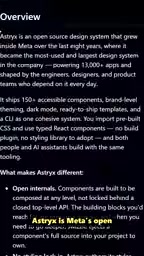
Meta's open-source ASTRIX design system has 150+ components, letting AI agents and developers read the same docs.
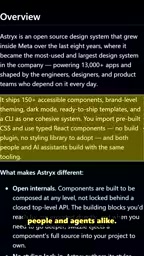
ASTRIX is Meta's open-source design system with over 150 components, whose key feature is treating AI coding agents as equal readers alongside human developers. To address agents repeatedly writing button styles from scratch, ASTRIX lets both read the same documentation: no plugin build required—import CSS and add a theme Provider, and agents can produce spec-compliant interfaces. For integration, one CLI install lets every coding agent on your machine recognize ASTRIX, reducing multi-tool maintenance. Styling isn't locked to a tech stack—it supports Tailwind, CSS Modules, plain CSS themes, and CSS variable overrides. MIT licensed with 22,000+ stars, it represents a new idea: tools that adapt to both humans and agents.
Why Do AI Agents Keep Reinventing the Button?
If you've used an AI coding assistant, you've probably seen this scenario: ask it to add a button, and it writes CSS from scratch, tunes spacing, and picks colors. Ask for another button next time, and it starts all over again. The problem isn't that the model isn't smart enough—it's that it lacks a stable, reusable design system it can actually read and understand. Meta's open-source ASTRIX is aimed squarely at this pain point.
According to a YouTube channel introduction, ASTRIX is Meta's open-source design system, containing over 150 components, with a clear positioning—serving both people (developers) and agents (AI coding agents). This dual-audience positioning is what most distinguishes it from traditional component libraries.
A design system is a collection of reusable component libraries, design tokens (base variables like color, spacing, and typography), and usage guidelines, intended to keep interfaces across a product visually and interactively consistent. Traditional design systems (such as Material Design and Ant Design) are mainly aimed at human developers and designers, with documentation presented as text and images. AI coding agents face a particular difficulty: they can usually only read code through a limited context window, and if a component library's documentation is separated from its implementation, or lacks machine-parseable structured descriptions, the agent cannot reliably determine "which component should be reused"—so it tends to generate styles from scratch, causing duplicated effort and UI drift. This is why "agent readability" is increasingly seen as a new metric for design systems.
ASTRIX's Core Design: Let Agents Read the Same Documentation
Traditional design system documentation is written for humans, and AI agents either can't understand it or read a version that doesn't match the actual code. ASTRIX's approach is to have agents read the same documentation as you. According to the video, usage is quite lightweight: no plugin build required—import some CSS, add a theme Provider, and agents can produce interfaces that conform to the design spec based on the documentation.
This means agents no longer need to "guess" design intent—they have something to go on. The same button component is invoked per the documentation by human developers and by agents alike, greatly improving output consistency. For team collaboration, this can significantly reduce UI style drift.
A theme Provider is a common pattern in front-end frameworks like React: it injects theme variables (such as color, border radius, and font size) into the component tree via context, so child components can read them without passing props down through every level. For AI agents, the presence of a Provider means style sources are centralized and predictable—the agent only needs to mount it once at the root node, and style values inside components are uniformly determined by the theme, rather than being hard-coded in each component. This is also the technical basis for ASTRIX's emphasis that "importing CSS plus adding a Provider is enough": it consolidates theme configuration into a single entry point, reducing the complexity for agents to understand and modify styles.
Install the CLI Once, and Every Coding Agent on Your Machine Knows ASTRIX
ASTRIX makes a smart trade-off in engineering integration: according to the video, you only need to install the CLI once, and every coding agent on your machine can recognize ASTRIX. This solves a real-world problem—developers often use multiple AI coding tools at once, and if each tool requires separately configuring component library context, maintenance costs are high. Install once, effective globally, lowering the barrier to adoption.
From a toolchain perspective, this step turns the "design system" from a human-only asset into infrastructure that agents can consume. When generating code, agents will prioritize the existing 150+ components rather than reinventing the wheel each time.
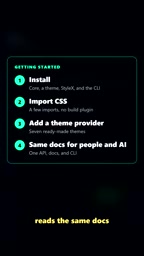
The CLI (command-line interface) here does more than install dependencies—it likely registers the component library's metadata or documentation index with local AI coding tools, so agents can retrieve ASTRIX's component list and usage when generating code. Similar mechanisms have emerged in recent years in standards like MCP (Model Context Protocol): through a one-time local configuration, multiple agent clients share the same set of tools and knowledge sources. This "install once, effective globally" idea essentially elevates the component library from a project-level dependency to machine-level context, avoiding pasting documentation repeatedly into each AI tool or maintaining multiple prompts.
No Constraints on Styling: Tailwind, CSS Modules, or Plain CSS
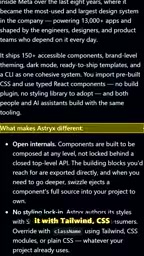
ASTRIX doesn't mandate a particular styling approach. According to the video, you can customize styles with Tailwind, CSS Modules, plain CSS themes, or by directly overriding CSS variables. This flexibility is friendly to teams with existing tech stacks—no need to rebuild your styling system just to use a design system.
Overriding CSS variables is especially lightweight, suitable for theme switching or brand customization. For AI agents, variable-based styles are also easier to understand and modify, reducing the likelihood of agents generating hard-coded style values.
Open-Source License and Community Response
ASTRIX uses the MIT license, and according to the video, the project has received over 22,000 stars. The MIT license means commercial projects can use and modify it with confidence, which is critical to a design system's adoption rate. Twenty-thousand-plus stars also suggests that developers have real demand for the concept of an "agent-oriented design system."
Looking at industry trends, AI coding tools are evolving from "able to write code" to "writing code that conforms to standards." Design systems are an important vehicle for putting standards into practice, and ASTRIX's design with agents as first-class citizens represents a new way of thinking: rather than making agents adapt to human tools, make tools adapt to both humans and agents.
What It Means for Developers in Practice
If you're using AI agents for front-end development, there are three things worth noting about ASTRIX: broad component coverage (150+), low integration cost (no plugin build, one-time CLI install), and flexible styling options (no tech stack lock-in). It may not suit every project, but for teams that want agents to produce more consistent UIs, it's a low-risk open-source option.
Longer term, the "agent readability" of design systems may become a new evaluation criterion. ASTRIX's exploration in this direction is worth watching.
Related articles
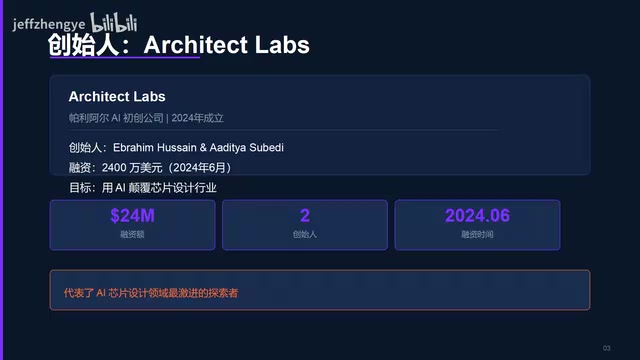
AI Independently Designs CPU Architecture 'Frostbite': 4.59x Energy Efficiency Boost
AI independently designed the complete CPU architecture Frostbite, achieving 4.59x better energy efficiency and 8.77x better performance per unit area. This article analyzes Architect Labs' technical path, five-step design flow, foreign media commentary, and current limitations, exploring the potential impact of AI chip design on Intel, AMD, and the RISC-V ecosystem.
Meta's Your Algorithm: Reshaping Recommendation Ranking with Natural Language
Meta reveals technical details of Facebook's "Your Algorithm": users describe interests in natural language, and the system uses LLM validation, 4-channel retrieval, layered filtering, and a fine-tuned LLM re-ranker to turn preferences into Feed and Reels ranking signals.

Huawei Found Liable for Trade Secret Theft: A New Legal Flashpoint in US-China Tech Rivalry
A jury found Huawei liable for stealing US trade secrets involving T-Mobile and Cisco source code. This analysis examines the legal, business, and geopolitical implications and compliance lessons for Chinese tech firms.