Microsoft AI Frontiers Team Disbanded: The Research Shift Behind John Langford's Departure

Microsoft Research's AI Frontiers team has been disbanded and core researcher John Langford has departed, sparking widespread discussion about the survival space of big tech's basic research divisions.
Microsoft Research's AI Frontiers team, focused on frontier AI exploration, has reportedly been disbanded, and renowned longtime Microsoft researcher John Langford has departed, with the news drawing 234 points and 133 comments on Hacker News. AI Frontiers undertook exploratory, long-horizon topics; the team's disbanding coinciding with its key figure's departure is seen as a signal of organizational strategy adjustment. HN discussion focuses not on the individual's destination but on the tightening evaluation logic of big tech research divisions—basic research requires tolerance for failure and uncertainty, yet organizations under commercialization pressure struggle to sustain such patience. The article further notes this is not an isolated case: research organizations at several tech giants are contracting, purely exploratory teams are being merged into product divisions, and research budgets are tilting toward what can be implemented and quantified.
Microsoft Research's AI Frontiers team, which focused on frontier AI exploration, has reportedly been disbanded, with core researcher John Langford confirming his departure. The news sparked widespread discussion on Hacker News, garnering 234 points and 133 comments, reflecting heightened outside attention to the fate of big tech's basic research divisions.
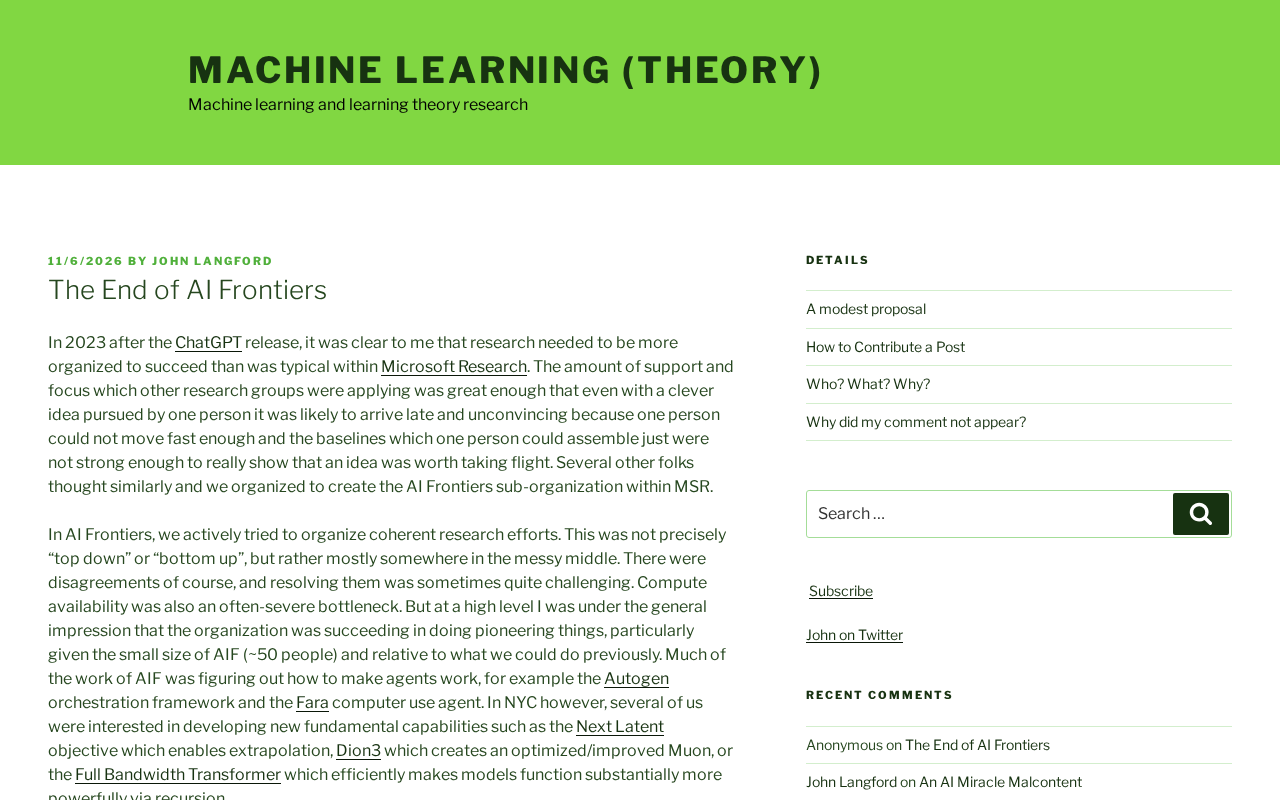
The End of a Frontier Research Group
According to Business Examiner, Microsoft Research's AI Frontiers team has been officially disbanded, and the well-known researcher John Langford, a longtime Microsoft employee, has departed as a result. The relevant page preserved by Archive.today and the HN discussion thread together form the main sources of information for this event.
AI Frontiers was tasked within Microsoft's research system with exploratory, long-horizon AI topics rather than short-term projects directly serving product lines. Langford has long-standing credentials in machine learning, and his personal moves are often seen as a bellwether for the team's direction. When a team named after the "frontier" is disbanded and its key figure chooses to leave, it is hard for outsiders not to connect this with organizational strategy adjustments.
Among the 133 comments in the HN thread, many voices pointed to the tightening evaluation logic of research divisions at large tech companies—basic research requires tolerance for failure and uncertainty, and organizations under commercialization pressure often find it hard to sustain such patience.
Microsoft Research (MSR), founded in 1991, is one of the largest corporate research institutions in the world, comprising multiple laboratories and interdisciplinary teams and long supporting basic research in computer science, artificial intelligence, and other fields. Unlike product divisions, MSR researchers typically enjoy greater freedom in choosing topics, with outputs mainly consisting of papers, open-source tools, and academic collaborations. AI Frontiers belongs to a frontier team within the MSR system that leans toward exploratory, long-horizon topics; such teams often do not directly bear product delivery metrics, and their value is reflected more in technology reserves and talent attraction. Understanding this special positioning of MSR within Microsoft helps grasp the organizational meaning behind the phrase "the team was disbanded"—it usually means a reallocation of resources from exploratory research to product-oriented R&D, rather than a simple natural termination of a project.
Why Langford's Departure Deserves Attention
The departure of a single researcher usually isn't news, but Langford's departure coinciding with the team's disbanding makes it a different matter.
In the machine learning community, Langford has long been active at the intersection of academia and industry, with a working style that leans open and frequently engages with the community. The value of such researchers lies not only in producing papers but also in maintaining the channel between companies and the academic ecosystem. When such a role leaves, what is often affected is a team or even the research culture of a direction, not just a specific project.
Judging from the tone of the HN discussion, the community cares less about "who left" and more about "why they left." The phrase "the team was disbanded" itself carries a passive connotation, suggesting the decision came from a higher-level resource reallocation rather than the researcher's personal career choice.
John Langford is a well-known researcher in machine learning who has long served at Microsoft Research and has deep expertise in online learning, reinforcement learning, and large-scale machine learning systems. One of his identities most familiar to the community is as the primary maintainer of the open-source machine learning project Vowpal Wabbit, which is widely used in industrial fast online learning scenarios. In addition, Langford has long been active in organizing academic conferences and community exchanges, and his research style emphasizes open collaboration and close integration with industrial practice. For this reason, his departure is not only a personal career change but is also seen as a signal of a change in Microsoft's willingness to invest in exploratory AI research—such bridge-type researchers, who combine academic influence with engineering implementation capability, are often key nodes for the cultural cohesion of a research team.
The Common Predicament of Big Tech Research Divisions
The fate of AI Frontiers is not an isolated case. In recent years, the research organizations of several tech giants have been undergoing similar contraction and restructuring: purely exploratory teams are merged into product divisions, research budgets tilt toward what can be implemented and quantified, and long-horizon topics give way to projects that can quickly build competitiveness.
This shift has its practical logic. Competition in generative AI has entered a white-hot stage, and the costs of compute and talent have risen sharply, pushing companies to concentrate resources on areas that can be directly converted into product advantages. But the cost is also obvious—basic research directions that require years of accumulation and show no short-term returns tend to rank lower in resource allocation.
It is worth distinguishing "research" from "R&D." The former pursues the advancement of the boundaries of knowledge, while the latter serves clear product goals. When organizations measure the former by the standards of the latter, the survival space for frontier research teams is naturally compressed. The disbanding of AI Frontiers can be seen as a concrete manifestation of this logic within Microsoft.
What It Means for the AI Research Ecosystem
The contraction of corporate research divisions will push some research talent toward universities, open-source communities, or startups. This is not necessarily a bad thing, but the ecosystem structure will change: big tech was once one of the few places that could simultaneously provide compute, data, and freedom, and the narrowing of this space means certain types of research will find it harder to find a home.
For individual researchers, choices require more trade-offs—whether to stay within the system and accept clearer goal constraints, or to move to a freer environment with more dispersed resources. Langford's choice may only be the beginning.
For industry observers, the end of AI Frontiers provides an observation window: in the second half of the AI race, how much cost are tech giants willing to pay for "uncertainty." The answer to this question will profoundly affect the output landscape of basic research in the coming years.
One-line Summary
Microsoft Research's AI Frontiers team has been disbanded, with core researcher John Langford departing, sparking widespread discussion about the survival space of big tech's basic research divisions.
Paragraph Summary
Microsoft Research's AI Frontiers team, which focused on frontier AI exploration, has reportedly been disbanded, and the well-known longtime Microsoft researcher John Langford has departed as a result. The news garnered 234 points and 133 comments on Hacker News. AI Frontiers undertook exploratory, long-horizon topics; the team's disbanding coinciding with the departure of its key figure has been interpreted by outsiders as a signal of organizational strategy adjustment. The focus of discussion in the HN community is not the individual's destination but the tightening evaluation logic of research divisions at large tech companies—basic research requires tolerance for failure and uncertainty, yet organizations under commercialization pressure struggle to sustain such patience. The article further notes that this is not an isolated case: research organizations at several tech giants are contracting, purely exploratory teams are being merged into product divisions, and research budgets are tilting toward what can be implemented and quantified.
Related articles
 Tech Frontiers
MuJoCo: An Analysis of DeepMind's Open-Source General-Purpose Physics Simulator
An in-depth analysis of Google DeepMind's open-source physics simulator MuJoCo: high-performance C++ kernel, MJCF modeling format, contact solving principles, MJX GPU acceleration, and robot reinforcement learning use cases.
 Tech Frontiers
Claude API Quick Start: The Official Quickstarts Project Collection
Anthropic's official claude-quickstarts project collection helps developers quickly build deployable apps with the Claude API. Nearly 20k stars, Python-based, great for beginners and prototyping.
 Tech Frontiers
AI Agents Connecting Directly to APIs: Which Calls Can Be Safely Allowed?
AI agents can call any API, but the real challenge is deciding which calls can be safely allowed. This article analyzes allowance decisions from three dimensions—intent matching, least privilege, and controllable impact—and argues that the control layer should sit outside the agent, combined with audit traceability to build a trustworthy API call governance mechanism.