Microsoft Breaks Revenue Records for 10 Consecutive Quarters: AI Dividends Still Paying Off

Microsoft's quarterly revenue hit $92.3 billion, up 19% year-over-year, with ten consecutive record quarters as AI commercialization continues to pay off.
Microsoft's latest earnings report shows quarterly revenue of $92.3 billion, up 19% year-over-year, marking the tenth consecutive quarter of record revenue. This growth rate is uncommon for a mature tech company of its size, indicating that its growth curve has not slowed due to expansion. Azure cloud services and AI-related businesses are seen as the core drivers. Microsoft's AI commercialization has broadly followed a path of "infrastructure first, application layer follows," first承接 training and inference compute demand, then embedding AI capabilities into mature product lines such as Office and GitHub to create subscription increments. Strong revenue provides positive feedback for massive capital expenditure and also signals to the market that enterprise AI procurement has entered常规 budgets, though long-term investment returns still need to be verified in subsequent quarters.
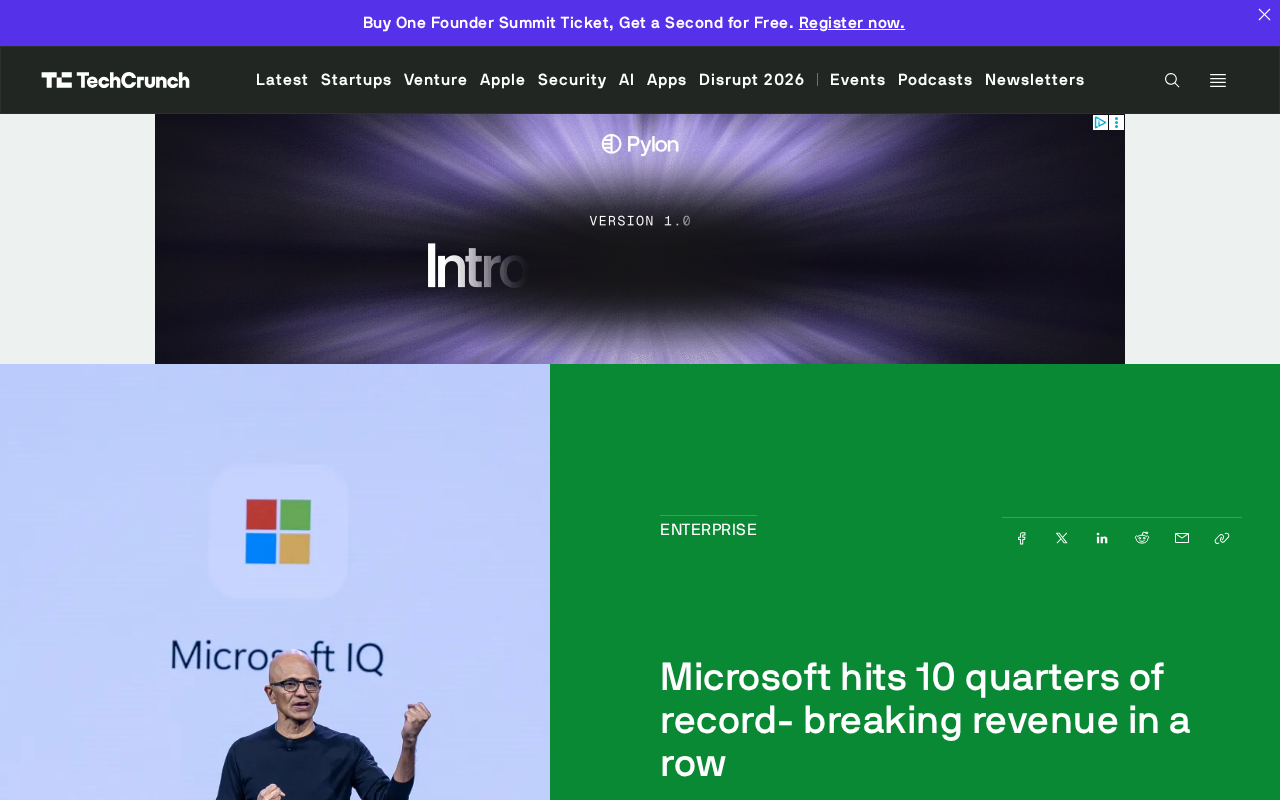
Microsoft has once again delivered a record-breaking quarterly earnings report. According to its latest results, quarterly revenue reached $92.3 billion, up 19% year-over-year—marking the tenth consecutive quarter of record revenue for the company. However heated the debate over an AI bubble may become, at least judging from Microsoft's books, the commercial returns from AI are still being realized.
What $92.3 Billion Means
A single quarter of $92.3 billion with 19% year-over-year growth is uncommon for a company of Microsoft's size. Once large tech companies reach maturity, revenue growth typically settles into the single digits. The fact that Microsoft has set new records for ten straight quarters shows that its growth curve has not noticeably flattened as its scale has expanded.
Behind this figure, Azure cloud services and AI-related businesses are the core narrative. Microsoft has repeatedly emphasized over the past several quarters that demand for AI infrastructure and Copilot-style products is the main driver of its revenue growth. Although the information disclosed this time does not break down data by business segment, the overall 19% growth rate is enough to show that enterprise demand for AI compute and tools has not yet peaked.
Azure and Intelligent Cloud are the key to understanding Microsoft's revenue structure. Azure is Microsoft's public cloud platform, offering compute, storage, databases, AI inference, and other services, and belongs to the "Intelligent Cloud" segment; alongside it are "Productivity and Business Processes" (including Office, Dynamics, and LinkedIn) and "More Personal Computing" (including Windows, gaming, and search advertising). The overall revenue growth rate in the earnings report is a weighted result across the three segments, so the 19% figure cannot be directly equated with Azure's growth rate. Historically, Azure's growth rate has usually been higher than the company's overall rate, while mature businesses such as Office have grown at rates close to single digits—this structural difference is precisely why Microsoft emphasizes "cloud and AI-driven growth."
Copilot is Microsoft's umbrella brand for embedding large-model capabilities into its product lines, covering GitHub Copilot (code completion), Microsoft 365 Copilot (office scenarios such as Word, Excel, and Teams), and vertical versions for security, sales, and other areas. Its business model is per-seat subscription, a typical incremental revenue source that complements usage-based cloud consumption.
The Rhythm of Ten Consecutive Record Quarters
Ten consecutive quarters of record results—the time span itself deserves attention. It means Microsoft's growth is not a short-term pulse over one or two quarters, but a relatively stable upward curve. For a company whose revenue base is already so large, maintaining this continuity says more than a single-quarter surge.
In terms of rhythm, Microsoft's AI commercialization path has broadly followed the logic of "infrastructure first, application layer follows": first承接 training and inference demand through its cloud platform, then embedding AI capabilities into mature product lines such as Office, GitHub, and Dynamics to create subscription-based incremental revenue. The advantage of this approach is that even if demand in one link fluctuates, other links can provide a buffer.
Balancing AI Investment and Returns
The other side of record revenue is Microsoft's massive capital expenditure on AI infrastructure. The market is scrutinizing the AI input-output ratio of tech giants more strictly—revenue growth may look good, but investors also care whether that growth is enough to cover data center and compute costs.
The core information Microsoft disclosed this time is the strong performance on the revenue side. The 19% growth provides positive feedback for AI investment: at least for now, demand-side growth is fast enough to support supply-side expansion. This is also a key difference between Microsoft and other companies still searching for a path to AI monetization—it has already converted AI demand into measurable subscription and cloud consumption revenue.
Capital expenditure (CapEx) in the context of tech giants mainly refers to spending on data center construction, GPU/in-house chip procurement, and power and network infrastructure. Such investment is not directly expensed in the current period on financial statements, but is gradually amortized over future years through depreciation, so rising capital expenditure often shows up first in cash flow and depreciation before affecting profit margins. For Microsoft, its partnership with OpenAI makes it both a buyer of model capabilities and a provider of compute resources, so the recovery path for its AI investment includes both external cloud sales and internal product value enhancement. To judge the input-output ratio, the industry typically watches whether the gap between capital expenditure growth and cloud business revenue growth is narrowing.
Signal Significance for the Industry
Microsoft's results are often seen as a bellwether for enterprise AI demand. Ten consecutive quarters of record results send a relatively clear signal to the market: enterprise customers' purchases of AI are not conceptual hype, but常规 spending that has already entered budget sheets. This is a positive reference for the entire AI industry chain—from chips to model services to the application layer.
Of course, a single quarter's earnings report cannot answer all questions about AI's long-term returns. Whether growth can continue, when capital expenditure will enter a more efficient payback period, and how deep the paid conversion of Copilot-style products will be—these still need to be verified by data in subsequent quarters. But for now, Microsoft has used a report card of $92.3 billion in revenue, up 19% year-over-year, to provide a rather optimistic footnote to the question of "whether AI is worth investing in."
The key difference between enterprise AI demand and consumer AI lies in the procurement decision mechanism: enterprise customers typically go through budget approval, security and compliance assessment, and pilot validation, and once something enters the annual budget it tends to have strong continuity. Therefore, what Microsoft's results reflect is not one-off trial demand, but procurement behavior that has already solidified into recurring expenditure. For this reason, its earnings reports are regarded as an important window for observing the AI industry's transition from an "investment phase" to a "harvest phase," especially as a reference for upstream chipmakers and downstream application developers.
One-line Summary
Microsoft's quarterly revenue reached $92.3 billion, up 19% year-over-year, marking ten consecutive record quarters as AI commercialization continues to pay off.
Paragraph Summary
Microsoft's latest earnings report shows quarterly revenue of $92.3 billion, up 19% year-over-year, marking the tenth consecutive quarter of record revenue. This growth rate is uncommon for a mature tech company of its size, indicating that its growth curve has not slowed due to expansion. Azure cloud services and AI-related businesses are seen as the core drivers. Microsoft's AI commercialization has broadly followed a path of "infrastructure first, application layer follows," first承接 training and inference compute demand, then embedding AI capabilities into mature product lines such as Office and GitHub to create subscription increments. Strong revenue provides positive feedback for massive capital expenditure and also signals to the market that enterprise AI procurement has entered常规 budgets, though long-term investment returns still need to be verified in subsequent quarters.
Related articles

Gemini 4 Carbon Hands-On: The Strongest AI Model? Compared with Claude Opus 5.5
Google's Gemini 4 Carbon tops the Artificial Analysis leaderboard with 71% on CW Bench and leads Vending Bench. Hands-on comparison with Claude Opus 5.5: stunning front-end design but slightly behind in web development, with a clear price advantage.

Gemini 4 Carbon Tops Global Rankings as AI Productivity and Open-Source Ecosystems Surge
Google DeepMind's Gemini 4 Carbon tops global benchmarks, built for complex agents and system security. ByteDance launches Doubao Work integrated with Feishu, Anthropic's AI autonomously breaches 5 system-level attack chains, and ModelBest and Fudan open-source on-device multimodal and image generation models.

Overseas Creator Breaks Down N8n AI Agent Business Playbook: From Tooling to Monetization
An overseas creator breaks down the N8n AI agent business playbook: comparing Zapier, Make, and N8n, detailing four monetizable automation categories—lead capture, WhatsApp follow-up, booking, and content pipelines—plus agency pricing and a sales playbook.