Microsoft Kills Copilot on TVs: The Dream of an AI Assistant on Smart TVs Falls Apart

Microsoft will end all TV-side Copilot support this year, with the partnership exiting in less than two years.
According to Windows Central, Microsoft will terminate support for all TV-side Copilot features this year, less than two years after LG and Samsung announced integration at CES 2025, and none of the three parties has officially responded. The article argues that TV-side AI assistants face structural challenges such as inefficient remote-control interaction and fragmented usage scenarios, and the deeper reason is that TV manufacturers want to use AI to raise hardware premiums while Microsoft wants to expand terminal coverage, leading to inconsistent expectations for input-output ratios; the feature neither built user stickiness nor brought commercial returns. Microsoft's exit does not mean an overall retreat of TV AI, but it shows that directly porting a general assistant to TVs is not a smooth path. The author believes this reflects a shift in AI assistant competition toward high-frequency entry points such as phones, PCs, and office work, and that the correct form of TV AI-ization should be underlying capabilities integrated into content discovery and picture quality optimization.
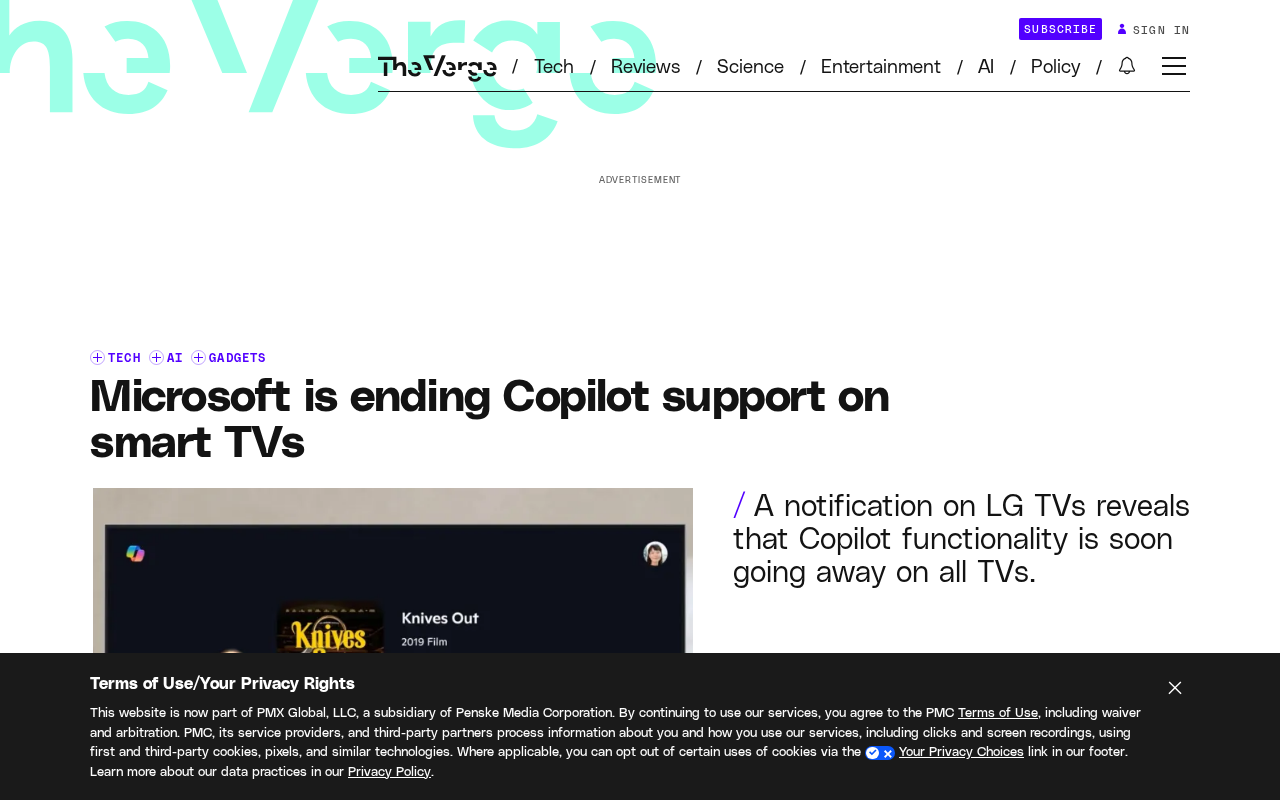
According to Windows Central, Microsoft will end support for all TV-side Copilot features this year. This decision comes less than two years after LG and Samsung announced at CES 2025 that their latest smart TVs would integrate Copilot. The news did not come from an official announcement by LG, Samsung, or Microsoft, but rather leaked through media reports, drawing a close to this brief marriage between smart TVs and AI assistants.
From High-Profile Partnership to Quiet Exit
At CES 2025, LG and Samsung promoted Copilot integration as one of the highlight features of their new TVs. Users expected to be able to invoke Microsoft's AI assistant directly through the TV remote to handle content recommendations, information queries, and other interactions. However, the lifecycle of this feature was far shorter than outsiders expected. Windows Central's report noted that Microsoft will stop providing Copilot support on TVs this year, but did not disclose a specific termination timeline or transition plan.
Currently, LG, Samsung, and Microsoft have all made no official response to the matter. This silence itself also indicates that TV-side Copilot has significantly dropped in strategic priority for both sides.
CES (Consumer Electronics Show) is one of the world's largest consumer electronics technology exhibitions, held every January in Las Vegas. For TV manufacturers, CES is the most important stage for launching annual products and showcasing technology roadmaps, and partnerships announced there often carry strong PR and symbolic significance—but there is often a time gap between booth demonstrations and actual mass-production features. LG and Samsung's high-profile promotion of Copilot integration at CES 2025 was a typical case of "trade-show hype," and its actual rollout pace, covered models, and feature completeness often depended on subsequent commercial negotiations, which partly explains why the cycle from announcement to exit appears especially short.
Why TV-Side AI Assistants Struggle to Gain a Foothold
TV-side AI assistants face several structural challenges. The first is the limitation of interaction methods: voice input via remote control is inefficient and far less natural than the keyboard-plus-touch combination on phones or computers. The second is the fragmentation of usage scenarios: users' core need in front of the TV is content consumption, not multi-turn conversations or complex task processing.
The deeper reason lies in the business model. TV manufacturers hope AI features can increase hardware premiums, while Microsoft hopes Copilot can cover more terminals to expand its user base. When the two sides' expectations for input-output ratios are inconsistent, the partnership becomes difficult to sustain. TV-side Copilot neither built sufficient user stickiness nor brought considerable commercial returns to either side.
Copilot is Microsoft's general-purpose AI assistant brand built on large language models. Its predecessor was Bing Chat, and it was uniformly renamed Copilot starting in 2023 and gradually embedded into Windows, the Edge browser, Microsoft 365, and mobile apps. Its product positioning is a cross-terminal "general conversational entry point," relying on cloud-based large-model inference, so every interaction incurs inference costs. This means that terminal installation volume itself does not directly generate revenue; only when users form high-frequency usage and convert to subscriptions (such as Copilot Pro) or drive other Microsoft services can costs be covered. TV-side users' usage frequency and willingness to pay are far lower than those in PC and office scenarios, which is the key context for evaluating the economics of this partnership.
Impact on Smart TV AI Features
Microsoft's exit does not mean an overall retreat of TV-side AI features. Samsung and LG are still advancing their own voice assistants and AI picture quality engines, and some manufacturers are also exploring localized recommendation capabilities based on large models. But the Copilot case shows that directly porting a general-purpose AI assistant to TVs is not a smooth path.
For users who have already purchased related TVs, what they care about most is the alternative solution after the feature ends. The report did not mention whether Microsoft will provide migration tools or compensation measures, and users may need to switch to the voice assistants built into their TVs.
TV manufacturers' built-in voice assistants (such as Samsung Bixby and LG's ThinQ AI) differ significantly from general assistants like Copilot in their technical paths. The former mainly target device control, channel switching, and limited information queries, and are mostly intent-recognition-based narrow-task systems with low operating costs and fast responses; the latter rely on large-scale cloud models for open-ended dialogue, offering stronger capabilities but at higher cost. In addition, "AI picture quality engines" on TVs in recent years mostly refer to real-time image processing based on traditional machine learning models (such as scene recognition, noise reduction, and super-resolution), usually running on local chips, and are not the same type of technology as cloud-based large-model assistants. Understanding this distinction helps judge which layer of capability manufacturers mean by "AI TV."
Editorial View
This adjustment reflects that competition among AI assistants has entered a new stage: manufacturers are no longer pursuing "everywhere" coverage, but focusing on high-frequency interaction entry points such as phones, PCs, and office scenarios. As the center of home entertainment, the correct form of TV AI-ization may not be attaching a general assistant externally, but deeply integrating AI capabilities into underlying experiences such as content discovery and picture quality optimization. Microsoft's contraction of its TV-side front line is a rational strategic trade-off.
For readers interested in the real-world application of AI, this event reminds us that the success of AI features depends not only on technical capability, but also on scenario fit and a closed commercial loop.
One-line Summary
Microsoft will end all TV-side Copilot support this year, with the partnership exiting in less than two years.
Paragraph Summary
According to Windows Central, Microsoft will terminate support for all TV-side Copilot features this year, less than two years after LG and Samsung announced integration at CES 2025, and none of the three parties has officially responded. The article's analysis suggests that TV-side AI assistants face structural challenges such as inefficient remote-control interaction and fragmented usage scenarios, and the deeper reason is that TV manufacturers hope to use AI to increase hardware premiums while Microsoft hopes to expand terminal coverage; the two sides' expectations for input-output ratios are inconsistent, and the feature neither built user stickiness nor brought commercial returns. Microsoft's exit does not represent an overall retreat of TV AI, but it shows that directly porting a general assistant to TVs is not a smooth path. The author believes this reflects a shift in AI assistant competition toward high-frequency entry points such as phones, PCs, and office work, and that the correct form of TV AI-ization should be underlying capabilities integrated into content discovery and picture quality optimization.
Related articles

Vibe Coding Full-Stack in Practice: AI Programming from Beginner to Enterprise Deployment
From Cursor to Claude Code, this Bilibili AI programming course uses four progressive projects to cover full-stack development, open-source secondary development, and team collaboration. The article analyzes the shock to frontend roles, the efficiency shift from 50 people to 5, and the methodology required for enterprise-grade projects.

David Blaine's Global Quest for Real Magic: From South Africa to Japan and India
David Blaine travels to South Africa, Japan, and India in his Do Not Attempt special, documenting Spinning drivers, black mamba rescuers, iaijutsu masters, and ascetics—exploring the boundary between magic and real human极限 challenges.

Is a Touchscreen MacBook Coming? Vergecast Reveals Apple Executive's Response
Vergecast podcast reveals a conversation between a reporter and Apple executive John Ternus about a touchscreen MacBook and Apple Pencil support. Ternus says iPad is the best device for a stylus, while the reporter bets MacBook will eventually support Apple Pencil.