Microsoft Outage Accidentally Boosts LibreOffice: Record-Breaking 1,000+ Donations in a Single Day

Microsoft outage triggers over 1,000 LibreOffice donations, reflecting a collective rethinking of cloud dependency and data sovereignty.
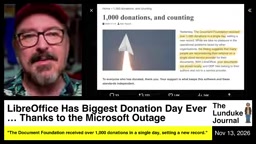
After a prolonged outage of Microsoft Outlook and other services, The Document Foundation behind LibreOffice received over 1,000 donations on November 13, setting a record. The foundation noted in measured terms that the timing suggests many people are reconsidering their dependence on a single cloud provider, emphasizing that LibreOffice stores documents locally and ODF files belong to their authors. The video's author further analyzes that any cloud service outage is inevitable, and long-term stability creates the comfortable illusion that "it will always work," leading people to over-concentrate critical documents in online services. The author borrows the "scream test" concept to show that the Microsoft outage was a society-wide stress test of backup strategies, exposing gaps in everyone's backup plans. The deeper lesson is that not only documents but also operating systems and applications should maintain 100% offline capability to avoid system paralysis from API changes or service termination. The author does not reject online services but advocates enjoying online convenience while keeping critical parts offline-available and easy to back up.
A "Vote with Your Feet" Triggered by an Outage
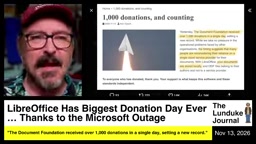
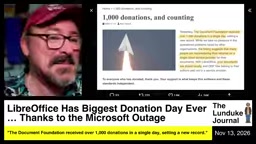
Last week, a prolonged outage of Microsoft Outlook and several other services gave many users their first real taste of what happens when cloud services are unavailable: they couldn't even open their documents or email. According to analysis by a YouTube tech channel, this failure directly set off a chain reaction—The Document Foundation, the organization behind LibreOffice, received over 1,000 donations on November 13 alone, setting an all-time record.
The Document Foundation struck a measured tone in its announcement: "We do not take schadenfreude in the operational problems of other organizations, but the timing suggests that many people are reconsidering their dependence on a single cloud service provider for storing documents." They also emphasized that LibreOffice stores documents locally, and that ODF files belong to their authors, not to a service provider.
This isn't simple "competitor piggyback marketing"—it's a collective shift in user mindset: when online services are running normally, people easily fall into the comfortable illusion that "it will always work"; an outage is like a wake-up call, forcing everyone to re-examine their data sovereignty.
LibreOffice is a free and open-source office software suite that includes word processing, spreadsheets, presentations, and other components, maintained by The Document Foundation. It natively uses ODF (Open Document Format) as its default file format; ODF is an open standard certified by the International Organization for Standardization (ISO), standing alongside Microsoft Office's OOXML format. "Open standard" means the file format specification is publicly available for anyone to inspect, and any software can implement reading and writing without being controlled by a single vendor. Therefore, when users save documents as ODF, the file content doesn't depend on a particular cloud service or software version—as long as there's a local program that supports ODF, the file can be opened, edited, and backed up at any time. This is precisely the technical foundation behind the Document Foundation's emphasis that "documents belong to their authors."
The "Comfort Trap" of Cloud Services: Why Outages Are Inevitable
The video's author put it bluntly in the analysis: no matter how excellent the engineers, how open the technical architecture, how comprehensive the power redundancy, any server, any cloud provider, any data center will always go down at some point—it could be a brief interruption, a prolonged failure, or permanent shutdown; there may or may not be data loss.
The reasons are varied: power outages, tornadoes, floods, disgruntled employees, accidentally flipped switches... no exceptions.
The problem is that long-term stable operation lulls people into complacency. The longer and more smoothly we use them, the more critical documents we put into Microsoft 365 or Google Drive, and the more we trust these services. The video's author uses a vivid metaphor to describe this psychology: "You start to think, oh, it'll always be fine."—until it isn't.
A Cautionary Tale from Gamers
This risk isn't unique to office scenarios. The video mentions that console gamers have repeatedly experienced similar situations for years: games on Xbox, PlayStation, or Switch can disappear, stop working, or even become impossible to re-download due to old storefronts shutting down, licenses expiring, or other reasons. What you purchased may not truly belong to you.
These moments are precious precisely because they remind people that offline backup of software, data, documents, and photos is far more valuable than imagined.
High availability of cloud services is typically achieved through redundancy design: multi-availability-zone deployment, multiple data replicas, load balancing, automatic failover, and so on. The SLA (Service Level Agreement) that providers promise often states "99.9%" or even "99.99% uptime," but this only means cumulative annual downtime is limited to a few hours or tens of minutes—it does not mean "never goes down." More importantly, SLAs usually only provide service credits, not compensation for business losses, nor do they guarantee data recovery. When users put their only copy in the cloud, they are effectively outsourcing availability responsibility entirely to the provider; once a failure occurs beyond the scope of redundancy design (such as misconfiguration, cascading failures, or regional disasters), users with no local copy have no buffer at all.
The "Scream Test": An Outage as a System Stress Test
The video's author introduces a classic concept from the software industry—the scream test: there's an old server in the server room that no one can explain the purpose of; rather than continue guessing, just pull the network cable, shut down the machine, and listen for who starts screaming. Whichever workstation someone jumps up and shouts "the server is down," you know exactly what that machine supports.
The Microsoft outage was, in a sense, a society-wide scream test. What it exposed wasn't Microsoft's problem, but the gaps in everyone's backup strategy: if these services disappeared permanently, what would you lose? Family photos, work documents, spreadsheets, personal data—which ones can you truly not afford to lose?
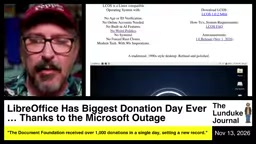
The author even half-jokingly suggests: "Take all of Google offline for two days, Sunday and Monday—no Gmail, no Google Drive, no Google authentication services—workplaces would be completely paralyzed. Then everyone would see exactly where the holes in their backup strategies are."
The scream test is an informal practice in system operations and legacy system governance, with the core logic of "discovering hidden dependencies by creating controlled failures." In large organizations, many old servers, internal services, or edge systems lack documentation, and no one knows who uses them; rather than spending a lot of time investigating, it's better to temporarily disable them during off-peak hours and observe which business processes or people immediately report problems. The source of the reports is the system's true stakeholders. This method works because it exposes dependencies through real behavior rather than questionnaires. Comparing the Microsoft outage to a society-wide scream test means: ordinarily people can't articulate how much they depend on a cloud service until it suddenly disappears, and the demand manifests in the form of "screams."
Local-First: Comprehensive Offline Capability from Operating Systems to Documents
The LibreOffice donation wave is just the surface; the deeper lesson is: not only should documents be available offline, but the entire computing experience should be able to run 100% offline.
The video's author uses his own Linux distribution as an example, whose second design principle is "no online accounts required." The reason is precisely the risks mentioned above: online services can disappear at any time; even if the service remains, API upgrades can suddenly render old software versions unusable—this happens "extremely frequently."
When online functionality becomes a critical component of an operating system or software, once the network is interrupted, the company goes bankrupt, or the interface becomes incompatible, at best a feature becomes unavailable, at worst the entire system is paralyzed. Software activation, online search, AI tools—many of these are indeed cool, but they put the lifeline of local computing in someone else's hands.
The author's point is not to reject online services. The video explicitly states that the features brought by the internet are "excellent," that platforms like YouTube and X have driven tremendous progress, and that they should continue to be used. But the key is: maintain offline availability while enjoying online convenience. Documents, photos, operating systems, applications—all critical parts should be able to run fully offline and be easy to back up at any time.
Final Thoughts: Data Sovereignty Is Not Just a Slogan
LibreOffice receiving over a thousand donations in a single day is a telling signal: users are beginning to vote with their wallets for "local-first." The Document Foundation didn't take the opportunity to mock its competitor, but calmly stated a fact—your documents should belong to you, not to a service provider.
This Microsoft outage will eventually pass, and online services will return to normal. But if it prompts more people to check their backup strategies, keep a local copy of critical files, and seriously consider offline availability, then the collective awakening behind those 1,000+ donations may be more valuable than the outage itself.
Related articles

When STEM Data Slips into Dravidian Language Models: Hidden Issues Exposed by the BPB Metric
Training Dravidian multilingual models with standard BPE yields poor tokenization efficiency; switching to an akshara-preserving strategy greatly improves byte coverage. Mixing STEM data lowers training loss but silently degrades BPB, requiring multilingual replay to fix.

Qwen 4 Launch Imminent: How Big Is the Gap Between Local Models and Closed-Source Giants?
Reddit debates how Qwen 4 will reshape the open-source model landscape, as users test GLM 5.3 Flash and other local models for daily coding—and weigh real gaps against closed-source Sonnet 5.5.

MacBook Pro's OLED PWM Problem: When a 'Better' Display Becomes Worse for Your Eyes
MacBook Pro's OLED display is a spec upgrade, but PWM dimming causes eye strain for some users. We examine PWM mechanics, the debate, sensitive users, and engineering trade-offs.