Military Analyst Breaks Down the Russia-Ukraine Strategic Bombing Dilemma
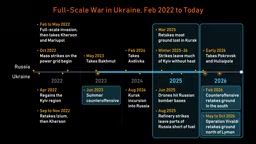
Ukraine's frontline performance rebounds while Russia sinks into diminishing returns; strategic bombing cannot compensate for stalled ground operations.
Based on a military analyst's views on the Lex Fridman podcast, the Russia-Ukraine battlefield shows a counterintuitive dual aspect: Ukraine's ground operations are at their best since the summer 2023 counteroffensive, while Russia is in its worst state since winter 2023. Russia keeps expanding strikes on energy and civilian infrastructure, with cumulative damage possibly taking years to fully surface, so despite Ukraine's resilience the economic cost remains highly uncertain. The analyst sees Russia's approach entering diminishing returns, with the turning point traceable to summer 2025, and manpower pressure set to intensify. As ground operations stall, Russia turns to strategic bombing as a pillar, yet history shows such bombing has a poor record of achieving political objectives — more a passive choice than an active escalation.
In an appearance on the Lex Fridman podcast, a military analyst offered a rather counterintuitive assessment of the Russia-Ukraine battlefield: Ukraine is turning in its best ground performance since the summer 2023 counteroffensive, while the Russian military is in its worst fighting state since the winter of 2023. This mismatch between battlefield performance and strategic strikes is shaping a winter full of uncertainty.
Two Faces of One War
The analyst summed up the current situation as a kind of "dichotomy" — Ukraine is performing well at the front, but at the same time enduring Russia's steadily expanding strike campaign. These strikes target not only military objectives but energy systems and all manner of civilian infrastructure, and their cumulative damage has accumulated over several years.
In other words, tactical success at the front does not automatically translate into security for society behind the lines. The degree of infrastructure damage determines how much pressure a country can withstand through the winter — and that, the analyst argues, is the most unpredictable part.
Beyond Resilience, the Economic Cost Remains Unknown
The analyst states plainly that Ukraine has proven its resilience and will make it through this winter. But "surviving" and "recovering" are two different things.

The extent of economic damage remains murky for now. The impact of accumulated destruction to energy facilities and civilian infrastructure often only becomes fully apparent years later — supply chain disruption, lost production capacity, population movement. None of these variables can be quantified in the short term. The analyst describes the trajectory of this winter as "quite uncertain," and the key question is not whether Ukraine can hold out, but what it will cost once it does.
Russia's Predicament: Diminishing Returns and Manpower Pressure
In contrast to Ukraine's frontline performance stands the situation of the Russian military. The analyst considers this year to be the Russian army's worst operational showing since the winter of 2023.

More importantly, his judgment: the Russian military's current approach has entered a phase of diminishing returns. This turning point did not occur in 2026 — the analyst traces it back to the summer of 2025. That said, manpower problems will gradually intensify and become an inescapable constraint on the Russian military.
The significance of this judgment is that it frames Russia's strategic shift as a passive choice rather than an active escalation. When ground operations stall, the remaining option naturally falls to long-range strikes.
Diminishing returns (收益递减) is originally an economic concept, referring to the gradual decline in marginal output from continuing to increase one input while other inputs remain fixed. In a military context, it describes a situation in which one side repeatedly uses the same tactics and pours more troops and resources into the same direction, only to gain ever smaller battlefield progress while casualties and equipment losses keep rising. Identifying this inflection point is extremely difficult, because battlefield information is delayed and noisy, and command levels tend to interpret stagnation as temporary difficulty rather than a structural bottleneck. For the Russian military, the manpower constraint (人力压力) is a second constraint layered on top of diminishing returns: rising costs of contract soldier recruitment, compressed training cycles, and the urgent need for personnel rotation and rest all intensify as operations drag on, gradually draining the offensive forces available for commitment.
The Historical Record of Strategic Bombing Is Not Good
The analyst's core criticism of Russia's current strategy rests on a historical pattern: strategic bombing has a poor — one could even say very poor — record when it comes to achieving the political objectives of war.
When ground operations in a war fail or bog down, hoping to force the other side to submit through bombing has rarely succeeded in history. The analyst closes with a telling observation: almost every political leader believes bombing will work on their adversary, even if you explicitly tell them the historical data does not support it.
This explains why the Russian military increasingly treats strategic bombing as a strategic pillar — not because this path has proven effective, but because the returns from other paths are disappearing.
Strategic bombing (战略轰炸) refers to systematic air raids on cities, industrial zones, and infrastructure aimed at destroying the enemy's war-economic potential, civilian will, and the decision-making capacity of political leadership, as distinct from tactical bombing directed at battlefield military units. Its theoretical foundations trace back to the air power doctrines of Giulio Douhet and Billy Mitchell in the 1920s, which held that air forces could independently decide the outcome of a war. During World War II, Germany's city bombing of Britain, the Allies' incendiary raids on Hamburg and Dresden, and the great Tokyo firebombing were the largest-scale practices. Postwar systematic assessments (such as the United States Strategic Bombing Survey) generally concluded that such operations had some effect in weakening enemy industrial production, but almost never succeeded on their own in the political objective of breaking civilian morale and forcing a government to surrender — Britain kept fighting through the Blitz, and Germany and Japan resisted under sustained bombing until ground forces approached. Operation Rolling Thunder and Operation Linebacker II in the Vietnam War, and the 1999 air campaign against Yugoslavia during the Kosovo War, are modern continuations of this historical controversy.
Implications for AI and Tech Professionals
The value of this analysis is not limited to the military domain. It offers a classic case of "means-ends mismatch": when the marginal returns of one approach diminish, organizations tend to double down on another approach with a historically low success rate rather than admit that the overall strategy needs adjustment. This pattern finds parallels in technology selection, product strategy, and even organizational decision-making.
Recognizing the signals of "diminishing returns" requires more judgment than sticking to an established course. The analyst places the Russian military's turning point in the summer of 2025 rather than the present, which precisely illustrates that such signals often can only be confirmed in hindsight — and in real-time decision-making, almost no one is willing to be the first to acknowledge them.
One-line Summary
Ukraine's frontline performance rebounds while Russia sinks into diminishing returns; strategic bombing cannot compensate for stalled ground operations.
Paragraph Summary
Based on the views of a military analyst on the Lex Fridman podcast, the article points out that the Russia-Ukraine battlefield presents a counterintuitive dual aspect: Ukraine's ground operations have reached their best level since the summer 2023 counteroffensive, while the Russian military is in its worst state since the winter of 2023. Meanwhile, Russia continues to expand strikes on energy and civilian infrastructure, whose cumulative damage may take years to fully manifest, so although Ukraine has shown resilience, the economic cost remains highly uncertain. The analyst argues that the Russian military's approach has entered a phase of diminishing returns, with the turning point traceable to the summer of 2025, and manpower pressure will further intensify. As ground operations stall, Russia turns to strategic bombing as a pillar, but history shows strategic bombing has a poor record of achieving political objectives — this looks more like a passive choice than an active escalation.
Related articles
Microsoft's Six-Pillar Framework for Productionizing AI Agents
A detailed look at Microsoft's framework for productionizing AI agents: six pillars—Center of Excellence, governance, landing zone, security, AgentOps, and optimization—with real enterprise cases and actionable steps.

Codex Security: A Configuration Guide to Automatically Blocking Vulnerabilities at the PR Stage
OpenAI engineers demonstrate Codex Security PR Reviews: automatically scan for vulnerabilities at the GitHub PR stage, have AI generate fix commits and re-verify, with repository-level automatic review and alert threshold configuration.

Daybreak Blue Application and Enablement: Complete Process Guide
Based on the official demo video, this guide details the Daybreak Blue application and enablement process, covering enterprise verification, intended use statements, role permission configuration, user access verification, and API key creation to help cybersecurity teams quickly onboard frontier AI models.