MiniMax M3.1 Flash Launches on Together AI: A New Powerhouse for Agentic Tasks

MiniMax M3.1 Flash launches on Together AI with 1M token context and vision capabilities.
Together AI announced the official launch of MiniMax M3.1 Flash as a Day-0 launch partner. Internally codenamed "Space Bunny," the model targets agentic tasks, coding, computer use, and cybersecurity, supporting a 1M token context window and vision capabilities, callable directly via Together AI. The article analyzes the value of ultra-long context for agent state consistency, the role of vision in UI automation and document understanding, and the model's targeted optimizations for planning, tool calling, code generation/debugging, and vulnerability analysis. The author views the partnership as a sign of platform confidence in the model, offering developers a new option for building agentic applications, though real-world accuracy and safety still require community validation—and deep collaboration between model vendors and inference platforms will become the norm.
Model Release and Platform Partnership
Together AI recently announced that the MiniMax M3.1 Flash model is now officially available on its platform, launched simultaneously as a "Day-0 launch partner." Internally codenamed "Space Bunny," the model targets agentic tasks, coding, computer use, and cybersecurity scenarios, supporting a context window of up to 1 million tokens along with vision capabilities. Developers can call the model directly through the Together AI platform.
According to Together AI's official tweet, M3.1 Flash is designed to provide efficient support for agentic workflows that require long context and complex reasoning, with its vision features further expanding the possibilities for multimodal applications.
Core Capabilities
Ultra-Long Context and Vision Support
M3.1 Flash's 1 million token context window enables it to process large-scale documents, long conversation histories, or complex codebases—critical for agents to maintain state consistency over long-running operations. The addition of vision capabilities allows the model to parse image content, making it suitable for computer-use scenarios such as UI automation and document understanding.
Tokens and Context Windows: A token is the basic unit of text processed by a language model, roughly corresponding to a word fragment in English or one or a few characters in Chinese. The context window refers to the maximum total number of tokens the model can "see" at once in a single inference, including the input prompt and generated content. A 1 million token window is roughly equivalent to hundreds of thousands of Chinese characters or over a thousand pages of documents, allowing the model to maintain coherent understanding of an entire codebase, long meeting transcripts, or continuous multi-turn conversations without segmentation. The larger the window, the higher the demands on GPU memory and attention computation, so such capabilities typically rely on engineering techniques like sparse attention and KV cache optimization, with inference platform serving costs rising accordingly.
Vision-Language Models (VLMs): Vision capabilities mean the model can receive image inputs in addition to text, typically through a vision encoder that splits images into patches and maps them to vectors, which are then fed alongside text tokens into the language backbone for joint reasoning. This enables the model to "read" screenshots, charts, scanned documents, or interface elements, supporting tasks such as UI automation and information extraction from receipts and tables. For computer-use agents, visual input is often the only channel for perceiving screen state, making the combination of vision and long context a prerequisite for end-to-end interface operation.
Optimized for Agentic and Security Scenarios
The model is explicitly optimized for agentic tasks, coding, and cybersecurity. In agentic scenarios, the model needs to plan, invoke tools, and handle multi-turn interactions; coding capabilities cover code generation and debugging; and cybersecurity may involve vulnerability analysis or threat detection. These features align closely with current demand for deploying AI agents.
Agentic Workflows and Tool Calling: An agent refers to a model-driven system that can autonomously plan steps and cyclically execute an "observe—think—act" loop. The key lies in the model outputting structured tool-calling instructions (such as search, code execution, or interface clicks), then feeding execution results back into context for continued reasoning. This requires stable instruction following, error recovery, and state tracking—long context is precisely the foundation for maintaining multi-turn state consistency. Compared with traditional single-turn Q&A, agentic task failures often stem from accumulated errors and abnormal tool returns, so latency, cost, and reliability jointly determine usability—which is why inference platforms play a key role in agent deployment.
Industry Impact and Outlook
As an inference platform, Together AI's Day-0 partnership demonstrates its confidence in M3.1 Flash's performance. For developers, this adds another model option supporting long context and vision, particularly reducing integration complexity when building agentic applications. However, the model's actual performance still requires community validation, especially its accuracy and safety in coding and cybersecurity tasks.
As agentic applications heat up, deep collaboration between model vendors and inference platforms will become the norm, driving more efficient AI infrastructure development.
(Note: This article is based on Together AI's official tweet and does not include independent test data.)
Background
Day-0 Partners and Inference Platforms: Day-0 means launch support is completed on the same day the model is officially released, typically indicating the platform obtained model weights or APIs in advance and completed deployment, quantization, and performance tuning. Inference platforms (such as Together AI) provide hosted APIs, batch processing, and elastic compute, allowing developers to call models without deploying GPU clusters themselves, with token-based billing. For model vendors, simultaneous launches with multiple inference platforms expand distribution channels; for developers, it enables horizontal comparison of different models under the same interface, reducing migration and integration costs.
Related articles

Why Does Self-Play AI Always Get Crushed by Cheap Units? An RTS Developer's Account of the Dilemma
An independent developer trained an RTS commander AI with pure self-play, only to find it dominated historical versions but was crushed by human players using cheap tier-1 units. This article analyzes the causes of self-play strategy collapse, explores solutions such as exploiters, diversity rewards, and reward design, and introduces the open Bot Kit and AI league plan.
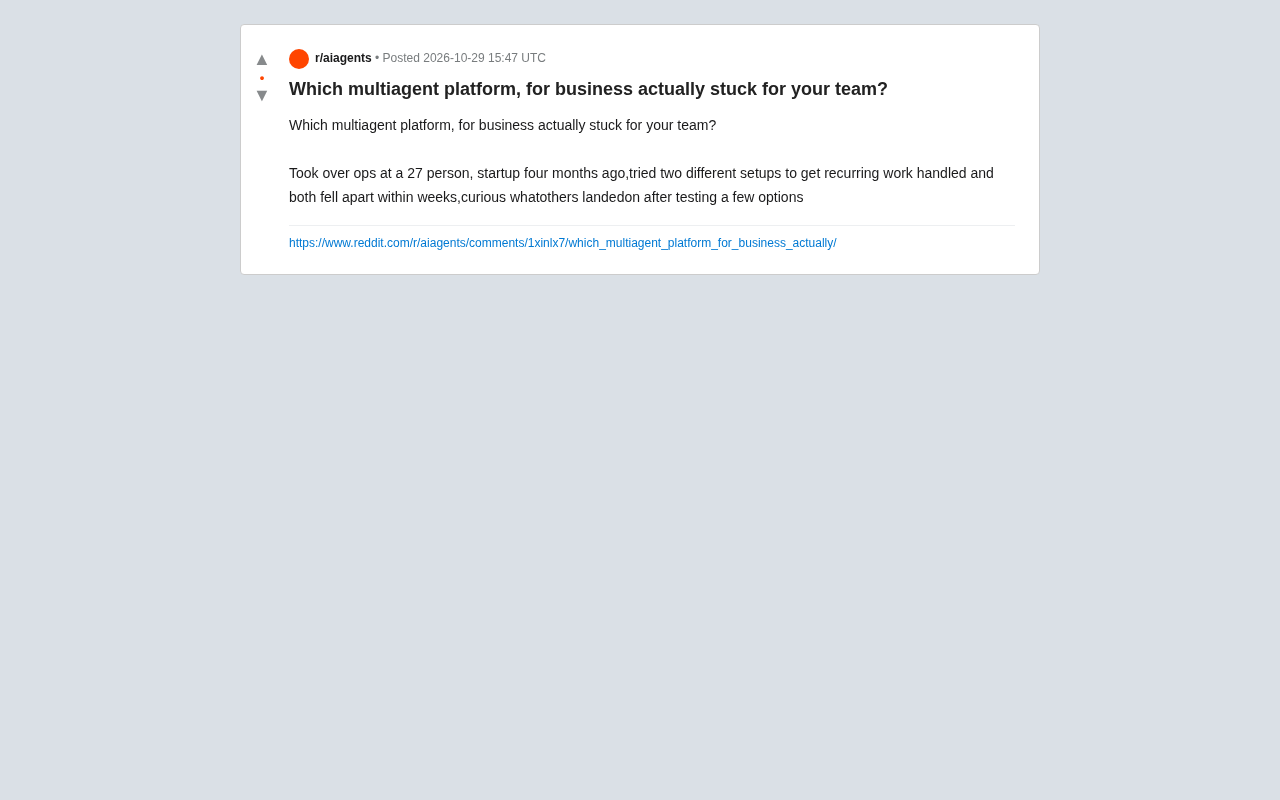
Which Multi-Agent Platform Wins? A Small Team's Battle Scars and Selection Considerations
A 27-person startup's ops lead tried two multi-agent platforms in four months and both failed. This article analyzes why small-team deployments break down, and offers selection guidance on integration depth, observability, and progressive rollout.

Thrive Holdings Takes ADT Private in $7.6 Billion Deal
Thrive Holdings acquires ADT for $7.6 billion in an all-cash take-private deal expected to close in Q1 2027. Analysis of the deal structure, ADT's asset value, and impact on the smart home security industry.