Mistral Open-Sources Trillion-Parameter Model, Targeting Cybersecurity

Mistral open-sources trillion-parameter model weights, targeting cybersecurity and sparking the open vs. closed-source debate.
Mistral has opened up the weights of its trillion-parameter AI model, explicitly targeting cybersecurity and emphasizing that enterprises gain defensive control unavailable from closed-source models. The article analyzes how open weights enable local or private cloud deployment for sensitive security data, reducing compliance pressure and allowing customized fine-tuning against evolving attacks. However, trillion-parameter models bring high inference hardware and operational thresholds, and open weights do not mean open training data or processes. The article concludes with enterprise evaluation dimensions: infrastructure cost, technical reserves, and compliance requirements.
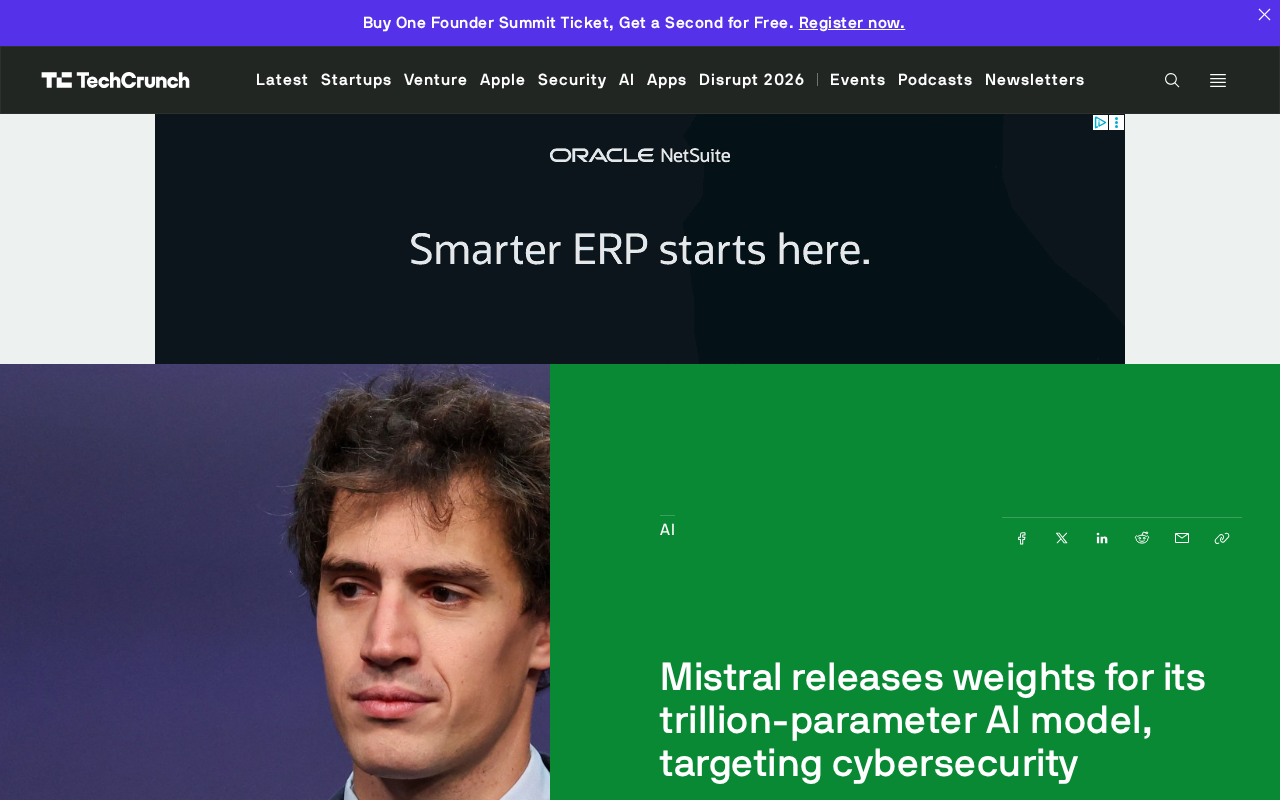
Mistral recently did something that has drawn considerable attention in the AI world: it opened up the weights of its trillion-parameter-class AI model, explicitly targeting cybersecurity scenarios. This move is not just about technical specs—it strikes at the core divide in how AI models are delivered: how should enterprises choose between open weights and closed-source APIs?
Trillion-Parameter Model Open-Sourced, Mistral Doubles Down on Cybersecurity
According to the original report, Mistral says its new model gives organizations a kind of control over cyber defense that closed-source models cannot provide. This statement captures the essential value of open weights: when model weights are in the enterprise's own hands, security teams can audit, fine-tune, and deploy them according to their own needs, rather than relying on a vendor's black-box service.
Trillion-parameter scale means the model has extremely strong representational capacity, capable of handling complex security log analysis, threat intelligence correlation, and anomaly detection tasks. But what really excites security teams is probably not the parameter count itself, but the word "controllable."
Open Weights vs. Closed-Source Models: The Route Debate in Cybersecurity Scenarios
Cybersecurity has special requirements for AI models. Security teams often need to process highly sensitive data, including internal network traffic, vulnerability information, and attack traces—data that is hard to trust to a third-party closed-source model. Open-weight models allow enterprises to deploy in local or private cloud environments, keeping data within their domain and greatly reducing compliance pressure.
On the other hand, security operations is a field that requires continuous iteration. Attack techniques keep evolving, and enterprises need to quickly adjust model behavior based on the latest threats. Although closed-source models can be called via API, fine-tuning capabilities and underlying access are limited, leaving enterprises to passively wait for vendor updates. Open weights allow security teams to conduct customized training for specific attack patterns, building their own defensive moat.
The "control" that Mistral emphasizes hits exactly this pain point. Of course, open weights also mean enterprises must bear the responsibility for deployment, operations, and security hardening themselves—raising the bar for technical capability.
Open Weights is a key concept in AI model distribution in recent years, referring to vendors publicly releasing trained model parameters (weights), allowing third parties to download, run in their own environments, modify, and even redistribute them—though not necessarily disclosing training data, training code, or the complete training pipeline. It is often conflated with "open-source models," but strict open source also requires availability of training data and code. The core value of open weights is that users can perform local inference, fine-tuning, quantization compression, and security auditing on the model without sending data through vendor APIs. Meta's Llama series is a representative driver of this approach. In contrast, the closed-source API model (such as OpenAI's GPT series) only provides a calling interface, with the model running on the vendor side and users unable to access the weights. The divergence between the two is essentially a trade-off between control and convenience: open weights grant data sovereignty and customization freedom, while closed-source APIs offer out-of-the-box managed services and ongoing maintenance.
Engineering Challenges and Real-World Constraints Behind Trillion-Parameter Scale
Opening up a trillion-parameter model is not without cost. Such models place extremely high demands on inference infrastructure, requiring substantial GPU memory and compute support. If enterprises want to deploy locally, the hardware investment cannot be underestimated. In addition, open weights do not mean open training data and training processes—model interpretability and potential bias remain issues that require attention.
From an industry trend perspective, open-weight models are extending from small and medium scale to ultra-large scale. Mistral's move may prompt more vendors to rethink their open-source strategies, especially in vertical industry markets. Cybersecurity is just the starting point; finance, healthcare, and other sectors sensitive to data sovereignty have similar needs.
The relationship between parameter scale and inference cost requires clarifying a common misconception: parameter count determines the model's representational capacity and knowledge storage capacity during training, but actual inference overhead also depends on whether the model uses a Mixture-of-Experts (MoE) architecture. If a trillion-parameter model adopts MoE design, only a subset of experts is activated per inference, and actual compute consumption may be far lower than an equivalent dense model. Even so, the memory footprint of a trillion-parameter model remains substantial—estimated at FP16 precision, loading the weights alone requires about 2TB of VRAM, typically requiring multi-GPU, multi-node parallel inference, or INT8/INT4 quantization to compress usage to the hundreds-of-GB level. This means "local deployment" is not feasible on a single machine for most enterprises; they need to build an inference cluster. In addition, security hardening for open-weight models includes preventing prompt injection, model theft, and adversarial sample attacks—operational responsibilities that fall entirely on the adopter and are hidden costs that cannot be ignored during evaluation.
How Enterprises Should Evaluate Such Models
For security teams considering adopting open-weight models, several dimensions are worth weighing: first, infrastructure cost—the inference overhead of trillion-parameter models needs to be estimated in advance; second, the team's technical reserves—whether it has model fine-tuning and security hardening capabilities; third, compliance requirements—whether local deployment meets industry regulatory requirements for data retention and auditing.
Mistral's release sends a signal: open weights are entering the ultra-large-scale era, and cybersecurity may be one of the first battlegrounds where it lands. Closed-source models still hold advantages in ease of use and managed services, but the control and customization space offered by open weights is increasingly attractive to security-sensitive organizations.
One-line Summary
Mistral opens up trillion-parameter model weights, targeting cybersecurity scenarios and sparking the open vs. closed-source route debate.
Paragraph Summary
Mistral has opened up the weights of its trillion-parameter-class AI model, explicitly targeting cybersecurity scenarios and emphasizing that enterprises thereby gain defensive control that closed-source models cannot provide. The article analyzes that security teams handle highly sensitive data such as network traffic and vulnerability information; open weights allow local or private cloud deployment, keeping data within the domain and reducing compliance pressure, while also enabling customized fine-tuning against evolving attack techniques. But trillion-parameter models also bring high inference hardware and operational thresholds, and open weights do not mean open training data and processes—interpretability and bias still require attention. The article concludes with evaluation dimensions for enterprises: infrastructure cost, technical reserves, and compliance requirements, judging that open weights are entering the ultra-large-scale era, with cybersecurity being one of the first battlegrounds where it lands.
Related articles

Fifty Years Studying Power: Robert Caro's Writing and Insights on Power
Robert Caro reflects on 50 years studying power: Lyndon Johnson's persuasion and leverage, Robert Moses's transformation from idealist to ruthless builder, the dilemmas of large-scale construction, and his methods of compressing themes and solitary focus in biography writing.

Can a $20,000 Robot Do Your Chores? The Test Results Are Surprising
A YouTube test video shows how a $20,000 robot responds to commands like washing dishes, turning off lights, taking out trash, and feeding the dog. This article analyzes its real capability boundaries, the state of voice interaction technology, and how far household robots are from mainstream adoption.
The Complete Guide to Running AI Models Locally: Inference Engines and Tool Stack Explained
A systematic breakdown of the complete local LLM tool stack: from PyTorch and GGML compute libraries to llama.cpp, vLLM, SGLang inference engines and Ollama, LM Studio wrapper layers, with benchmark data on performance differences and selection logic.