MIT President: In the AI Era, the Humanities Are Needed More Than Ever

MIT's president says humanistic insight is a necessity, not a garnish, in the AI era.
At MIT SHASS's 75th anniversary symposium, President Sally Kornbluth said MIT has never needed the humanities' particular insight and guidance more than now. The article analyzes this as a response to a structural shift: as AI lowers the barrier to purely technical skills, value judgment and ethical frameworks become scarce. Humanistic training provides the value coordinates that complement AI's pattern recognition and optimization. For AI practitioners, interdisciplinary collaboration is becoming an engineering precondition, and career moats are shifting toward judgment and ethical scrutiny.
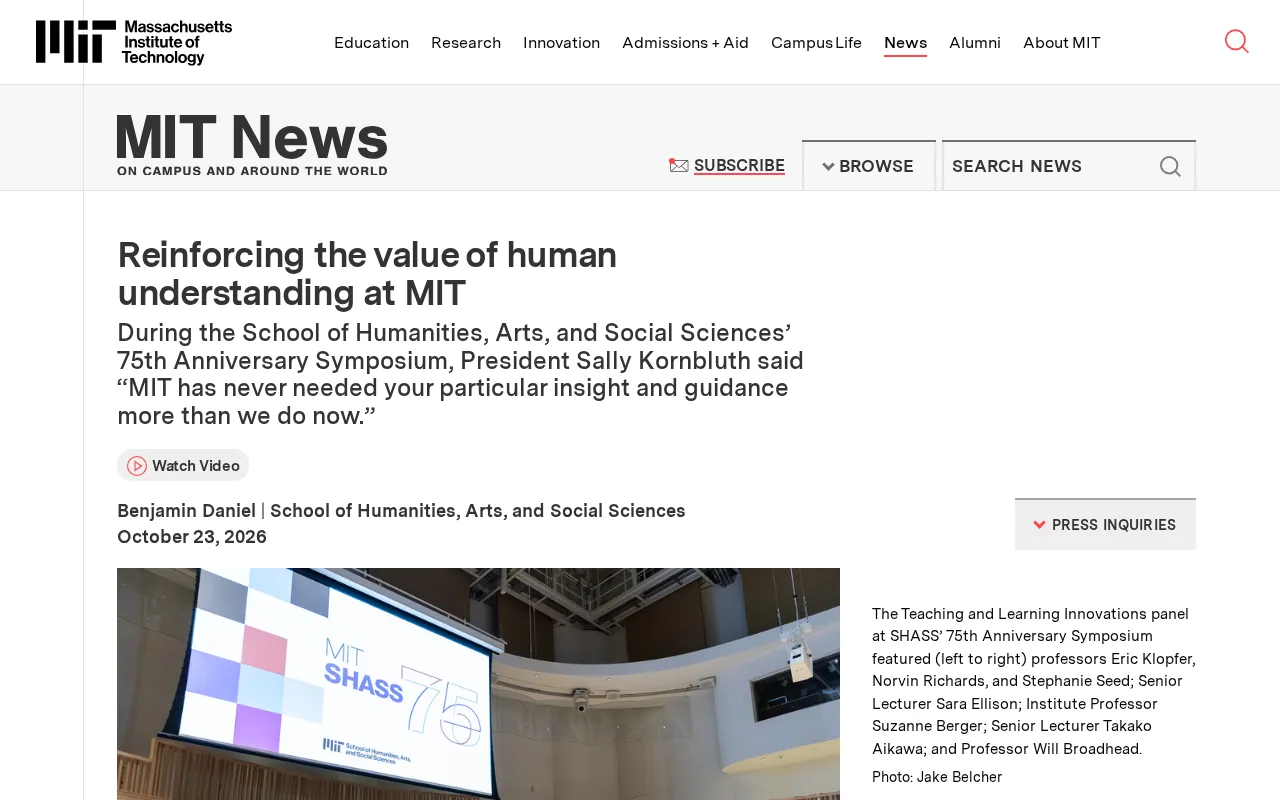
At the 75th anniversary symposium of MIT's School of Humanities, Arts, and Social Sciences (SHASS), President Sally Kornbluth delivered remarks that the tech world should take seriously: "MIT has never needed your particular insight and guidance more than it does now." This was no mere courtesy—it came from the head of one of the world's top science and engineering institutions, and it points to a question being rewritten by AI: the more powerful technology becomes, why does human understanding matter more?
Why a STEM Powerhouse Emphasizes Humanistic Value
MIT is renowned for engineering and the hard sciences, and SHASS has long been seen as the "other pole" on this technical campus. Kornbluth's public reinforcement of the irreplaceable role of the humanities and social sciences on the 75th anniversary occasion is, in effect, a response to a structural anxiety: when AI can generate code, write papers, and simulate conversation, the barrier to purely technical skills is dropping rapidly—while judgment, ethical frameworks, and understanding of complex social contexts are becoming scarce commodities.
This is not the first time MIT has championed the liberal arts, but an explicit endorsement by the president at an institutional milestone carries stronger symbolic weight. It means the humanities are no longer merely a "general education garnish" to STEM education, but are placed on equal footing with technical education.
SHASS is one of MIT's five schools—its full name is the School of Humanities, Arts, and Social Sciences—encompassing more than twenty departments and interdisciplinary programs including economics, linguistics, philosophy, history, music, and theater. It stands alongside the School of Engineering, the School of Science, and the Sloan School of Management, and carries the general education core requirements for all undergraduates. In MIT's undergraduate curriculum, humanities, arts, and social science courses account for a considerable proportion of credits, and students must take courses across multiple fields to satisfy breadth requirements. SHASS is therefore not a marginal appendix but an institutionalized component of MIT's educational system—its public prominence has simply long been overshadowed by achievements in engineering and technology.
What "Particular Insight" Points To
Kornbluth used the phrase "particular insight and guidance"—particular insight and guidance, not a vague "humanistic literacy." The wording deserves unpacking. AI excels at pattern recognition and optimization, but it is not good at answering "should we do this," "for whom are we doing it," and "who bears the cost." These questions are precisely the traditional territory of philosophy, history, sociology, and linguistics.
In other words, humanistic training provides a coordinate system for value judgment. When technical teams confront model bias, privacy boundaries, and the impact of automation on employment, what is often missing is not engineering capability but the ability to examine a problem within its historical and social context. MIT's president calling this capability a "necessity" is no exaggeration.
The field of AI ethics and algorithmic governance has developed several core issue frameworks, mainly including: algorithmic bias and fairness (differential model performance across social groups), explainability and transparency (whether decision bases can be traced), privacy and data consent, accountability mechanisms (who is responsible when things go wrong), and the impact of automation on labor structures. What these issues share is that technical solutions alone cannot provide final answers—normative ethical theory, legal traditions, and empirical social science research are needed to define the boundaries of the problem. The advancement of regulatory frameworks such as the EU AI Act is precisely an institutionalized attempt to translate such value judgments into compliance requirements, making ethical review an actual step in the product development process rather than an afterthought.
Practical Implications for AI Practitioners
For practitioners who work with models and data every day, the takeaway from this news is quite concrete. First, interdisciplinary collaboration is shifting from slogan to engineering necessity—ethical review, user research, and policy compliance are no longer patches at the end of a project but preconditions. Second, the center of gravity of individual career moats is shifting: many people can write prompts, but few can judge whether an AI product should launch and what impact it will have on which groups of people.
Third, Kornbluth's remarks also remind the tech community to guard against a habitual mindset—treating the humanities as "soft" and as the opposite of the quantifiable. In reality, tolerance for uncertainty, integration of diverse perspectives, and mastery of narrative and persuasion are often the variables that determine success or failure in bringing AI products to market.
The Long-Term Significance of an Anniversary Symposium
SHASS's 75th anniversary was originally a retrospective academic event, but the president's remarks gave it a forward-looking character. Against the backdrop of AI capabilities continuing to leap forward, debates over whether "studying the liberal arts is still useful" recur around the world, and MIT's answer is direct: it is not a question of whether it is useful, but that the further technology advances, the more we need people to safeguard the understanding of what it means to be human.
For readers concerned with the relationship between AI and society, what may be most worth remembering from this symposium is the sentence itself—it comes from a school that understands technology best, yet speaks of matters beyond technology.
One-line Summary
At the SHASS 75th anniversary event, MIT's president emphasized that humanistic insight is a necessity, not a garnish, in the AI era.
Paragraph Summary
At the 75th anniversary symposium of MIT's School of Humanities, Arts, and Social Sciences (SHASS), President Sally Kornbluth said MIT has never needed the humanities' particular insight and guidance more than it does now. The article argues that this statement addresses a structural shift in the AI era: the barrier to purely technical skills is falling rapidly while value judgment and ethical frameworks are becoming increasingly scarce. Humanistic training provides a value coordinate system for answering "should we do this, for whom, and who bears the cost," complementing AI's strengths in pattern recognition and optimization. For AI practitioners, the implication is that interdisciplinary collaboration is becoming an engineering precondition rather than a slogan, and that individual career moats are shifting from technical execution to judgment and ethical scrutiny. A retrospective academic event is thus given a forward-looking significance.
Related articles

14 Core Concepts of Reasoning Models: From Chain of Thought to GRPO Explained
A systematic breakdown of 14 core concepts of reasoning models: chain of thought, test-time compute, verifiers, RLVR and GRPO, distillation, and reward hacking, plus rules for controlling thinking-token costs to help you decide when reasoning is worth paying for.

OpenAI's Claimed Refutation of ETH Sparks Debate, Meta Bets Big on AI Infrastructure
OpenAI claims an AI-assisted discovery that challenges the Exponential Time Hypothesis (ETH) and launches the mid-tier GPT-6.1 Tera. Cloudflare discloses a cross-customer data leak postmortem, and Meta plans $95B in AI infrastructure financing.

Data Scraping, AI Proofs, and Open Source Contracts: This Week's Deep Dive into the Tech World
From the 3D model crawler controversy and OpenAI's Lean formal proofs to AI agents challenging Brooks' Law and Debian rejecting LLM review, this week's tech discussions center on openness and verifiability.