MIT Professors Track How AI Chatbots Answer Midterm Election Questions

MIT professors launch a project to longitudinally track AI chatbot answers to 2026 U.S. midterm election questions, auditing their reliability and bias.
MIT professors Adam Berinsky and Chara Podimata have partnered on a new study to systematically track how AI chatbots respond to 2026 U.S. midterm election questions. As voters increasingly turn to conversational AI for political information, chatbots' synthesized answers may amplify model bias. The project emphasizes longitudinal monitoring during the election cycle, examining differences across models, the impact of question phrasing, handling of sensitive topics, and factual errors. Independent academic tracking offers a path to audit AI political information without relying on vendor disclosure.
As more and more voters turn to AI chatbots for political information, a key question emerges: how will these systems answer questions like "Who should I vote for?" MIT professors Adam Berinsky and Chara Podimata are tracking AI's performance in the 2026 U.S. midterm elections through a new project.
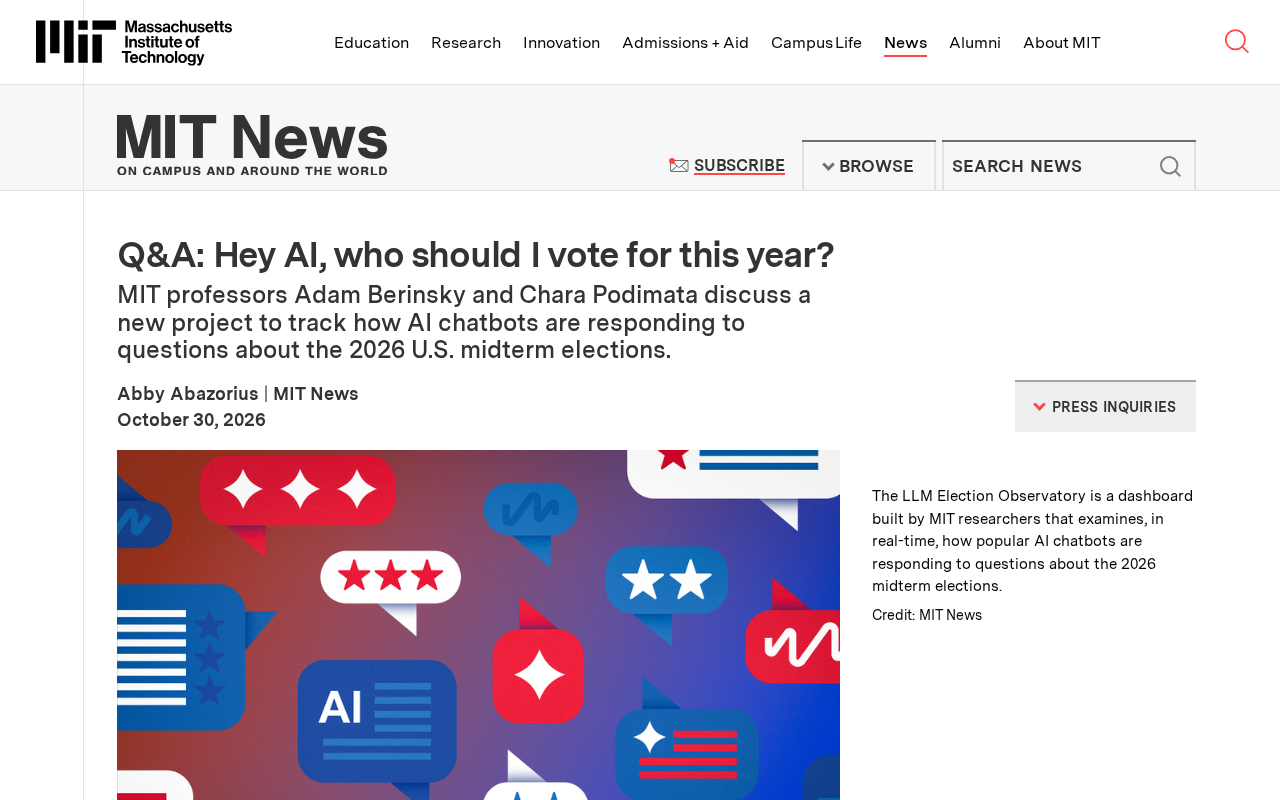
AI Political Q&A: A New Frontier in Urgent Need of Monitoring
According to MIT News, political science professor Adam Berinsky and electrical engineering and computer science professor Chara Podimata have partnered on a new study aimed at systematically tracking how AI chatbots respond to questions related to the 2026 U.S. midterm elections.
The backdrop of this research is not complicated: the channels through which voters obtain political information are undergoing a structural shift. Traditionally, people learned about candidates and issues through news media, party propaganda, or social networks; today, conversational AI has become an unavoidable new entry point. Users can directly ask chatbots questions and receive seemingly neutral, personalized answers.
The problem is that whether these answers are reliable, whether they carry bias, and whether they produce systematic deviations under different phrasings currently lack public, continuous monitoring data. Berinsky has long studied political information dissemination and public opinion, while Podimata's research involves algorithmic fairness and the social impact of machine learning. Their collaboration恰好 covers two dimensions: "political behavior" and "AI systems."
Algorithmic Fairness is one of Professor Podimata's research directions, referring to the principle that machine learning systems should not exhibit systematic discrimination or bias in their outputs across different groups. In political Q&A scenarios, algorithmic fairness concerns whether a model gives answers of comparable quality and consistent orientation when the same political question is asked with different wording or by different user identities. Fairness research typically distinguishes between "group fairness" (different demographic groups receive equal treatment) and "individual fairness" (similar individuals receive similar treatment), and develops auditing tools to detect implicit bias in model outputs. Introducing this framework into election information monitoring means not only examining what the model "says" but also to whom and in what context it says it, thereby identifying systematic patterns that may influence voter perceptions.
What the Project Aims to Answer: From "Who Should I Vote For" to Systematic Tracking
The original report uses "Hey AI, who should I vote for this year?" as its title, and this question itself highlights the core tension of the research. Directly asking for voting advice is an extreme but real user behavior—even though chatbots typically do not give explicit candidate recommendations, how they handle such questions (evasion, guidance, providing voting information, or suggestive hints) is itself worth recording.
From the information disclosed in the report, the project focuses on "tracking" rather than single-instance testing. This means the research team is concerned with how AI systems' response patterns change over time during the election cycle, rather than a snapshot at a single point in time. This longitudinal perspective is relatively rare in research on AI's political impact; most existing work focuses on single-round evaluations or capability tests of specific models.
Specifically, the dimensions that may need monitoring include: differences in answers to the same political question across models, whether changes in question phrasing trigger shifts in responses, whether models choose to refuse or provide information on sensitive topics, and whether answers contain factual errors. The report does not disclose specific methodological details of the project, but the backgrounds of the two professors suggest the research may combine large-scale query testing with analytical frameworks from political communication.
Longitudinal Monitoring refers to repeated observation of the same subject over an extended time span to capture trends and patterns of change over time. In research on AI's political impact, longitudinal perspectives are rare because most evaluations are constrained by compute and time and can only produce single-round snapshots. Election cycles last for months, during which models are updated, policies adjusted, and social issues evolve; a single test cannot reflect these dynamics. Longitudinal monitoring requires research teams to design repeatable query sets, fix observation frequency, and control for variations in question phrasing, thereby distinguishing "model behavior changes" from "question perturbations." This method is mature in epidemiology and public opinion tracking, but its migration to the field of AI auditing remains exploratory, with challenges in ensuring comparability across time points and handling discontinuities caused by model version iterations.
Why This Matters
The role of AI chatbots versus search engines in political information scenarios is fundamentally different. Search engines return lists of links, and users must judge source credibility themselves; chatbots directly generate synthesized answers, and users face a "pre-digested" conclusion. This difference amplifies the potential impact of model bias—if answers contain bias or factual errors, users lack the natural incentive to cross-check against original sources.
Multiple sources indicate that AI political bias and the quality of election information are high-frequency topics in current AI governance discussions. According to MIT News, the project by Berinsky and Podimata is a direct response to this concern: establishing an observable, comparable record during the election cycle so that the public and researchers can judge the actual performance of chatbots in political Q&A, rather than remaining at the level of assumptions.
This also touches on a more fundamental question: when AI becomes the intermediary layer for political information, who audits its answers? Independent tracking by academic institutions offers one possible path—not relying on model vendors' self-disclosure, nor on scattered user reports, but systematically collecting evidence.
AI Auditing refers to systematic examination of AI systems' behavior, outputs, and impacts by independent third parties to assess whether they conform to expected norms or public values. Unlike model vendors' self-assessments, independent auditing emphasizes external verifiability and is typically conducted by academic institutions, nonprofit organizations, or regulatory agencies. In political information scenarios, auditing focuses on factual accuracy, bias, handling of sensitive questions, and the presence of manipulation risks. Auditing methods may include black-box query testing, red-team exercises, and user experiments. The project by Berinsky and Podimata is essentially a continuous auditing attempt oriented toward election scenarios, whose value lies in establishing a public evidence base that does not depend on vendor disclosure, providing a factual basis for regulation and public discussion.
Beyond Monitoring: Questions Left for the Industry
The project is currently in its startup phase, and the report does not provide a complete research design or expected output format. But the questions it raises are already clear: the behavior of AI chatbots in election scenarios needs continuous observation, not one-time evaluation.
For AI developers, this means political Q&A may become a category requiring dedicated design in model evaluation; for the public, understanding the limitations of chatbots when answering political questions is a basic prerequisite for using such tools. Whether the tracking project by Berinsky and Podimata can establish a reusable monitoring framework will determine whether such research can expand from a single election cycle to longer-term observation of the information ecosystem.
The original report is presented in Q&A format, emphasizing the two professors' direct statements about the project. As the 2026 midterm election cycle progresses, the interim findings of this tracking study deserve continued attention.
The political Q&A category in model evaluation has not yet formed an industry standard. Existing mainstream evaluation benchmarks mostly focus on factual knowledge, reasoning ability, or safety (such as refusing harmful requests), but political Q&A involves gray areas: models should neither give voting advice nor fail to provide accurate election procedure information; they must avoid bias while not losing informational value through excessive evasion. Designing political Q&A evaluations requires balancing multiple dimensions: factual correctness, neutrality, information completeness, reasonableness of refusals, and stability across different question framings. This requires evaluation designers to have political science knowledge, not just generic NLP metrics. If the project's monitoring framework matures, it may drive the formation of reusable evaluation categories and metrics, filling the gap in the current model evaluation system in the field of election information.
One-line Summary
MIT professors launch a project to longitudinally track AI chatbot answers to 2026 U.S. midterm election questions, auditing their reliability and bias.
Paragraph Summary
MIT political science professor Adam Berinsky and computer science professor Chara Podimata have partnered on a new study to systematically track how AI chatbots respond to questions related to the 2026 U.S. midterm elections. The backdrop is that voters increasingly turn to conversational AI for political information, and chatbots directly generate synthesized answers that may amplify model bias. The project focuses on longitudinal monitoring during the election cycle rather than one-time evaluation, examining dimensions such as differences in answers across models, the impact of question phrasing, handling of sensitive topics, and factual errors. Independent tracking by academic institutions offers a path for auditing AI political information that does not depend on vendor disclosure, and also raises the industry question of whether political Q&A needs to become a dedicated evaluation category.
Related articles

Anthropic IPO Explained: Fuel for the AI Boom or the Spark for a Bubble?
Anthropic files for an IPO under ticker ANT. Breaking down the prospectus: 80% of revenue from usage-based pricing, $72B of an $80.7B net loss being non-cash charges, 900% net revenue retention, and how past IPOs like SpaceX performed on day one and over three years — answering the AI bubble question.

Will AI Kill the Research Paper? Mathematicians Offer a New Answer
Mathematicians on the Lex Fridman podcast discuss whether AI will kill research papers—from journal review pressure to Lean formal verification, GitHub open source fatigue to Mathlib's crowdsourcing model, exploring the evolution of academic contributions and the future of mathematical knowledge verification.

Enterprise LLM Development: From RAG to Multi-Agent in Practice
A course breakdown of enterprise LLM application development: from prompt engineering and RAG to multi-agent engineering practice and FDE project delivery, helping developers understand why Agent technology is a key focus for enterprise deployment and learn systematically to avoid detours.