MuEdit: Solving the Inter-Domain Conflict Challenge in Multi-Task Editing of Large Models

MuEdit reveals that multi-task editing failures stem from inter-domain null-space misalignment and proposes a Conflict Index with a two-stage mitigation strategy.
When updating cross-domain knowledge in LLMs, sequential multi-task editing often fails due to inter-domain null-space misalignment: heterogeneous tasks sharply shrink the common null space, leaving insufficient safe update directions. MuEdit proposes a Conflict Index to quantify geometric interference and mitigates conflicts via conflict-aware ordering and dynamic low-rank approximation. It significantly outperforms baselines across five domains and three backbone models, preserves general capabilities, and remains effective in incremental task arrival scenarios.
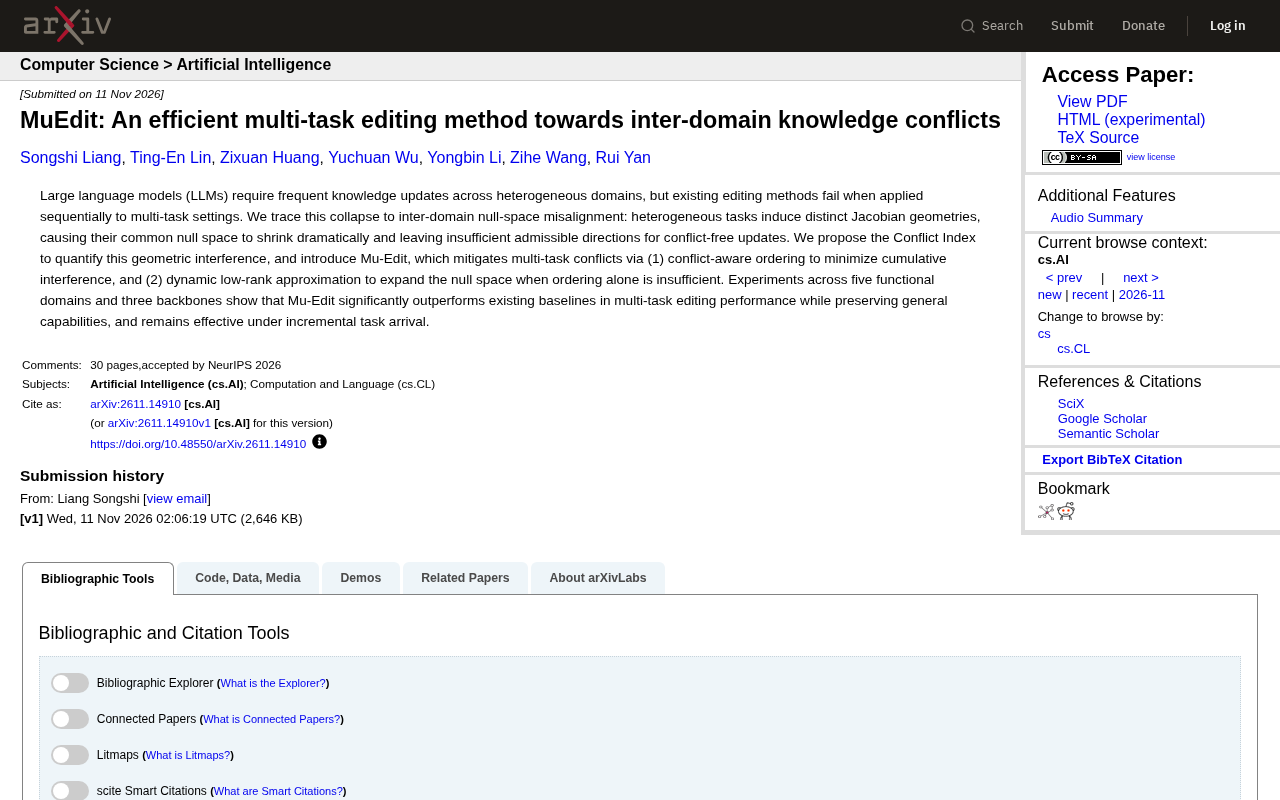
Large language models (LLMs) need to frequently update knowledge across domains, but existing editing methods often fail when applied sequentially in multi-task scenarios. A study titled "MuEdit: An efficient multi-task editing method towards inter-domain knowledge conflicts" attributes this failure to "inter-domain null-space misalignment" and proposes a targeted solution.
Why Does Multi-Task Editing "Collapse"?
The study points out that heterogeneous tasks induce different Jacobian geometries, causing their common null space to shrink sharply. The null space represents the "safe directions" in model parameter updates that do not affect the original tasks. When the common null space is compressed, the feasible directions for conflict-free updates become insufficient, and sequential editing interferes with each other, ultimately leading to performance collapse.
To quantify this geometric interference, the authors propose the "Conflict Index," which converts the degree of interference between tasks into a measurable metric. This metric not only explains the failure mechanism but also provides a basis for subsequent conflict mitigation strategies.
Null Space and Jacobian Geometry: In model editing, the null space refers to the directions in the parameter update space that do not change the model's output for the original tasks. For a single task, one can find the null space of its Jacobian matrix (i.e., the sensitivity matrix of outputs with respect to parameters) to ensure that editing does not affect old knowledge. Jacobian geometry describes the distribution relationship of the Jacobian matrices corresponding to different tasks in the parameter space. When multiple heterogeneous tasks are edited sequentially, the intersection of their respective null spaces (common null space) rapidly shrinks due to differences in the Jacobian matrices between tasks, resulting in insufficient available safe update directions, thereby causing editing conflicts and performance collapse.
Mu-Edit's Two-Stage Mitigation Strategy
Mu-Edit mitigates multi-task conflicts through two complementary mechanisms:
- Conflict-aware ordering: By adjusting the editing order of tasks, it minimizes cumulative interference. Experiments show that a reasonable order can significantly reduce the Conflict Index.
- Dynamic low-rank approximation: When ordering alone is insufficient, this method dynamically expands the null space to provide more feasible directions for conflict-free updates.
This "order first, then expand" approach balances efficiency and editing effectiveness, avoiding the limitations of a single strategy.
Low-Rank Approximation: In matrix operations, low-rank approximation refers to approximating the original matrix with a lower-rank matrix to capture its main structure and reduce computational complexity. In Mu-Edit, dynamic low-rank approximation is used to expand the null space: when the common null space is insufficient, this method dynamically constructs an approximate null space through low-rank decomposition, providing more feasible directions for parameter updates while minimizing interference with the original tasks. This approach controls computational overhead while ensuring editing effectiveness and is a key technique for addressing multi-task conflicts.
Experimental Validation: Covering Five Domains and Three Backbone Models
The study conducted experiments on five functional domains and three backbone models. The results show that Mu-Edit significantly outperforms existing baselines in multi-task editing performance while maintaining the model's general capabilities. Furthermore, in the scenario of incremental task arrival, Mu-Edit remains effective, indicating its potential to handle dynamic task streams.
Implications for Knowledge Editing Practice
The value of this work lies in the fact that it does not stop at "patch-style" improvements but analyzes the root causes of multi-task editing conflicts from a geometric perspective, providing a quantifiable diagnostic tool (Conflict Index) and an actionable solution (ordering + dynamic low-rank). For applications that require continuous updating of cross-domain knowledge, Mu-Edit offers a new path that balances editing efficiency and model stability.
However, the study also leaves some open questions: What is the computational overhead of the Conflict Index? Does dynamic low-rank approximation perform consistently on larger-scale models? These await answers from future work.
Conclusion
By revealing the mechanism of inter-domain null-space misalignment, Mu-Edit provides a new approach for multi-task knowledge editing. Its combination of conflict-aware ordering and dynamic low-rank approximation demonstrates performance superior to baselines in experiments while maintaining the model's general capabilities. For researchers and engineers concerned with knowledge updating and editing in large models, this is a noteworthy advancement.
One-line Summary
MuEdit reveals that multi-task editing failure stems from inter-domain null-space misalignment and proposes a Conflict Index and a two-stage mitigation strategy.
Paragraph Summary
When updating cross-domain knowledge in large language models, sequential multi-task editing often fails due to "inter-domain null-space misalignment": heterogeneous tasks cause the common null space to shrink sharply, leaving insufficient safe update directions. MuEdit proposes a Conflict Index to quantify geometric interference and mitigates conflicts through a two-stage approach of conflict-aware ordering and dynamic low-rank approximation. On five functional domains and three backbone models, MuEdit significantly outperforms baselines, maintains the model's general capabilities, and remains effective in incremental task arrival scenarios, offering new ideas for handling dynamic task streams.
Related articles

AI Writes Your Code—Do You Still Need to Learn Git? Five Reasons
AI coding agents handle Git operations automatically—is it still necessary to learn Git? Five reasons: team communication, reviewing agent PRs, monitoring code changes, fallback when AI goes down, and the joy of learning—plus how the focus of learning Git is shifting in the agent era.

Anthropic Reportedly Prices IPO at $83 Per Share, Valuing Company at $1.5 Trillion
Anthropic reportedly prices IPO at $83 per share, above the expected range, with a fully diluted valuation of $1.5 trillion. This article analyzes the signal significance of the pricing and its impact on the AI industry's financing environment.

Open-Source Code Hosting Platform Codeberg Suffers Outage, Sparking Debate in Developer Community
Open-source code hosting platform Codeberg.org suffered an outage, sparking Hacker News debate over nonprofit platform stability and open-source infrastructure dependency risks.