Multi-LLM Provider API Integration: Standardization Challenges and Compliance Headaches

Multi-LLM provider architectures are technically feasible but carry heavy compliance burdens; no standardized API solves everything.
The article discusses a developer's Reddit question about a help desk platform using four LLM providers for classification, drafting, summarization, and embedding. While technical integration is manageable, each enterprise customer demands clarity on data flows and retention, leading to four contracts and repeated security reviews. The article notes that multi-provider architectures amplify compliance burdens; standardized APIs and routers mainly address technical integration, not compliance. Community practices include reducing providers, data masking, self-hosting, and leveraging DPAs/SOC 2. Conclusion: no silver bullet; routers are technical abstractions, and transparent communication and proactive data governance are key.
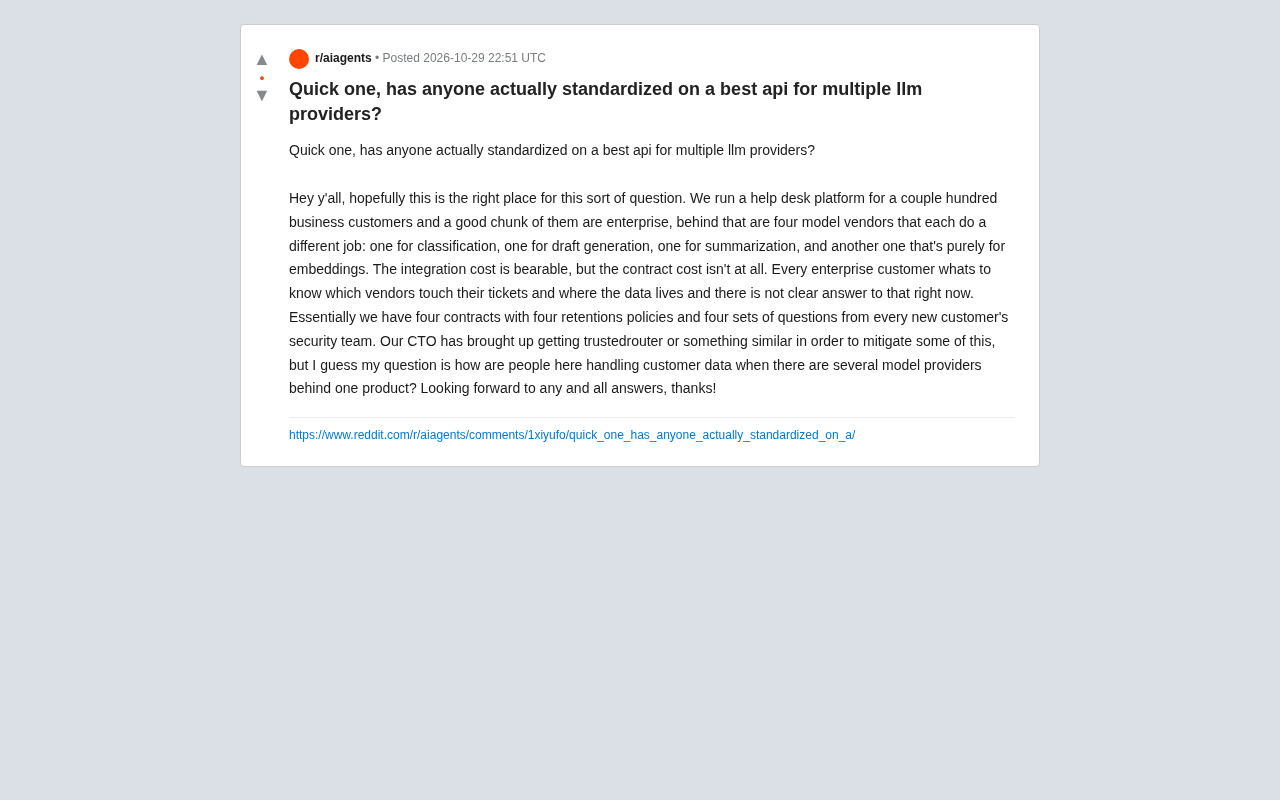
When building AI-driven products, integrating multiple large language model (LLM) providers is not uncommon. But if your product serves enterprise customers, compliance and contractual issues can be trickier than technical integration. A recent Reddit question from a developer highlights this pain point: they provide a help desk platform to hundreds of enterprise customers, using four model providers in the backend to handle classification, draft generation, summarization, and embedding tasks. The technical integration cost is acceptable, but the contractual cost is unbearable—every enterprise customer wants to know which providers touch their data and where the data is stored, and there are currently no clear answers. They have to manage four contracts, four data retention policies, and deal with repeated questions from each new customer's security team. The CTO proposed introducing an intermediary layer like trustedrouter to alleviate the problem, but the core question remains: when there are multiple model providers behind a single product, how does everyone handle customer data?
The Rise of Multi-Provider Architectures and Compliance Pain Points
Using multiple LLM providers is often driven by functional specialization: different models perform differently on classification, generation, summarization, and embedding tasks, and combining them can improve results. However, this architecture brings significant compliance burdens. Enterprise customers are particularly concerned about data privacy and supply chain transparency; they need to know exactly which third parties their data flows to and how those third parties store and process it. Each additional provider means another contract, another set of data retention policies, and repeated audits by security teams. This repetitive work not only consumes legal and security resources but can also slow down sales cycles.
Data Processing Agreements (DPAs) are common contractual tools between enterprise customers and LLM providers, used to define the boundaries of provider responsibility when processing customer data. A standard DPA typically covers purpose limitation, retention periods, sub-processor disclosure, security measures, and data subject rights response mechanisms. When there are multiple model providers behind a product, enterprise customers often require reviewing each provider's DPA individually, and may even require the product company to assume the role of "data controller" rather than merely "data processor." This directly amplifies the complexity of contract management: four providers mean four DPAs, four sub-processor lists, and four different sets of cross-border data transfer clauses. Understanding the hierarchy of DPAs helps explain why purely technical routing cannot replace compliance arrangements at the contractual level.
The State of Standardized APIs: Ideal vs. Reality
Developers hope to find a standardized API to uniformly access multiple LLM providers, but there is currently no industry-recognized best solution. While some open-source libraries and commercial routers (such as trustedrouter) attempt to abstract different providers' interfaces, they mainly address technical integration issues rather than the complexity of contracts and compliance. Routers can unify at the request level, but data still flows to each provider, and enterprise customers' security reviews cannot be bypassed. Therefore, a technical intermediary layer alone cannot fully eliminate the compliance burden of multiple providers.
SOC 2 (System and Organization Controls 2) is a security and compliance audit framework developed by the American Institute of Certified Public Accountants (AICPA), built around five trust services criteria: security, availability, processing integrity, confidentiality, and privacy. Enterprise customers' security teams often use SOC 2 Type II reports as a prerequisite for vendor onboarding because they demonstrate that a vendor has consistently applied established controls over an extended period. In multi-LLM provider scenarios, each provider's SOC 2 report covers different scopes, and customers need to check the sub-processor lists, data encryption methods, and incident response processes in each one. This means that even if the technical layer achieves unified access, compliance reviews still need to be conducted provider by provider—the differences in SOC 2 reports themselves are a major source of repetitive work.
Community Practices: How to Handle Multi-Provider Data Compliance
In the Reddit discussion, developers shared various coping strategies. A common approach is to minimize the number of providers, choosing one that can cover most tasks, or using different models from the same provider. Another approach is data masking and tokenization, removing sensitive information before sending to models, but this may affect model performance. Some teams use self-hosted models for sensitive data and only send non-sensitive tasks to third-party APIs. Additionally, some enterprises choose to sign unified Data Processing Agreements (DPAs) with providers and leverage providers' compliance certifications (such as SOC 2) to simplify customer reviews. However, each of these solutions has trade-offs and needs to be weighed according to business needs.
Data masking and tokenization are two privacy-enhancing techniques often confused but with different mechanisms. Masking typically refers to removing or replacing sensitive fields (such as names, emails, account numbers) before sending to models so that data can no longer directly identify individuals; tokenization replaces sensitive values with meaningless tokens and retains the mapping in a controlled environment for later restoration. The former is simple to implement but may lose context and affect model output quality; the latter retains some reversibility but introduces new risks around token custody and access control. In multi-provider architectures, these two techniques can only reduce the exposure surface of a single request, not change the fact that data actually flows to multiple providers. Therefore, they need to be used in conjunction with contractual terms and data minimization principles, rather than as standalone compliance solutions.
Limitations and Possibilities of Router Solutions
Router products like trustedrouter promise to simplify multi-provider management by offering a unified API, routing policies, and logging monitoring. They do reduce technical complexity and may offer some compliance auxiliary features, such as data flow mapping or access control. But the router itself is also a third-party service that enterprise customers may equally need to review. Therefore, routers are better suited as technical integration tools rather than compliance solutions. At the contractual level, enterprises still need to contract directly with each provider or manage indirectly through the router provider, with transparency and responsibility allocation clearly defined.
Conclusion: No Silver Bullet, But Optimization Is Possible
There is currently no standardized best API that can simultaneously solve the technical and compliance issues of multiple LLM providers. For enterprises in regulated industries, reducing the number of providers, adopting data minimization principles, and combining self-hosted models may be more pragmatic paths. If using a router, it should be viewed as a technical abstraction layer, and contractual and compliance responsibilities should be clearly defined. Ultimately, transparent communication and proactive data governance strategies are more important than searching for a universal API.
One-line Summary
Multi-LLM provider architectures are technically feasible but carry heavy compliance and contractual burdens; no standardized API can solve everything.
Paragraph Summary
The article revolves around a developer's Reddit question: their help desk platform uses four LLM providers for classification, draft generation, summarization, and embedding tasks. Technical integration is manageable, but every enterprise customer demands clarity on data flows, storage locations, and retention policies, resulting in four contracts, four sets of policies, and repeated security reviews that are hard to bear. The article points out that while multi-provider architectures can improve task performance, they significantly amplify compliance burdens; existing standardized APIs and routers (like trustedrouter) mainly address technical integration and cannot bypass the fact that data still flows to each provider. Community practices include reducing the number of providers, data masking and tokenization, self-hosting sensitive models, and leveraging DPAs and SOC 2 certifications to simplify reviews. The conclusion is that there is no silver bullet; routers should be viewed as a technical abstraction layer, and transparent communication and proactive data governance are more critical than searching for a universal API.
Related articles

Private Key Set to 4? CA's Elementary Mistake Leaves TLS Exposed
CA eMudra set private keys to tiny values like 4, making TLS certificates brute-forceable. A Computerphile video demonstrates the full process from extracting public keys to forging certificates, and explores the fragility of the PKI trust chain.

How Gen Turns Data into Decisions with ChatGPT Work
In an OpenAI user case, business leader Gen shares how ChatGPT Work turns data into decisions: within hours of launch, teams can judge whether integrations and onboarding flows work, shifting decision iteration from hundreds of trial-and-error attempts to a fast feedback loop.

ChatGPT vs. Claude In-Depth Comparison: Strong at Coding but Weak at Research — How to Bridge the Gap?
A user considers switching from ChatGPT to Claude, finding Claude stronger at coding but shallower at research. We analyze the differences and share tips to make Claude's research deeper.