Multimodal LLM Deployment and Fine-Tuning in Practice: Job Skills and Learning Path
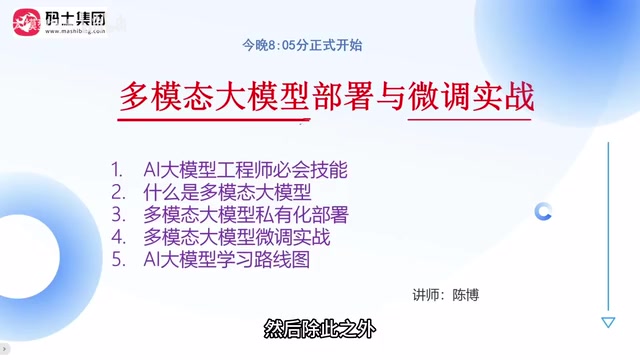
Bilibili public class: deployment is easy, fine-tuning is the real focus, plus a three-skill framework for engineers.
Based on a Bilibili public class, this article shares practical experience in multimodal LLM deployment and fine-tuning. Instructor Chen Bo notes deployment via existing inference tools has a low barrier, while fine-tuning is where effort is needed. He summarizes engineer skills into application development, training and fine-tuning, and underlying principles. The article concludes with learning advice: clarify the skill map, avoid over-focusing on deployment tools, and advance along three lines in parallel.
Multimodal large models are moving from the lab into engineering deployment, making deployment and fine-tuning essential skills for AI engineers. In a public class on Bilibili, instructor Chen Bo—who has over a decade of algorithm experience—shared insights on "deployment and fine-tuning in practice," with a focus on the fine-tuning phase: how to train multimodal large models with datasets to strengthen their capabilities on specific tasks.
Deployment vs. Fine-Tuning: Difficulty Gap and Learning Focus
At the outset, the instructor made a key judgment: deployment, leveraging existing inference tools, has a relatively low barrier to entry; the real effort should go into fine-tuning. This view aligns with what engineers generally experience in practice—inference frameworks are already quite mature, whereas fine-tuning involves data preparation, parameter adjustment, and performance evaluation, making it a longer chain with more variables.
The core logic of fine-tuning is not complex: prepare a corresponding dataset, feed it to the large model, train and adjust internal parameters to enhance the model's capability in a certain area. But there is a clear gap between "getting it to run" and "tuning it well," which is exactly where hands-on tutorials add value.
Inference Toolkit refers to software frameworks used to efficiently run trained large models in production environments, commonly including vLLM, TensorRT-LLM, TGI (Text Generation Inference), and others. These tools significantly reduce inference latency and memory footprint through operator fusion, KV Cache optimization, continuous batching, quantization (e.g., FP16/INT8/INT4), and other techniques, while supporting dynamic batching and distributed deployment. Since these frameworks are highly encapsulated, engineers only need to configure model paths and service parameters according to the documentation to complete deployment, hence the low entry barrier. However, note that deployment still involves engineering details such as service monitoring, concurrency tuning, and hardware selection—it's just that compared with fine-tuning, it is more standardized and has lower trial-and-error costs.
What AI Large Model Engineers Need to Master
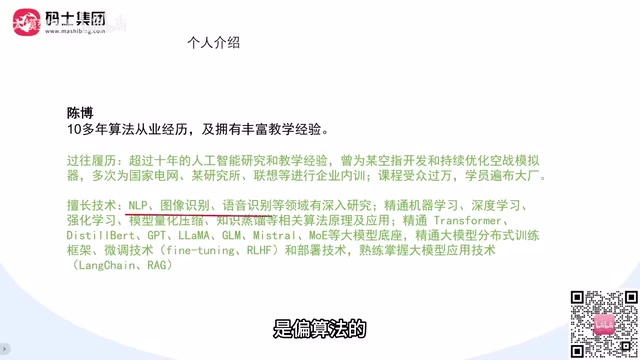
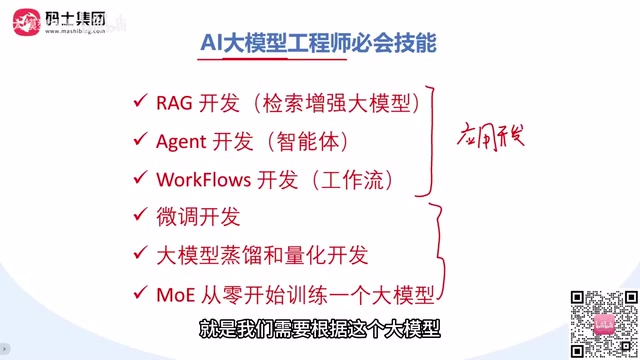
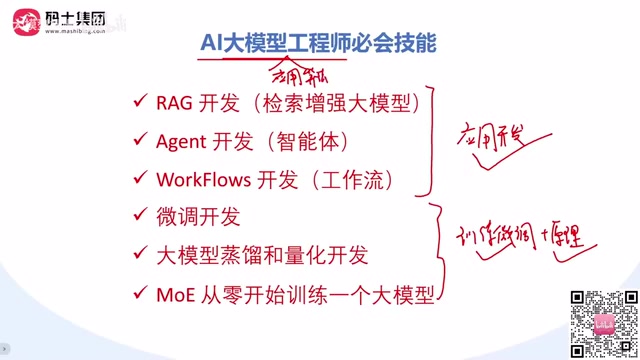
Instructor Chen Bo has over ten years of algorithm industry experience and has provided in-house training for enterprises, with a technical background in deep learning, machine learning, and large model algorithms. He summarized the skill requirements for large model-related positions into three aspects:
- Application development: Building applications based on large models, corresponding to roles such as AI large model application engineer and large model application backend engineer.
- Training and fine-tuning: Training and fine-tuning based on base models, corresponding to directions such as large model application algorithm engineer.
- Underlying principles: Understanding the working mechanisms and core knowledge of large models.
His assessment is that having all three capabilities—application development, fine-tuning training, and principle understanding—is sufficient in the current environment to qualify for large model-related engineer positions and meet the practical needs of enterprises. This summary cuts through over-granular skill anxiety and provides a relatively pragmatic competency framework.
Where Multimodal Fine-Tuning Fits in the Skill Map
The course topic "Fine-Tuning Multimodal Large Models" clearly falls into the second category—training and fine-tuning. Compared with pure text models, multimodal models handle multiple inputs such as images and text, placing higher demands on data organization and task design during fine-tuning. The instructor did not elaborate on specific technical details in the public class clip, but from his division of job competencies, it is clear that multimodal fine-tuning is one of the core competitive advantages of application algorithm engineers.
Multimodal Large Language Model (MLLM) refers to large-scale pre-trained models capable of simultaneously processing and understanding multiple modalities of data (such as text, images, audio, and video). Its typical architecture usually contains three core components: a modality encoder (e.g., a vision Transformer, used to convert images into feature vectors), a modality alignment module (mapping features from different modalities into a unified semantic space through projection layers or cross-attention mechanisms), and a large language model backbone (responsible for final semantic understanding and generation). Compared with pure text models, fine-tuning multimodal models not only requires adjusting language model parameters but often also freezing or fine-tuning modality encoders and carefully designing modality alignment strategies. Common fine-tuning approaches include full-parameter fine-tuning and parameter-efficient methods such as LoRA (Low-Rank Adaptation), the latter enabling good task adaptation under limited compute.
Implications for the Learning Path
The message from this public class offers two reference points for learners. First, clarify the job skill map before choosing learning priorities, avoiding excessive time on deployment tools at the expense of building fine-tuning capabilities. Second, fine-tuning capability requires dataset preparation and training practice—theory alone makes it hard to develop engineering intuition. For developers hoping to enter the large model field, advancing along three lines in parallel—application development, fine-tuning training, and principle understanding—is a relatively clear growth path.
Positioned as a "nanny-level hands-on" course, it emphasizes the combination of deployment and fine-tuning, and is suitable for developers who already have some deep learning foundation and wish to systematically fill in their large model engineering capabilities.
One-line Summary
A Bilibili public class points out that in multimodal large model practice, deployment has a low barrier while fine-tuning is the real learning focus, and offers a three-capability framework for engineers.
Paragraph Summary
Based on a public class on Bilibili, this article shares practical experience in deploying and fine-tuning multimodal large models. Instructor Chen Bo, with over a decade of algorithm experience, notes that deployment leveraging existing inference tools has a low barrier, while fine-tuning is where effort is needed. The core logic of fine-tuning is to prepare datasets, train models, and adjust parameters to strengthen specific capabilities. He summarizes large model engineer skills into three areas: application development, training and fine-tuning, and underlying principles, believing that mastery of all three qualifies one for the role. Multimodal fine-tuning falls under training and fine-tuning, with higher demands on data organization and task design. The article concludes with learning advice: clarify the skill map first, avoid over-focusing on deployment tools, support fine-tuning with datasets and training practice, and advance along three lines in parallel as a clear growth path.
Related articles

Vibe Coding Full-Stack in Practice: AI Programming from Beginner to Enterprise Deployment
From Cursor to Claude Code, this Bilibili AI programming course uses four progressive projects to cover full-stack development, open-source secondary development, and team collaboration. The article analyzes the shock to frontend roles, the efficiency shift from 50 people to 5, and the methodology required for enterprise-grade projects.

David Blaine's Global Quest for Real Magic: From South Africa to Japan and India
David Blaine travels to South Africa, Japan, and India in his Do Not Attempt special, documenting Spinning drivers, black mamba rescuers, iaijutsu masters, and ascetics—exploring the boundary between magic and real human极限 challenges.

Is a Touchscreen MacBook Coming? Vergecast Reveals Apple Executive's Response
Vergecast podcast reveals a conversation between a reporter and Apple executive John Ternus about a touchscreen MacBook and Apple Pencil support. Ternus says iPad is the best device for a stylus, while the reporter bets MacBook will eventually support Apple Pencil.