Museum of the City of New York: A Hand-Built City Model 21 Years in the Making
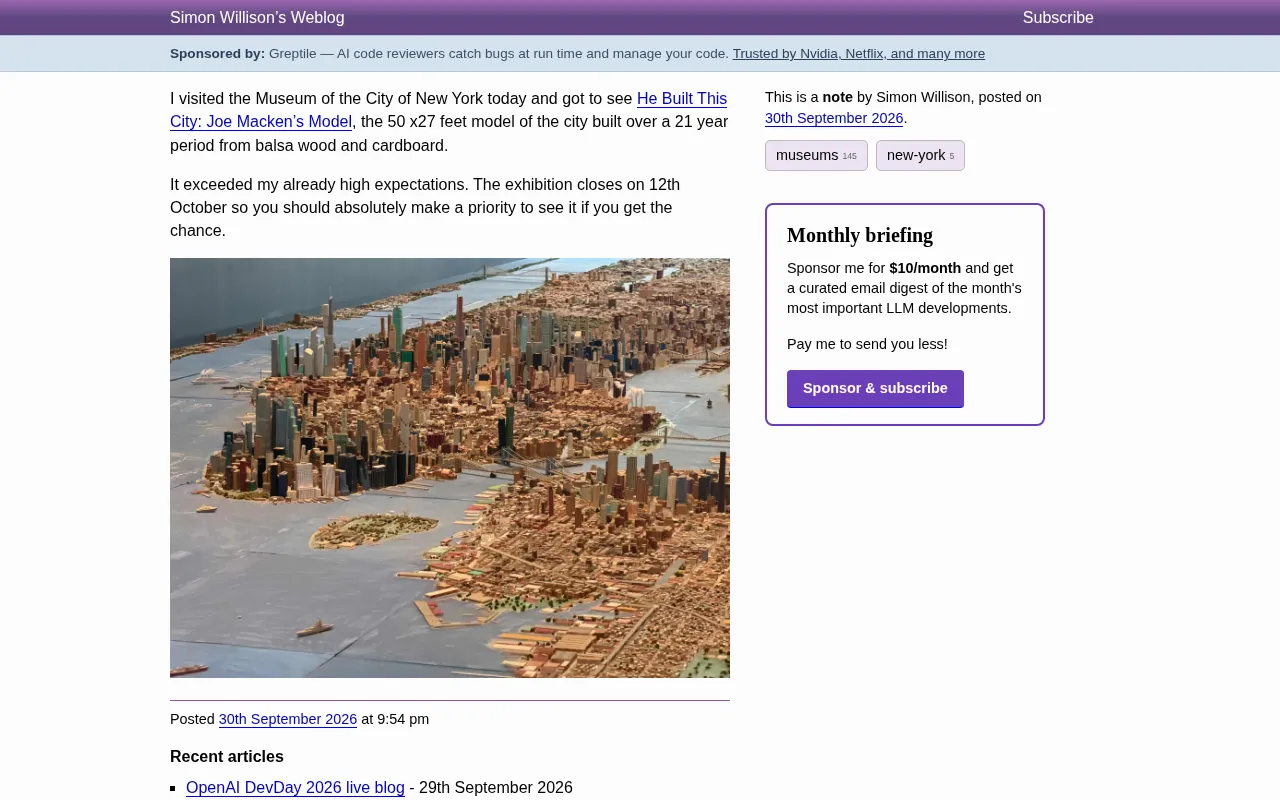
Joe Macken spent 21 years hand-building a 50×27-ft Manhattan scale model, now on display at the Museum of the City of New York until October 12.
The Museum of the City of New York is currently exhibiting *He Built This City: Joe Macken's Model* — a 50×27-foot miniature of Manhattan handcrafted from balsa wood and cardboard over 21 years. The model captures Manhattan's full urban fabric and extends into Brooklyn. Tech blogger Simon Willison visited and said the experience exceeded his already high expectations. In an age of 3D modeling and AI generation tools, this painstaking decades-long labor of love stands out for its time and human craftsmanship. The exhibition closes October 12.
A Breathtaking Miniature City
Tech blogger Simon Willison recently visited the Museum of the City of New York and documented his experience with an exhibit titled He Built This City: Joe Macken's Model. This is no high-tech digital installation — it's a purely handcrafted miniature city model, built by Joe Macken using balsa wood and cardboard over the course of 21 years.
The model measures 50 × 27 feet (approximately 15 × 8 meters), faithfully reproducing the urban fabric of Manhattan Island and extending into the edges of Brooklyn. For anyone familiar with New York City's cityscape, the combination of scale and detail alone is a visual shock.
Balsa wood is a lightweight timber native to Central and South America, with an extremely low density (around 0.12 g/cm³ — one of the lightest commercially available woods). This makes it a classic material in model-making: easy to cut, sand, and glue, and long favored by aircraft modelers, architects, and scale model builders alike. Constructing a city-scale miniature by hand from balsa wood means individually cutting, shaping, and assembling every single building. Over a 21-year span, this highly repetitive work takes on a quality that is almost meditative in nature.
An Experience That Exceeded Expectations
Simon Willison admitted that he already had high expectations going in — and that the actual experience "exceeded my already high expectations." In the wide-angle photographs he took, the dense, orderly spread of Manhattan's buildings stretches out in remarkable detail, with Brooklyn's edges carefully rendered along the perimeter.
This kind of work — completed independently by a single person over more than two decades — embodies a spirit of craftsmanship that today's digital modeling tools simply cannot replicate. In an era where 3D modeling, laser scanning, and AI-generated imagery are increasingly commonplace, a city model built piece by piece by hand from wood and cardboard feels all the more precious for the time invested and the human touch it carries.
Limited Run — Worth a Special Trip
Willison specifically noted in his post that the exhibition closes on October 12. He recommends that anyone with the opportunity to visit New York should "make a priority to see it if you get the chance."
For readers who love urban planning, architectural models, or handcraft, this work — the product of 21 years of dedication — is both a tribute to the city of New York and a story about patience and perseverance. The exhibition is located at the Museum of the City of New York; interested readers can check the museum's official website for details and opening hours.
Note: This article is based on Simon Willison's firsthand visit account and covers exhibition information and personal impressions — it is not a technical review.
Related articles

The Touchscreen MacBook and Apple's Delightful Mess: A Deliberate Gamble
The Vergecast unpacks the touchscreen MacBook Pro's launch logic, the ProLed naming controversy, the iPad squeezed between iPhone and Mac, and how Apple stays competitive with premium hardware in the AI era.

Fifty Years Studying Power: Robert Caro's Writing and Insights on Power
Robert Caro reflects on 50 years studying power: Lyndon Johnson's persuasion and leverage, Robert Moses's transformation from idealist to ruthless builder, the dilemmas of large-scale construction, and his methods of compressing themes and solitary focus in biography writing.

Can a $20,000 Robot Do Your Chores? The Test Results Are Surprising
A YouTube test video shows how a $20,000 robot responds to commands like washing dishes, turning off lights, taking out trash, and feeding the dog. This article analyzes its real capability boundaries, the state of voice interaction technology, and how far household robots are from mainstream adoption.