n8n and Agentic AI in Practice: Build AI Automation Workflows in 90 Days

A 90-day Telugu-taught bootcamp for building AI agents and n8n automation workflows.
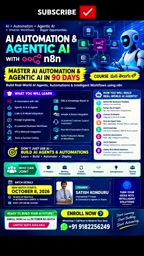
This 90-day hands-on training program, taught in Telugu, helps learners shift from "using AI" to "building AI." Using n8n as the core automation framework, the course covers AI agent development, LLM integration, RAG, database operations, and API connectivity — all grounded in real-world business scenarios. It targets IT freshers, working professionals, developers, and career switchers, with local-language instruction filling a gap in technical education for non-English-speaking regions. The new batch starts October 8th.
From Using AI to Building AI
Most people today interact with AI at the "user" level — opening a chat interface, typing a prompt, copying the output. But the people who truly stand out in the job market are those who can build: developers who can construct AI agents, wire together automated workflows, and integrate large language models (LLMs) with real business systems.
That's exactly the core philosophy behind this 90-day hands-on training program taught in Telugu — "Don't just use AI. Build AI agents and automations." The course targets IT freshers, working professionals, developers, and career switchers, with a strong emphasis on practical, project-based learning over pure theory.
Why n8n as the Automation Backbone
n8n is an open-source workflow automation tool that has gained significant traction in the AI developer community. Compared to SaaS solutions like Zapier or Make, n8n's advantages lie in its self-hosting capability, visual node-based orchestration, and openness to custom code and APIs — making it especially well-suited for building complex business workflows with AI capabilities.
The course positions n8n as the central automation framework, covering everything from basic node connections to sophisticated AI workflows. Students don't just learn to drag and drop automations — more importantly, they learn how to embed LLM calls, database operations, and external APIs into production-ready pipelines. This tool-centric, project-driven teaching approach is far more aligned with real-world work than studying technologies in isolation.
Technology Stack Covered
According to the course overview, the 90-day curriculum systematically covers the following key modules:
AI Agents and LLM Integration
Learn how to build AI agents capable of executing tasks autonomously, and integrate large language models into automated workflows. This is the essence of Agentic AI — enabling AI not just to answer questions, but to plan steps, invoke tools, and complete multi-stage tasks.
The fundamental difference between an AI agent and a standard LLM call lies in the decision loop: a standard call is a one-shot input/output exchange, while an agent continuously perceives its environment, plans the next action, calls external tools (such as search, code execution, or API requests), and decides whether to continue or terminate based on the results. This pattern is commonly referred to as the ReAct (Reasoning + Acting) or Tool-Use framework. Common implementations include LangChain's Agent module, OpenAI's Function Calling / Assistants API, and simulating agent behavior directly in n8n through node chaining. A key challenge in Agentic AI is managing the model's hallucination risks and controlling tool-call boundaries — which is why designing proper error handling and human-in-the-loop nodes in real projects is just as important.
RAG and Databases
Retrieval-Augmented Generation (RAG) is the key technology for enabling AI to answer questions based on private knowledge bases. The course combines RAG with database operations, helping students understand how to make intelligent agents "read" proprietary organizational data rather than relying solely on the model's general knowledge.
RAG (Retrieval-Augmented Generation) works by retrieving relevant text snippets from an external knowledge base before prompting the LLM, then passing those snippets as context along with the question — allowing the model to respond based on real-time, private data rather than only the static knowledge acquired during training. Its core components typically include text embedding, a vector database (such as Pinecone, Weaviate, or pgvector), and similarity-based retrieval. For enterprise applications, the significance of RAG is that it allows AI to access internal documents, product manuals, and customer service records without retraining the model — balancing cost efficiency with knowledge freshness. Combining RAG with n8n's workflow nodes enables a complete automated pipeline: user query → knowledge base retrieval → context assembly → LLM call → response returned.
APIs and Real-World Workflows
Connect various services through APIs to build end-to-end applications for practical scenarios. The emphasis on "real-world AI workflows" means that course examples are grounded in deployable business requirements — not toy demos.
Who Is This For?
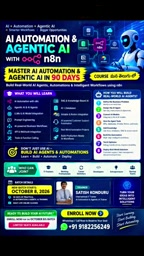
The course explicitly targets four groups: IT freshers, working professionals, developers, and career switchers. This positioning reflects a broader trend: AI automation skills are expanding beyond the exclusive domain of professional developers into a wider range of career paths.
For newcomers, mastering a tool like n8n — low barrier to entry but high ceiling — is a pragmatic path into AI engineering. For working professionals and developers, it's an opportunity to build hands-on Agentic AI capabilities. For career switchers, project-focused training helps build a demonstrable portfolio faster.
One notable aspect is that the course is taught in Telugu, filling a gap in technical training resources for non-English-speaking regions. Local-language instruction significantly lowers the comprehension barrier and makes quality learning more accessible to regional audiences.
Enrollment Information
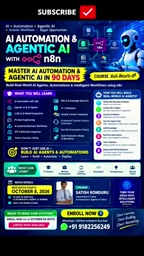
The new course batch begins on October 8th, following a cohort-based format. Interested learners can reach out via phone or WhatsApp to inquire and enroll (+91-918-225-6249).
Takeaway
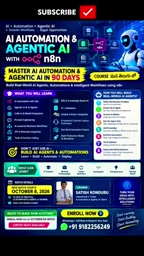
This is a practice-oriented, regionally focused training program built around n8n and Agentic AI. From a technical stack perspective, it addresses several key dimensions of AI application development today — automation orchestration, intelligent agents, LLM integration, RAG, and APIs. For learners looking to transition from "AI user" to "AI builder," this kind of program offers a structured path from beginner to practitioner. As with any course promotion, the actual teaching quality and outcomes are best evaluated alongside real student reviews and feedback.
Related articles

Mistral Large 4 Open-Sources a Trillion Parameters, Microsoft Offers Voluntary Severance to 60,000 Employees
Mistral Large 4 open-sources a trillion-parameter multimodal model with a coding agent score of 48; SanDisk earnings show AI inference reshaping NAND demand; Google Gemini adds in-app file editing, OpenAI raises Codex quotas, and Microsoft offers voluntary severance to 60,000 employees.
Mistral Large 4 Opens Its Weights: AI Morning Brief Roundup of Models and Ecosystem Trends
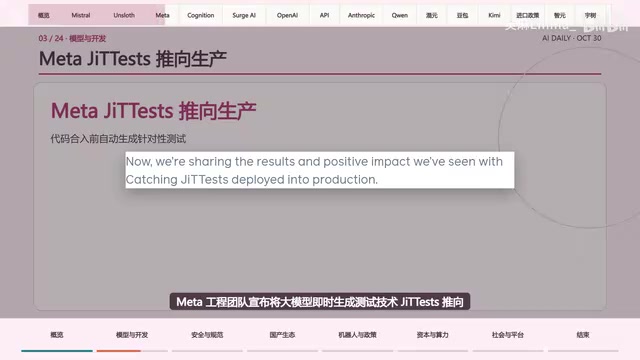
Mistral Large 4 opens its weights, a 1-trillion-parameter MoE architecture that can run locally on MacStudio; Meta's test-generation technology enters production; top tax benchmark pass rate only 10.8%; Canadian government takes a stake in Cohere; Doubao Work opens third-party model calls. This AI Morning Brief rounds up model, ecosystem, capital, and policy developments.
Mistral Large 4 Goes Open Source: A 1T-Parameter European Qwen Challenging DeepSeek
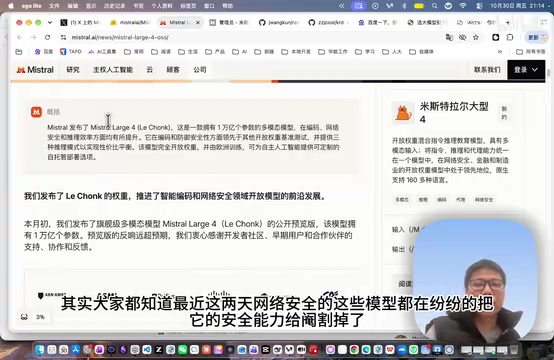
Mistral Large 4 is now open source: 1T total parameters, 52B activated, focused on coding and cybersecurity, with ~610G NVFP4 weights. We analyze its comparison with DeepSeek V4 Flash, API pricing, demo realism, and local deployment value.