Naming the World's Most Famous Sourdough: Hunter Schafer and Michelle Yeoh's Fermentation Experiment

A celebrity conversation anthropomorphizes sourdough as a "little creature," reflecting the healing power and social传播 logic of fermentation culture.
The article uses the conversation between Hunter Schafer and Michelle Yeoh around a jar of sourdough as an entry point to analyze why this short video went viral. In the conversation, Schafer calls the starter a "little creature" and asks whether it has a name, while Michelle Yeoh wonders whether it has made all the pizza dough. The article points out that naming starters is a common habit in fermentation culture, rooted in acknowledging the "personality" of the microbial community and a sense of responsibility for care. From a technical perspective, sourdough is a dynamic symbiotic system of yeast and lactic acid bacteria, and refrigeration is a common means of dormant preservation. The article further places this conversation in the context of the continued rise of home baking on social media, arguing that it brings core fermentation elements such as care, waiting, naming, and companionship into the context of celebrity daily life, while the video title soliciting names from viewers is a clever interactive design.
When Celebrities Start Raising a "Little Creature": An Unexpected Viral Fermentation Conversation
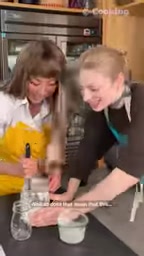
In a short YouTube video, Hunter Schafer and Michelle Yeoh have a seemingly casual yet metaphor-rich conversation around a jar of sourdough. In the video, Schafer points at the container and asks: "Does it have a name? All of it?" The two then mix the dough, and Yeoh curiously follows up: "Wait, so does that mean that this little creature has made all of the pizza dough?" After getting a negative answer, she softly says "Oh, okay," then with a smile thanks the other: "Thank you, love you!" Finally, this lump of dough referred to as a "little creature" is put into the fridge, having its own "home."
There are no complicated operations or technical terms in the scene, but it is precisely this anthropomorphic expression of fermented dough that turns an everyday kitchen moment into a miniature narrative about creation, growth, and companionship.

Why "Naming the Dough" Resonates
The Biology of Fermentation and Emotional Projection
Sourdough is essentially a symbiotic system formed by flour and water under the action of wild yeast and lactic acid bacteria. It needs to be regularly "fed"—replenished with flour and water—to maintain the activity of the microbial community. When Schafer refers to it as a "little creature," she is actually tapping into a common psychological habit in fermentation culture: many home bakers name their starters and treat them as pets rather than ingredients.
This anthropomorphism is not meaningless cute rhetoric. The microbial community does change with the environment, feeding frequency, and flour type, forming unique flavor characteristics. Naming a starter is, to some extent, acknowledging its "personality" and establishing a sense of responsibility for continuous care.
Sourdough starter is a stable microbial community formed by the long-term symbiosis of wild yeast and lactic acid bacteria. Common yeasts include Kazachstania humilis and Saccharomyces cerevisiae, while lactic acid bacteria are mainly from the genus Lactobacillus. Yeast ferments sugars to produce carbon dioxide, which makes the dough rise, while lactic acid bacteria produce lactic acid and acetic acid, giving the sour taste. The ratio of the two is affected by flour type, water content, temperature, and feeding frequency, so each household's starter differs in flavor and fermentation vitality. This "locality" and "individuality" are the scientific basis for bakers to regard it as a unique living entity.
From "It Hasn't" to "Maybe Someday"
Michelle Yeoh's question—"Has this little creature made all the pizza dough?"—receives a frank no. But the immediate follow-up is meaningful: if it grows big enough and strong enough, maybe one day it can.
This sentence highlights the time dimension of fermentation. Sourdough is not an instant product; its capacity accumulates over time and care. A newly started starter cannot make large batches of dough, but after continuous feeding and stable reproduction, it can become the core productivity of home baking. This "growth narrative" gives a jar of batter in the kitchen an appeal similar to a raising game.

Technical Perspective: Sourdough as a "Living System"
Stability and Variability of the Microbial Community
From the perspective of food science, sourdough is a dynamic microbial ecosystem. Yeast is responsible for gas production, and lactic acid bacteria for acid production; the balance between the two determines the fermentation speed and flavor direction of the dough. Different regions, different flours, and even different people's hand environments can all lead to differences in starter community composition.
This is also why "naming the starter" is not just an emotional act—it marks a unique microbial community formed under specific environmental conditions. When a baker says "this is my starter," behind it is a microbial combination selected in a particular kitchen.
Stability of the microbial community refers to the ability of a starter to maintain a relatively constant ratio of yeast to lactic acid bacteria during long-term feeding. A highly stable starter has predictable fermentation times and consistent flavor; variability comes from environmental disturbances, such as changing flour brands, temperature fluctuations, or long periods without feeding. Research shows that after several weeks of continuous feeding, the starter community tends to stabilize, but a sudden change in flour type may lead to community reorganization, causing slow fermentation or abrupt flavor changes. This explains why bakers often emphasize "don't change flour casually"—they are actually maintaining an already adapted micro-ecosystem.
The Fridge: A Technical Choice for Dormancy and Preservation
The video mentions that the dough is put into the fridge. Low-temperature refrigeration is a common way for home bakers to preserve starters; it can reduce microbial metabolic rates and decrease feeding frequency. But refrigeration also brings the problem of community recovery: after taking it out, multiple feedings are needed to restore activity.
Schafer says "Now it has a home," describing the fridge as a residence rather than a storage device. This language shift once again reinforces the "living thing" frame. Technically, the fridge does provide a stable dormant environment, but the word "home" gives it warmth.

Low-temperature refrigeration for preserving starters works by reducing the microbial metabolic rate. At around 4°C, the reproduction and gas production activities of yeast and lactic acid bacteria slow significantly, and the starter enters a near-dormant state, thereby extending the feeding interval from once a day to once a week. But refrigeration also has side effects: lactic acid bacteria still slowly produce acid at low temperatures, and long-term refrigeration may lead to excessive acidity. After taking it out, some old starter needs to be discarded, fresh flour and water added, and 2-3 consecutive feedings are required to restore fermentation vitality. Therefore, "putting it in the fridge" is not a once-and-for-all solution but part of rhythm management.
Fermentation Fever in Popular Culture: The Larger Trend Behind a Conversation
What makes this video noteworthy is not how much technical information it provides, but that it brings fermentation into the context of celebrity daily life. In recent years, home baking and sourdough have continued to heat up on social media. From the home bread craze during the pandemic to becoming part of lifestyle content today, fermentation has changed from a kitchen skill into a cultural symbol with a healing quality.
The conversation between Hunter Schafer and Michelle Yeoh does not deliberately popularize science, but it happens to present several core elements of fermentation culture: care, waiting, naming, and companionship. Michelle Yeoh's final "Thank you, love you!" is everyday politeness, but in the context of a "little creature," it carries an extra layer of salute to a living entity.
An Open Invitation for Naming Suggestions
The video title directly solicits names from viewers: "Taking name suggestions for the World's Most Famous Sourdough Starter." This itself is a clever interactive design—handing the naming right to the audience increases participation and gives an ordinary jar of starter narrative continuity.
If you were to name it, you could consider several directions: draw inspiration from the "symbiotic" characteristics of the microbial community; use the clue that it is put into the fridge and enters dormancy; or simply use a name related to "waiting" and "growth." After all, according to the logic in the conversation, although this "little creature" cannot make all the pizza dough now, it has a home, a name, and an expected future.
Related articles
 Tech Frontiers
MuJoCo: An Analysis of DeepMind's Open-Source General-Purpose Physics Simulator
An in-depth analysis of Google DeepMind's open-source physics simulator MuJoCo: high-performance C++ kernel, MJCF modeling format, contact solving principles, MJX GPU acceleration, and robot reinforcement learning use cases.
 Tech Frontiers
Claude API Quick Start: The Official Quickstarts Project Collection
Anthropic's official claude-quickstarts project collection helps developers quickly build deployable apps with the Claude API. Nearly 20k stars, Python-based, great for beginners and prototyping.
 Tech Frontiers
AI Agents Connecting Directly to APIs: Which Calls Can Be Safely Allowed?
AI agents can call any API, but the real challenge is deciding which calls can be safely allowed. This article analyzes allowance decisions from three dimensions—intent matching, least privilege, and controllable impact—and argues that the control layer should sit outside the agent, combined with audit traceability to build a trustworthy API call governance mechanism.