Nasdaq Plunges 5%: The Post-Election Retreat from the AI Trade

Nasdaq drops 5% in a day as post-election investors exit the AI trade, sparking bubble debate and valuation reset.
Based on a market update from Hacker News, the article analyzes the Nasdaq's 5% single-day decline attributed to investors collectively exiting AI trades after the election. The author notes that the drop reflects rapid deleveraging of concentrated AI bets and serves as a stress test of AI commercialization timelines and expectation management. Post-election uncertainty in regulatory, fiscal, and trade policy has shaken the "policy friendliness + capital inflow" assumptions underlying high AI valuations, prompting capital to step aside. The article emphasizes distinguishing the index decline from obstacles to AI technology deployment, arguing that a return to rational valuations may benefit AI companies with real revenue while concept-driven projects face a tougher financing environment. Given limited source information, trend judgments should remain cautious.
Market Signal: AI Stocks Hit by Sharp Pullback
According to discussions in the Hacker News community, the Nasdaq index fell 5% in a single day, with the market attributing the drop to investors collectively exiting AI-related trades after the election. This decline represents a significant move for a tech-heavy index and reflects the market's reassessment of short-term valuations in the AI sector.
Although the original source provides only a brief market update, the figure of "5%" alone sends a clear signal: the concentrated bets on AI from earlier periods are undergoing a rapid round of deleveraging. For those watching the tech industry, this is not just a matter of stock prices — it is a stress test of AI commercialization timelines and expectation management.
The Nasdaq index is one of the three major U.S. stock indices, dominated by tech stocks and growth companies. Its constituents include large tech firms such as Apple, Microsoft, and Nvidia, so it is often regarded as a barometer of the tech industry's health. Because the index is highly concentrated in high-valuation growth stocks, it is particularly sensitive to changes in interest rate expectations, risk appetite, and macroeconomic sentiment. A single-day drop of 5% is a relatively rare and severe move by historical standards, typically occurring only during financial crises, major policy shifts, or systemic risk events.
Deleveraging refers to the process by which investors voluntarily or involuntarily reduce borrowed positions and lower risk exposure. In the AI trade, much capital amplified its bets through margin financing, options, or leveraged ETFs. When market sentiment reverses, margin calls or risk-control rules force these positions to be liquidated in concert, which in turn magnifies the decline. This mechanism explains why the index's drop was rapidly amplified within a short period, and it also suggests that this pullback has a technical selling component rather than being driven purely by changes in fundamentals.
Why the Election Became a Turning Point for the AI Trade
The market widely links this pullback to post-election policy uncertainty. Election results often bring reassessments of regulatory expectations, fiscal direction, and trade policy, while the previously high valuations of the AI sector were largely built on the dual assumptions of "policy friendliness + capital inflow." When those assumptions need to be re-verified, capital chooses to step aside and wait.
Discussions on Hacker News (albeit with very few comments) suggest that some tech practitioners view this decline as an emotion-driven short-term reaction rather than a deterioration in AI fundamentals. But indeed, the AI trade had accumulated considerable gains over the past period, and any macroeconomic variable could trigger profit-taking.
Impact on the AI Industry: The Bubble Debate Resurfaces
A 5% Nasdaq decline will quickly be interpreted as evidence of an "AI bubble." What needs to be distinguished is that the index decline reflects a contraction in investors' risk appetite for AI-related assets, which is not equivalent to obstacles in AI technology deployment. Enterprise AI adoption, model capability iteration, and infrastructure investment are still ongoing, but the pricing logic of capital markets has shifted from "boundless optimism" to "demanding visible returns."
This shift may not be a bad thing for the industry. When valuations return to rationality, AI companies with real product revenue and customer value will find it easier to secure sustained funding, while concept-driven projects will face a harsher financing environment.
The core of the AI bubble debate is whether asset prices have significantly deviated from their intrinsic value. Proponents of the "bubble theory" argue that valuations in the AI sector have already priced in years of future earnings expectations, and that many companies have yet to generate revenue commensurate with their market caps; opponents point out that AI infrastructure investment, enterprise adoption rates, and model capability improvements have a real commercial basis, fundamentally different from the speculation lacking profit models seen in the 2000 dot-com bubble. Distinguishing "technology deployment" from "capital pricing" is key to understanding this debate: the former concerns whether AI can sustainably create productivity value, while the latter reflects how much premium the market is willing to pay for these future cash flows — and the two do not always move in sync.
What Investors Will Watch Next
In the short term, the market will closely monitor capital flows in the coming trading days and the degree to which post-election policy signals become clear. Volatility in the AI sector may remain elevated until a new consensus forms. For long-term observers, this pullback offers a window to reassess the quality of AI companies and how well their valuations match.
The original information is limited, presenting only the index decline and market attribution without covering specific stocks, policy details, or institutional views. Therefore, judgments about trends should remain cautious, avoiding excessive extrapolation.
Risk-off is a state in which market sentiment turns defensive, manifested by capital flowing from risk assets such as stocks into safe-haven assets such as Treasuries, gold, or cash. In the AI sector, risk-off tends to hit the highest-valuation, furthest-from-profit names first, while companies with stable cash flow are relatively resilient. Key things to watch going forward include: whether capital continues to flow out of tech funds, whether the volatility index (VIX) remains elevated, and the specific implementation of post-election regulatory and fiscal policy. These signals will determine whether this pullback is a short-term release of sentiment or the starting point of a longer-term valuation reset.
Related articles
 Tech Frontiers
Coldframe: A Honeypot Disguised as a Supermarket Freezer Controller
Coldframe is a honeypot disguised as Danfoss AK-SM 800A and Dixell XWEB freezer controllers, built as a single Python file that detects CVE-2025-41450 attempts and is identified as real devices on Shodan.
 Tech Frontiers
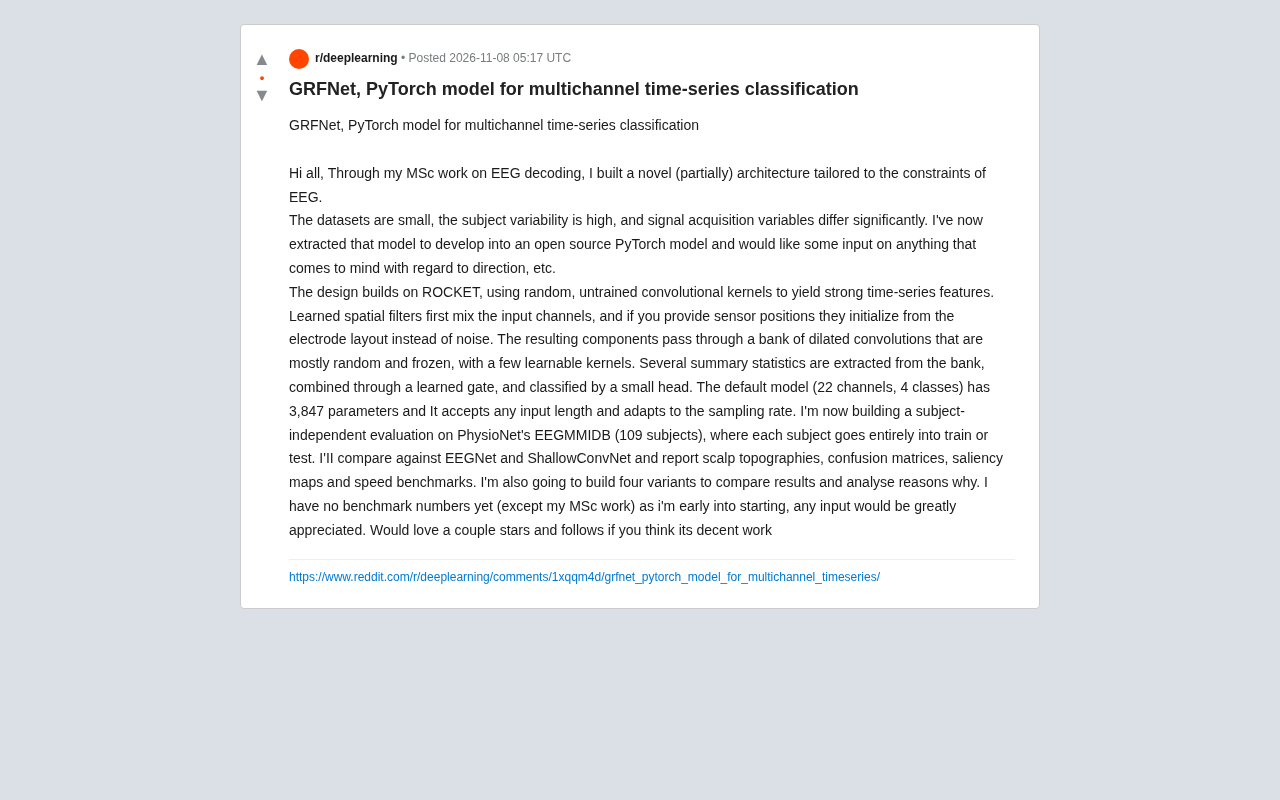
GRFNet: A Lightweight PyTorch Model Designed for Multichannel Time-Series Classification
GRFNet is a lightweight PyTorch model for multichannel time-series classification, originating from EEG decoding research. With only 3,847 parameters, it is based on the ROCKET architecture, combining random convolution kernels with learnable spatial filters, supports arbitrary input lengths, and will soon be evaluated on the PhysioNet dataset.
 Tech Frontiers
CUDA-Accelerated Rocket League Simulator: A Player-Made Hardcore Experiment
A Reddit post shows a "100% Accurate" Rocket League simulator accelerated with CUDA. We analyze its technical context, CUDA's value in game physics simulation, and the significance and limitations of such community projects.