Nemotron Post-Training in Practice: Localize a Model to French in 5 Steps

NVIDIA's tutorial breaks down the five-step Nemotron post-training process, transferable to any language.
The article introduces a 5-minute tutorial by NVIDIA developer Sophie on how to post-train the Nemotron model for French (or any language/culture). Opening with a government customer-service bot's wrong passport-policy answer, it shows base models lack local procedural knowledge and tone, making post-training essential. The solution relies on three components: Nemotron personas, a synthetic dialogue pipeline, and LoRA fine-tuning with systematic evaluation. The official eight-stage process is simplified into five steps: define behavior, generate synthetic dialogues, review and split data, LoRA fine-tuning, and deploy and evaluate. Only the personas dataset, behavior contract, and review rules need changing to transfer the loop to other languages, and all datasets, models, recipes, and libraries are open.
Why Is Post-Training Needed?
Base models typically cover only broad linguistic and cultural contexts; they know little about a specific region's official procedures, policy details, or even its conventions of expression. The NVIDIA Nemotron team gives a vivid example in its tutorial: a customer asks a government support bot, "I can't travel due to illness—how do I apply for a passport?" The base model's answer conflicts with the real policy, and its tone doesn't sound like customer service either. A post-trained model, by contrast, can answer accurately and in the expected tone.
This shows that post-training is indispensable if AI is to truly serve local scenarios. Recently, NVIDIA developer Sophie released a 5-minute tutorial that breaks down in detail how to post-train the Nemotron model for French (or any language/culture).
Post-training is an umbrella term for techniques that adjust a model's behavior through additional data and training stages after large-scale pre-training is complete. Common approaches include supervised fine-tuning (SFT), parameter-efficient fine-tuning (such as LoRA), and preference alignment (such as RLHF/DPO). Pre-training gives a model general language ability and broad world knowledge, but its training corpus consists mainly of general web text, which struggles to cover the policy details, administrative procedures, and customer-service tone of a particular country or region. Post-training exists precisely to inject domain knowledge, constrain output formats, and shape conversational style on top of that foundation, turning a model from "knows a little about everything" into "reliable and usable in a specific scenario." Compared with pre-training from scratch, post-training is cheaper and iterates faster, making it the mainstream path today for bringing general-purpose large models into vertical scenarios.
Three Core Components
The tutorial notes that achieving the above results depends on three core elements:
- Nemotron personas: help define the target audience and clarify the identity and style with which the model should interact with users.
- Synthetic dialogue generation pipeline: used to automatically produce high-quality, diverse training data—the data foundation for post-training.
- Fine-tuning and evaluation workflow: includes LoRA fine-tuning and systematic evaluation methods to ensure the model's behavior meets expectations.
These three components span the entire process from data to deployment, and they are also the key to automating the subsequent steps.
LoRA (Low-Rank Adaptation) is a parameter-efficient fine-tuning method. It freezes all of the base model's original weights and injects two small low-rank matrices alongside certain linear layers, updating only these two matrices during training. Because the number of trainable parameters is typically only about one-thousandth of the original model, LoRA significantly reduces memory usage and training time, and the output is a very small adapter file that is easy to distribute and swap. At inference time, the adapter weights can be merged back into the original model without adding extra latency. This is exactly why LoRA is particularly well suited to the deployment pattern of "one base model + multiple scenario adapters"; the mention that "LoRA parameters have been pre-tuned for the architecture" refers to default hyperparameter configurations—such as learning rate, rank size, and target layers—provided for a specific model structure.
The Eight Stages Broken Down into Five Hands-On Steps
The official team simplifies the complete eight-stage process into five easy-to-follow steps, explained one by one below.
Step 1: Define the Target Behavior
Before starting any training, you must clearly define the behavioral standard the model needs to meet. This includes dimensions such as output format, tone, and knowledge scope. The clearer the definition, the more targeted the subsequent synthetic data will be.
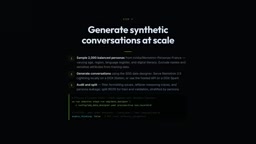
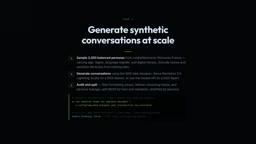
Step 2: Generate Synthetic Dialogues at Scale
Based on the behavior definition from Step 1, sample balanced character profiles from the personas dataset, then use the data design pipeline to generate dialogues in batches. You can choose to run 3.5 Lightning locally or call the hosted API on build.nvidia.com directly. The output of this step is the data source for subsequent training and validation.
Step 3: Review and Split the Data
The generated data cannot be used directly; it must be checked item by item for formatting issues, leftover reasoning traces, and character leakage. Once it passes review, split the data into a training set and a validation set.
The "leftover reasoning traces" mentioned in synthetic data review refer to the extra thinking process, draft-style analysis, or intermediate derivation text that a generative model attaches before outputting its final answer; "character leakage" refers to dialogue that exposes setting information that should have remained hidden—for example, the model calling itself an AI assistant, mentioning the personas configuration, or repeating system prompt content directly to the user. These two types of problems are very common in synthetic dialogues, and if they make it into the training set, the fine-tuned model will learn to include irrelevant content in formal replies or to break character consistency. Therefore, the review stage usually requires a combination of rule-based filtering and manual spot checks, and when splitting the training/validation sets, you should ensure both have consistent distributions so that an overly simple validation set doesn't cause you to overestimate performance.
Step 4: LoRA Fine-Tuning
Fine-tune the base model using LoRA. The tutorial notes that the LoRA parameters for the Lightning model have already been pre-tuned for its architecture, so you only need to update the data path and training parameters to get started. If your hardware environment is not a DGX series, you can adjust the settings yourself to suit your own equipment.
Step 5: Deployment and Evaluation
Deploy the base model and the fine-tuned model separately, run both pipelines simultaneously with the prompts you prepared earlier (or prompts designed on the spot), and compare the outputs. Focus on checking for hallucinations, tone drift, or replies that are out of character. Once you're satisfied with the results, you have a post-trained model customized for a specific use case.
Beyond French: A General Methodology
The tutorial emphasizes that although the demonstration uses French as an example, the entire process is not limited to that one language. You only need to replace the personas dataset and adjust the behavior contract and review rules accordingly; the loop logic is exactly the same. This means developers can quickly transfer the same methodology to any language or cultural scenario.
For scenarios that need further optimization, NVIDIA also provides reinforcement-learning-based improvement approaches and multi-node distributed training recipes; you can refer to the relevant resources for Nemo RL and Nemo Gym.
An Open Ecosystem, Ready to Use
The most appealing point is that all components of this solution—datasets, models, recipes, and libraries—are already open and available. Developers don't need to build from scratch; they can start experimenting directly on top of existing resources.
From defining behavior to evaluating deployment, the five steps cover the critical path of post-training. Whether you want to build a customer-service bot for the French market or customize a model for another language, this process from Nemotron is worth trying.
One-line Summary
An NVIDIA tutorial breaks down the five-step Nemotron post-training process, transferable to any language scenario.
Paragraph Summary
The article introduces a 5-minute tutorial released by NVIDIA developer Sophie on how to post-train the Nemotron model for French (or any language/culture). It opens with an example of a government customer-service bot giving a wrong answer about passport policy to illustrate that base models lack local procedural knowledge and an appropriate tone, making post-training indispensable. The solution relies on three core components: Nemotron personas to define the target audience and style, a synthetic dialogue generation pipeline to batch-produce training data, and LoRA fine-tuning with systematic evaluation to ensure the behavior meets expectations. The official team simplifies the eight-stage process into five hands-on steps: define the target behavior, generate synthetic dialogues at scale, review and split the data, LoRA fine-tuning, and deployment and comparative evaluation. The article stresses that you only need to replace the personas dataset and adjust the behavior contract and review rules to transfer the same loop to other languages, and that all datasets, models, recipes, and libraries are already open.
Related articles

DoorDash Announces Acquisition of Instacart: The Local Delivery Landscape Shifts
DoorDash officially announces its acquisition of Instacart, shifting the local delivery market. This article outlines the deal, the divided views in 472 Hacker News comments, and the key variables of regulatory review and business integration.

IKEA's Donut-Shaped Smart Lamp on Sale: Varmblixt Drops $20
IKEA's Varmblixt donut-shaped smart lamp is on limited-time sale for $79.99, a $20 discount, through November 11. Learn about design highlights, review feedback, and buying advice.

Vercel Flags SDK Cold Start 7x Faster, No Longer Extends Function Duration
Vercel Flags SDK optimization: cold start initialization drops from 70ms to 10ms (~7x faster); usage reporting now handled by the runtime, no longer extending function execution time. Learn how to upgrade and what it means for developers.