Neural Network Optimizers Have Random Names? Community Complains Search Is Too Hard

Neural network optimizers have whimsical names that collide with everyday words, causing inefficient searches and requiring community consensus.
Starting from a Reddit user's complaint about optimizer names like SOAP, Shampoo, and FOAM, the article notes that these algorithms share names with household products or physics terms, causing search troubles for researchers. The naming trend stems from the need for papers to attract attention and spread quickly, but it has become a naming competition that reduces information retrieval efficiency. The author suggests using qualified keywords, searching academic platforms like arXiv and Google Scholar, and leveraging community sharing, and calls for soft naming constraints with full names and domain labels in papers.
When Optimizer Names Become a Search Nightmare
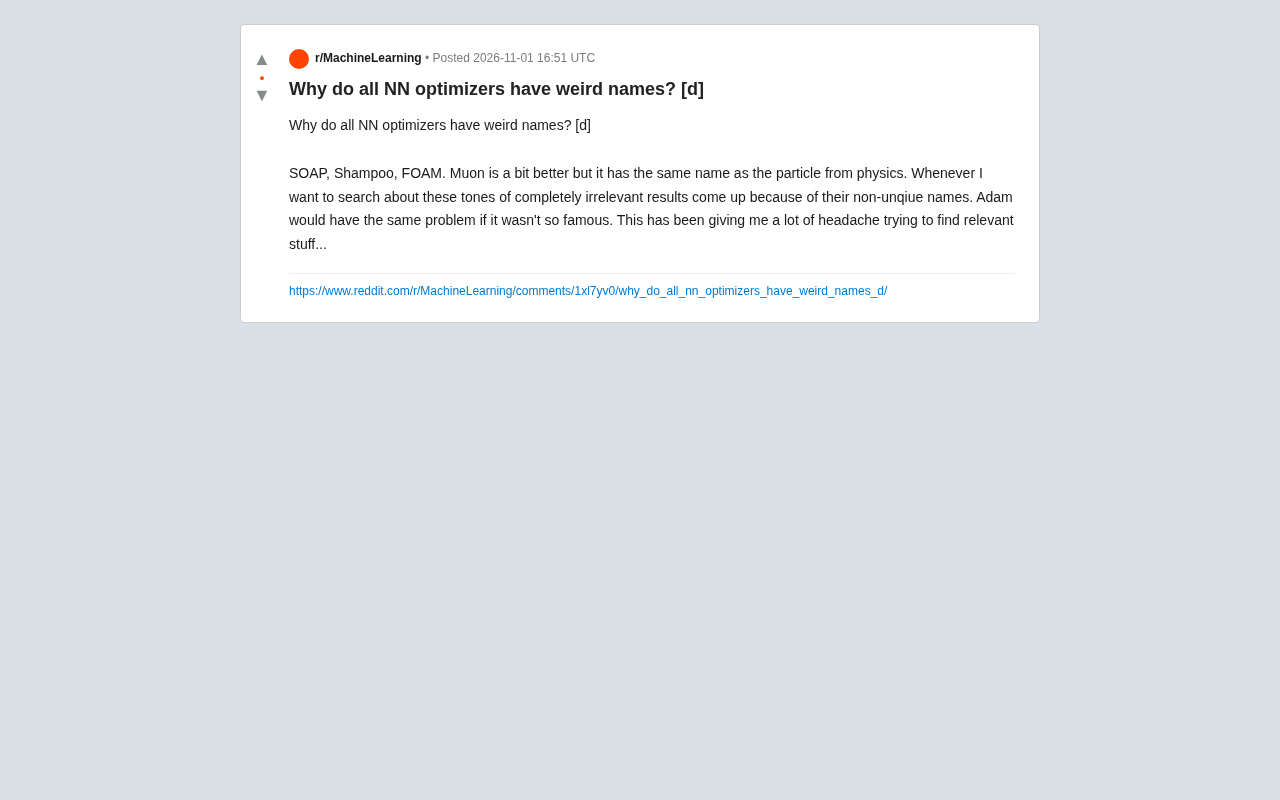
A Reddit user's complaint struck a chord: why are neural network optimizers named so strangely? SOAP, Shampoo, FOAM—these sound like household products or physics terms, yet they are names of important optimization algorithms in deep learning. The user lamented that every time they search for these optimizers, they get a flood of completely irrelevant results because the names are not unique.
This is not an isolated case. With the explosive growth of deep learning research, a large number of new optimizers emerge every year, and naming has gradually shifted from descriptive to whimsical, even arbitrary. This brings real trouble to researchers, engineers, and students.
Those Confusing Optimizer Names
The SOAP, Shampoo, and FOAM mentioned by the user are just the tip of the iceberg. Shampoo is a matrix-preconditioning-based optimizer, FOAM is related to adaptive learning rates, and SOAP is a recently proposed second-order optimization method. These names have no connection to the algorithm principles; they are simply acronyms chosen by the authors to be memorable or fun.
Muon is slightly better—at least it sounds like a normal algorithm name—but the problem is that it shares its name with the physics particle muon. The user pointed out that when searching for the Muon optimizer, physics-related content floods the results. Adam, one of the most famous optimizers, would also face the problem of search results being swamped by people or things with the same name if it were not so well-known.
The direct consequence of this naming style is a significant drop in information retrieval efficiency. Researchers need to spend extra time filtering results and may even miss key literature.
Matrix Preconditioning is an umbrella term for a class of optimization techniques whose core idea is to apply a linear transformation to the gradient (usually by multiplying or inverting a matrix) before the gradient update, in order to improve the condition number of the problem and make convergence more balanced across directions in parameter space. In deep learning, Adam approximately achieves diagonal preconditioning through element-wise adaptive scaling; Shampoo, on the other hand, maintains row and column covariance matrices for each layer's weight matrix and performs Kronecker factorization, thereby constructing a preconditioner closer to full second-order information at the cost of extra storage and computation. Understanding preconditioning helps grasp why second-order or quasi-second-order methods like Shampoo and SOAP differ from first-order methods (such as SGD and Adam) in naming and design philosophy.
Second-order optimization methods refer to algorithms that use second-derivative information of the loss function (the Hessian matrix or its approximation) to guide parameter updates. The classic Newton's method is a representative: it adjusts the gradient direction via the inverse Hessian, achieving faster convergence near the optimum. However, in deep neural networks with hundreds of millions or more parameters, storing and inverting the full Hessian is infeasible, so practical methods are mostly quasi-Newton methods or variants based on Kronecker factorization, diagonal approximation, low-rank approximation, and other techniques. Methods like SOAP attempt to capture part of the second-order curvature information at an acceptable computational cost to improve training stability and convergence efficiency.
The Deep Reasons Behind the Naming Chaos
Why do researchers favor such names? On one hand, academic papers need to attract attention, and a fun name is easier to remember and cite. On the other hand, innovation in the optimizer field is extremely fast, and many authors want short, catchy acronyms to represent complex mathematical processes. However, this trend has gradually evolved into a naming competition, with names becoming fancier and less practical.
From community discussions, this is no longer a simple joke but a problem that affects actual work efficiency. Some users suggest that new optimizers should consider search uniqueness when named, such as adding a domain prefix or using more descriptive names. But under the current academic evaluation system, such calls are unlikely to change the status quo quickly.
arXiv is the most important preprint platform in physics, mathematics, computer science, and other fields. Researchers usually upload papers there before formal peer review to quickly establish priority and get feedback. Many new deep learning optimizers first appear as arXiv preprints, which means naming happens before formal publication and lacks a unified registration mechanism. Google Scholar is a cross-publisher academic search engine covering journals, conference papers, preprints, and patents. Since general search engines have limited ability to disambiguate homonyms, searching directly within arXiv or Google Scholar and combining with metadata such as author names or years is often more efficient than filtering results in web search.
How to Cope with Search Difficulties
For researchers and engineers who need to look up optimizer information daily, some strategies can reduce the trouble. Use more precise keyword combinations, such as adding qualifiers like "optimizer" or "deep learning" after the optimizer name, or search directly on academic platforms like arXiv and Google Scholar. Following paper lists from top conferences and journals can also help avoid irrelevant results.
The power of the community is equally important. Forums like Reddit's r/MachineLearning often have users sharing optimizer comparisons and summaries, and this manually curated content is often higher quality than general search engine results. The discussion in that thread itself is an example: through community feedback, people can more quickly identify which names are confusing and share effective search tips.
Naming Conventions Need Community Consensus
The chaos in optimizer naming is essentially a manifestation of the academic community's lack of naming consensus. Although it is difficult to enforce regulations, soft constraints can be formed through community discussion. For example, when first proposing an optimizer in a paper, providing both the full name and a clear domain label can aid subsequent retrieval. Reviewers at conferences and journals can also suggest that authors choose more distinctive names.
From a broader perspective, this problem reflects some side effects of the rapid development of deep learning: new concepts emerge endlessly, but the accompanying knowledge management methods have not kept up. Optimizer naming is just one microcosm; similar troubles may also appear in model architecture and dataset names. Solving these problems requires joint efforts from the community to build a more friendly knowledge retrieval ecosystem.
Background Supplement
From a technical genealogy perspective, the optimizers mentioned in the article are not isolated from each other. Shampoo belongs to full-matrix preconditioning methods, and its follow-up work includes improvements in computational efficiency and simplifications toward more practical directions; SOAP can be seen as combining the Shampoo preconditioning framework with adaptive ideas similar to Adagrad, attempting to balance the use of second-order information and training stability. Muon takes another route: it orthogonalizes the momentum-updated matrix (e.g., approximating the polar decomposition via Newton-Schulz iteration), making the update direction more balanced in the singular value sense, and is often used in large-scale language model training. Understanding these methods within the technical threads of preconditioning, adaptive learning rates, and orthogonalization is more helpful for grasping the problems they each solve and their applicable scenarios than simply memorizing names.
One-line Summary
Neural network optimizers have whimsical names that collide with everyday words, leading to low search efficiency and requiring community consensus to improve.
Paragraph Summary
Starting from a Reddit user's complaint about optimizer names like SOAP, Shampoo, and FOAM, the article points out that these algorithms, which share names with household products or physics terms, cause search troubles for researchers. The naming trend stems from the need for papers to attract attention and spread quickly, but it has evolved into a naming competition that reduces information retrieval efficiency. The author suggests coping by using qualified keywords, searching on academic platforms like arXiv and Google Scholar, and leveraging community sharing, and calls for the academic community to form soft naming constraints by providing full names and domain labels in papers to build a more friendly knowledge retrieval ecosystem.
Related articles

AI Can Read Neural Network Weights Directly: Do Models Already Exceed Expectations?
A Reddit developer experiment shows language models can directly read neural network weights and infer their function. Astra, Opus 5.5, and Muse Spark 1.3 all passed the test, sparking discussion on model generalization and training sources.

India's Microdrama Market Explodes: EloElo Secures $80M Investment from NBCUniversal
EloElo secures $80M from NBCUniversal to boost StoryTV, its microdrama platform with over 33M monthly active users, as India's microdrama market draws global capital.

Acoustic Detection of Multi-Rotor UAVs: Fusing Handcrafted Features with Pre-Trained Embeddings
Study reveals data leakage from random splits in UAV acoustic detection, proposes source-disjoint protocol with stacked ensemble of handcrafted features and YAMNet embeddings, achieving 95.29% accuracy for low-cost drone detection.