Neural Operator PUN: A New Paradigm for Efficient Planning Under Noise

PUN learns noise-aware value fields with neural operators for efficient planning in unknown geometries.
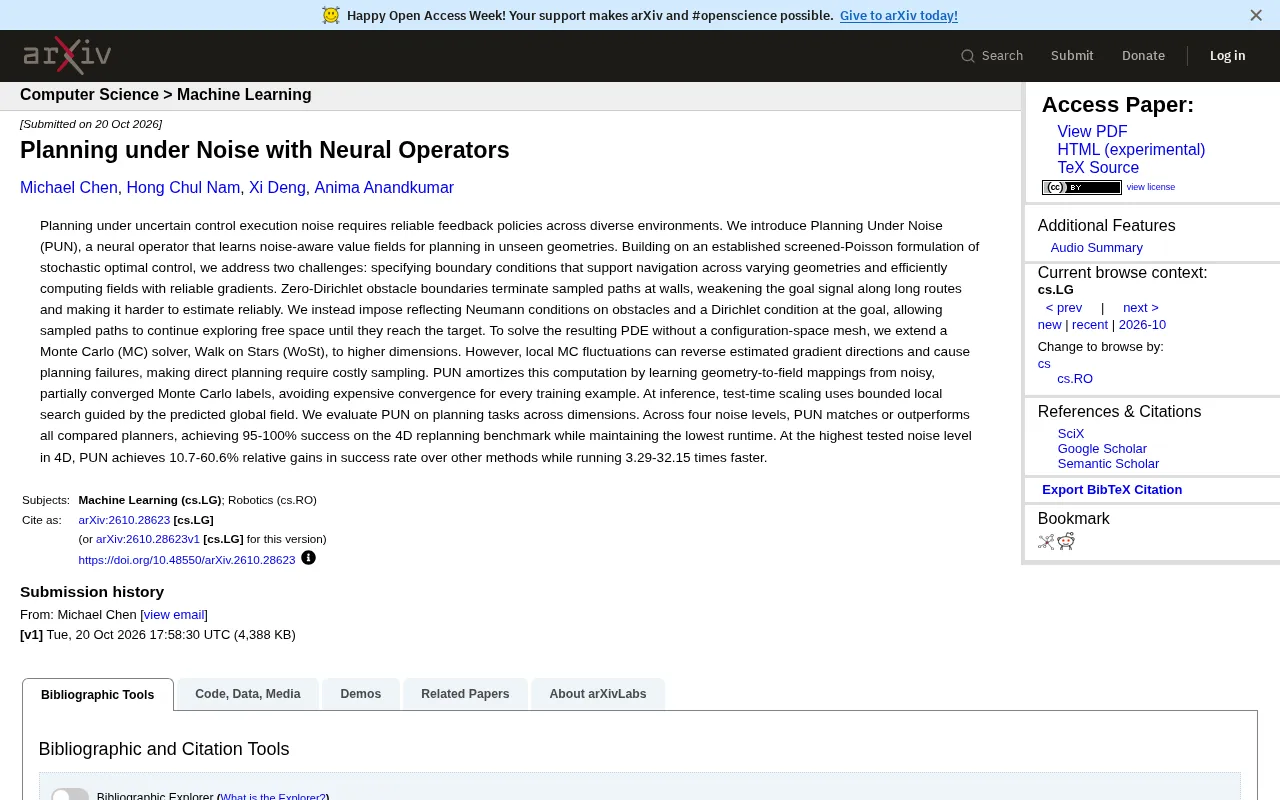
PUN is a neural-operator-based noise-aware planning framework built on the screened-Poisson formulation of stochastic optimal control. It uses reflecting Neumann conditions on obstacles and a Dirichlet condition at the goal to prevent goal-signal decay along long routes, extends Walk on Stars to high dimensions, and learns geometry-to-value-field mappings from partially converged noisy Monte Carlo labels to amortize expensive computation into training. At inference, test-time scaling guides bounded local search with the predicted global field. Experiments show 95–100% success on 4D replanning benchmarks, 10.7–60.6% relative success gains at maximum noise, and 3.29–32.15x speedups.
In real-world scenarios such as robot control and autonomous driving, execution noise is an unavoidable reality that planning algorithms must confront. Traditional methods often rely on precise environment models and expensive online computation, making it difficult to respond quickly in unknown geometries. A recent study titled Planning under Noise with Neural Operators proposes PUN (Planning Under Noise), a neural-operator-based planning framework designed to learn noise-aware value fields from noisy Monte Carlo labels, enabling efficient planning in unseen geometric environments.
Core Challenges: Boundary Conditions and Gradient Reliability
PUN is built on the screened-Poisson equation formulation of stochastic optimal control. The study points out that setting zero Dirichlet conditions on obstacle boundaries causes sampled paths to terminate upon hitting a wall, thereby weakening the goal signal along long routes and making value estimates unreliable. To address this, the authors instead impose reflecting Neumann conditions on obstacles and a Dirichlet condition at the goal, allowing sampled paths to continue exploring free space until they reach the target. This change significantly improves signal propagation in long-distance navigation.
Another difficulty lies in mesh-free solving. The study extends the Monte Carlo solver Walk on Stars (WoSt) to high-dimensional spaces, but local Monte Carlo fluctuations can reverse the estimated gradient direction, leading to planning failures. Relying directly on sampling is extremely computationally expensive. PUN learns a mapping from geometry to value field from noisy, partially converged Monte Carlo labels, amortizing computation into the training phase and avoiding the need for expensive convergence on every sample.
Dirichlet and Neumann conditions are the two most fundamental types of boundary constraints in solving partial differential equations. Dirichlet conditions directly specify the function value on the boundary (for example, fixing the value on obstacle surfaces to zero), whereas Neumann conditions constrain the derivative of the function along the boundary normal (for example, a reflecting boundary requires the rate of change of value along the normal to be zero). From the perspective of stochastic optimal control, the value function describes the expected cost required to reach the goal from a given point. Adopting a zero Dirichlet condition is equivalent to having paths be absorbed and terminated the moment they touch a wall, thereby truncating goal information along long routes; after switching to reflecting Neumann conditions, sampled trajectories are "bounced back" into free space at boundaries and can continue propagating the value signal from the goal—this is precisely the key mechanism by which PUN improves long-distance navigation stability.
Walk on Stars (WoSt) is a class of mesh-free Monte Carlo PDE solvers that can be viewed as a generalization of the classic Walk on Spheres algorithm. Starting from the query point, it iteratively samples random points on the largest inscribed sphere (or star-shaped region) centered at that point that just touches the boundary or goal, constructing a random walk path, and finally approximates the equation solution using an unbiased estimate of the path's terminal state. Because it does not require mesh partitioning, WoSt is naturally suited to handling complex, irregular, and even high-dimensional geometric domains. However, its estimator is stochastic: with finite samples, individual estimates exhibit noticeable fluctuations, and the gradient direction obtained by finite differencing the value field may be reversed by noise. PUN avoids the high cost of pointwise convergence precisely by handing such high-variance Monte Carlo labels to a neural operator for amortized learning.
Method Design: Learning + Test-Time Scaling
The core of PUN is a neural operator that takes geometric information as input and outputs a noise-aware value field. Training data is generated by noisy Monte Carlo simulations that are not fully converged, so the labels themselves contain fluctuations. The model learns to extract robust field representations from these imperfect labels. During inference, PUN employs test-time scaling: it uses the predicted global field to guide a bounded local search, thereby improving planning quality while maintaining computational efficiency. This combination of "global field prediction + local search" avoids both the high variance of pure sampling methods and the generalization limitations of pure learning methods.
Neural operators are a class of neural network architectures for learning mappings between function spaces. Their goal is not to learn a function from finite-dimensional vectors to vectors, but rather to learn an operator from "input functions (such as geometry, boundary conditions) → output functions (such as value fields)". Unlike ordinary CNNs or MLPs that operate on fixed discrete grids, neural operators are discretization-invariant and can generalize across different resolutions and geometries; representative examples include the Fourier Neural Operator (FNO) and DeepONet. In PUN, the neural operator takes geometric information and outputs the entire value field in one pass, shifting computation that would otherwise require repeated pointwise sampling into the training phase for amortization. At inference time, only a single forward pass is needed to obtain a global value estimate—this is the architectural basis of its efficiency.
Test-time scaling refers to investing additional computational resources at the inference stage to improve output quality, rather than relying solely on the fixed model capability from training. In planning tasks, a common approach is to use the learned global value field as a heuristic guide and perform local sampling or search refinement only within a bounded region near the predicted optimal path. This preserves the learned model's ability to generalize to unseen geometries while correcting biases and noise in the predicted field through local search, avoiding expensive global sampling over the entire state space. PUN formalizes this idea as "global field prediction + bounded local search", achieving a controllable balance between computational budget and planning quality.
Experimental Performance: Advantages Across Dimensions and Noise Levels
The study evaluates PUN on planning tasks across multiple dimensions, covering four noise levels. On the 4D replanning benchmark, PUN maintains the lowest runtime while achieving a 95–100% success rate. At the highest noise level in 4D, PUN improves success rate by a relative 10.7–60.6% compared with other methods, while running 3.29–32.15 times faster. These results show that PUN is not only more reliable under noise but also significantly more efficient.
Significance and Outlook
PUN's contribution lies in combining neural operators with the PDE formulation of stochastic optimal control and, by improving boundary conditions and amortizing Monte Carlo computation, achieving fast noise-aware planning in unknown geometries. Its test-time scaling strategy also offers learned planners a way to balance global guidance and local refinement. In the future, the method is expected to extend to higher dimensions and more complex dynamic environments, providing a new technical path for real-time robot planning.
One-line Summary
PUN uses neural operators to learn noise-aware value fields, enabling efficient planning in unknown geometries.
Paragraph Summary
PUN is a noise-aware planning framework based on neural operators, built on the screened-Poisson equation formulation of stochastic optimal control. To address the attenuation of goal signals along long routes caused by traditional zero Dirichlet boundaries, it adopts reflecting Neumann conditions on obstacles and a Dirichlet condition at the goal. To tackle the difficulty that gradient directions in high-dimensional mesh-free Monte Carlo solving are easily reversed by noise, it extends Walk on Stars to high dimensions and learns a mapping from geometry to value field from partially converged noisy Monte Carlo labels, amortizing expensive computation into the training stage. At inference, it uses test-time scaling, guiding a bounded local search with the predicted global field. Experiments show that it achieves a 95–100% success rate on the 4D replanning benchmark, improves success rate by a relative 10.7–60.6% at the highest noise level, and runs 3.29–32.15 times faster.
Related articles

Data Scraping, AI Proofs, and Open Source Contracts: This Week's Deep Dive into the Tech World
From the 3D model crawler controversy and OpenAI's Lean formal proofs to AI agents challenging Brooks' Law and Debian rejecting LLM review, this week's tech discussions center on openness and verifiability.

Build a Reasoning Model from Scratch: An 11-Hour Open-Source Course Breakdown
Sebastian Raschka releases a free 8-episode, ~11-hour video course teaching you to build a reasoning model from scratch with Python and PyTorch—from a small Qwen3 model through Verifier, Inference Time Scaling, GRPO, and distillation, with open-source code on GitHub.

An 11-Hour Reasoning Model Course in Practice: How Small Models Learn to Think
Starting from Sebastian Raschka's 11-hour reasoning model course and HN buzz, this analyzes small-model training, legal text version control, Anthropic data policy, and product reliability reviews.