New Advances in the Learnability Theory of Debate Training Protocols
Formalizing debate training as online learning reveals cooperative protocols have better learnability and judge errors matter greatly.
This paper re-examines debate as a training protocol, formalizing it as an online learning problem rather than only analyzing a static game under a given judge. The authors find that in some cases the best learning approach is not adversarial debate, and thus propose a cooperative protocol characterized by a combinatorial dimension. They further consider judge fallibility and prove that a small number of judgment errors can cause large learning errors. Synthesizing multi-source analyses, all parties agree on debate's theoretical potential but diverge on cooperative versus adversarial approaches. The article offers new theoretical perspectives for AI alignment training, emphasizing that protocol design must trade off judge reliability against task complexity.
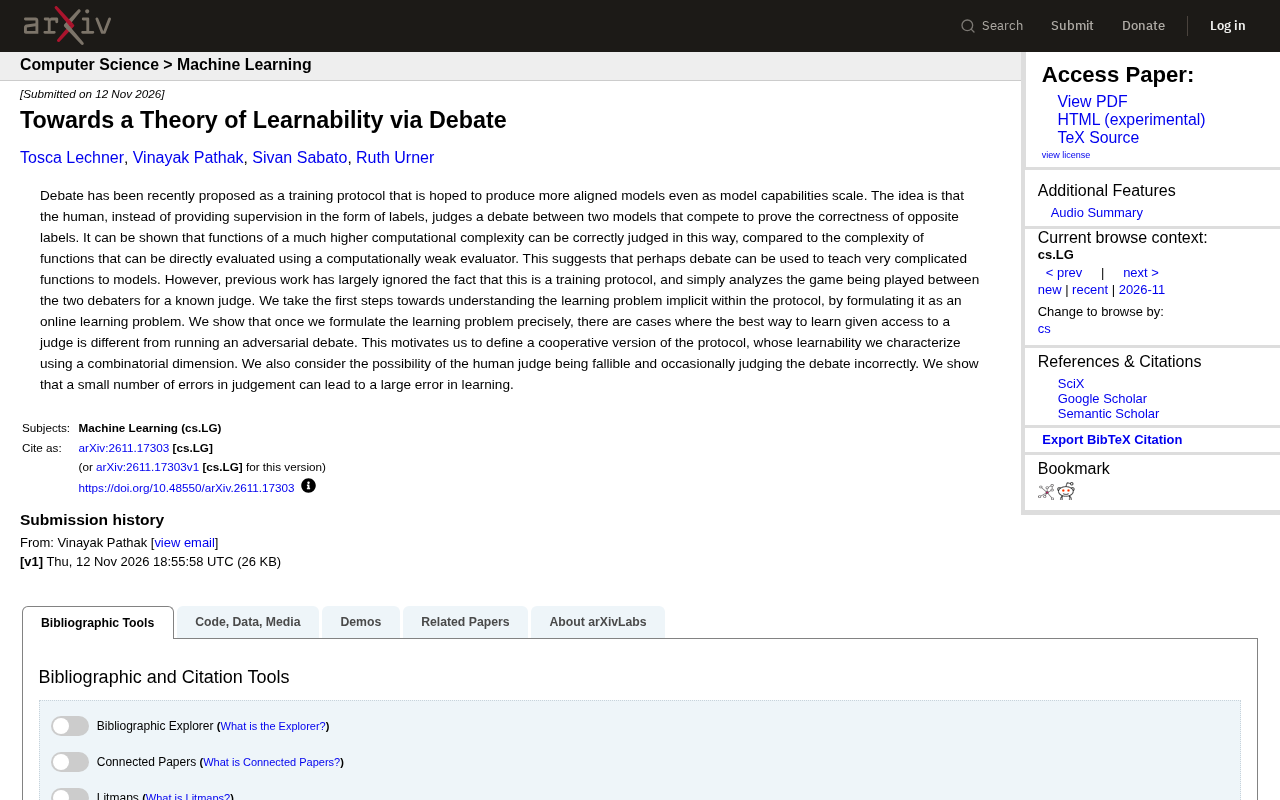
Debate, as a training protocol, has recently been regarded as a potential approach for maintaining alignment as model capabilities scale. The core idea is that humans no longer provide labels directly; instead, they judge a debate between two models arguing for the correctness of opposing labels. Prior work has shown that this approach can correctly judge functions of much higher computational complexity than direct evaluation by a computationally weaker evaluator. This suggests that debate may be able to teach models very complex functions. However, most prior work overlooks the fact that this is a training protocol, and only analyzes the game between two debaters under a known judge. This paper takes the first step toward understanding the implicit learning problem of this protocol by formalizing it as an online learning problem.
From Game Analysis to Online Learning
Past research has focused on the static properties of the debate game: given a judge, can debate correctly adjudicate? But the essence of a training protocol is dynamic learning—models gradually improve through the debate process. After precisely formalizing the learning problem, the authors find a counterintuitive conclusion: in some cases, the best way to learn given a judge is not to run adversarial debate. This finding challenges the default assumption that "debate means adversarial" and suggests that we need to re-examine the design space of the protocol.
Online learning is a framework in machine learning theory in which a learning algorithm receives data sequentially over time and makes predictions, obtains feedback after each step, and updates the model, with the goal of minimizing cumulative loss (regret) over the entire process. Unlike batch learning, online learning does not assume data are independent and identically distributed, and it emphasizes the algorithm's adaptability in dynamic environments. Formalizing the debate training protocol as an online learning problem means treating debaters as learners who adjust their strategies in each round of debate based on judge feedback, thereby enabling analysis of the protocol's learning guarantees and convergence, rather than only the equilibrium properties of a single game.
Proposal and Characterization of a Cooperative Protocol
Based on the above observations, the authors define a cooperative version of the protocol and characterize its learnability using a combinatorial dimension. The cooperative protocol no longer requires debaters to take opposing stances; instead, they collaboratively demonstrate the reasoning process, and the judge provides feedback based on this. This shift reduces the learning bias introduced by adversarial games and provides a new theoretical perspective for training protocols. According to the original analysis, the learnability of the cooperative protocol can be quantified via a combinatorial dimension, which provides a theoretical tool for subsequent experimental design.
The combinatorial dimension is a combinatorial measure used in learning theory to characterize the complexity of function classes, similar to the VC dimension but more suitable for analyzing the learnability of interactive learning protocols. In debate protocols, the combinatorial dimension typically measures how much "evidence" debaters need to present for the judge to distinguish correct from incorrect claims. The lower the dimension, the easier the function class is to learn; the higher the dimension, the more debate rounds or computational resources are required. By using the combinatorial dimension to characterize the learnability of the cooperative protocol, the authors essentially provide a theoretical boundary for the protocol's ability to effectively learn complex functions, offering a quantitative tool for comparing different protocol forms.
The Impact of Judge Fallibility
Real-world judges are not perfect; humans may occasionally make incorrect judgments. The authors consider the case of a fallible judge and prove that a small number of judgment errors can lead to relatively large errors in learning outcomes. This conclusion has cautionary implications for practical applications—when building debate training systems, judge reliability must be taken seriously; otherwise, theoretical learning advantages may be offset by noise. This finding also echoes discussions about judge quality in multi-source analyses.
In theoretical learning theory, judge fallibility is typically modeled as a noisy channel in which the judge gives an incorrect label with some probability. The authors prove that a small number of judgment errors can lead to relatively large errors in learning outcomes, a conclusion consistent with noise-sensitivity theory in statistical learning: when the hypothesis space is complex or the number of debate rounds is limited, judge noise is amplified, causing the learned function to deviate from the true target. This suggests that practical systems need to introduce redundant judging, confidence weighting, or error-correction mechanisms to reduce the negative impact of judge unreliability on training effectiveness.
Consensus and Divergence from a Multi-Source Perspective
Synthesizing analyses from Bilibili UP hosts and YouTube channels, all parties generally agree on the theoretical potential of debate protocols for learning complex functions, but there is divergence on whether cooperative or adversarial approaches are superior. Some argue that adversarial approaches are closer to real debate scenarios, while the theoretical results in this paper support the learnability advantage of cooperative approaches under specific learning objectives. This divergence suggests that future research needs to validate against actual tasks.
Implications for AI Alignment Training
The theoretical contribution of this paper lies in advancing debate training from game-theoretic analysis to a learning-theoretic framework, revealing key trade-offs in protocol design. For AI alignment practitioners, this means that adversarial debate cannot simply be applied by default; instead, the protocol form should be chosen based on judge capability and task complexity. At the same time, judge error tolerance should be an important parameter in system design. Although this paper remains a theoretical exploration, its proposed cooperative protocol and learnability characterization lay the foundation for subsequent empirical research.
One-line Summary
Formalizing debate training as online learning reveals that cooperative protocols have better learnability and that judge errors have a large impact.
Paragraph Summary
This paper re-examines the nature of debate as a training protocol, formalizing it as an online learning problem rather than merely analyzing a static game under a given judge as in prior work. The authors find that in some cases the best way to learn is not to run adversarial debate, and thus propose a cooperative protocol, characterizing its learnability using a combinatorial dimension. The study further considers judge fallibility and proves that a small number of judgment errors can lead to relatively large errors in learning outcomes. Synthesizing multi-source analyses, all parties agree on the theoretical potential of debate but diverge on cooperative versus adversarial approaches. The article provides a new theoretical perspective for AI alignment training, emphasizing that protocol design must trade off judge reliability against task complexity.
Related articles

DeepSeek SuperAgent Architecture Explained: A New Multi-Task Concurrent Agent Paradigm
DeepSeek Harness proposes SuperAgent architecture: a Router+Worker two-layer team model solving context confusion, loop blocking, and local sleep in multi-task Agents.

AI Now Generates GIFs Directly: The Era of Unlimited Custom Stickers Has Arrived
AI can now generate GIFs directly. Learn how to use GPT's Images 2.6 to create sticker GIFs with reference images and story prompts, plus sprite sheet frame-level editing, real-person performances, and chat log generation.

Burned Through 1.3 Billion Tokens and Tens of Thousands of Yuan to Build 500 Websites with AI
Bilibili creator Yu Pi built Vibefather, an AI website template library with 270+ templates and 500+ live sites, consuming over 1.3 billion tokens. Each template includes full prompts and design docs, open-sourced and integrable via Claude Code, Cursor, and more.