Nintendo Makes It Clear: Switch 2 Will Not See Another Price Increase

Nintendo says Switch 2 won't see further price hikes, pivoting to sales recovery after a 37.4% decline.
Nintendo President Shuntaro Furukawa stated during an earnings call that the company is not considering additional price adjustments for Switch 2. The console had already seen a $50 increase to a $499 starting price, and the latest earnings report shows a 37.4% sales decline. The article analyzes this as proactive strategic anchoring to stabilize expectations while leaving room for future adjustments. For players, short-term pricing is stable; for investors, the focus may shift from price recovery to sales recovery.
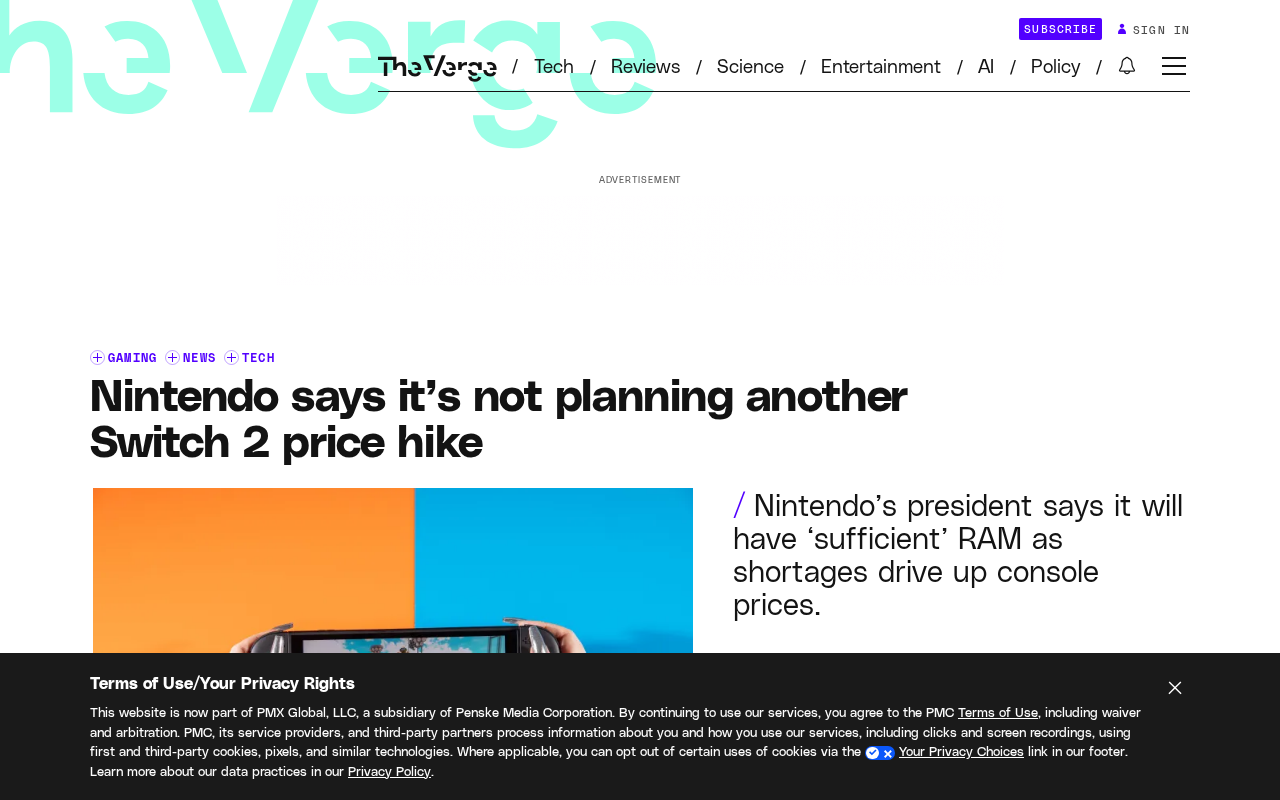
Nintendo President Shuntaro Furukawa stated explicitly during the latest earnings call that the company is "not considering any additional price adjustments for Switch 2." This comes just months after the console received a $50 price increase earlier this year, bringing its starting price to $499. With sales declining and cost pressures mounting, this statement deserves a closer look.
Sales Pressure After the Price Hike
According to Reuters, Nintendo disclosed in Thursday's earnings report that Switch 2 sales fell 37.4%. This figure directly echoes the price increase earlier this year—the $50 hike pushed the starting price to $499, and for a console that has only just entered its market cycle, sensitivity at this price range cannot be ignored.
While the company has not explicitly drawn a causal link between the sales decline and the price increase, the market reaction has been clear enough. Furukawa's statement that the company is "not considering additional price changes" is essentially a signal of stability to both the market and players: the current pricing is the balance point Nintendo believes it can sustain.
Price Elasticity is the key economic concept for understanding the relationship between sales and pricing in this article. It measures how sensitive demand for a product is to price changes: the greater the elasticity, the more a small price increase will cause a noticeable drop in sales. For durable consumer goods like game consoles, consumers often have clear budget thresholds—when the price crosses a psychological barrier (such as $499), some potential buyers will delay their purchase or switch to competitors. In this article, Switch 2's sales falling 37.4% after a $50 price increase is a typical signal of price elasticity at work. It should be noted that the sales decline is not attributable to a single factor, but the price increase undoubtedly amplified the magnitude of demand contraction—and this is one of the core business rationales behind Nintendo's choice to "not raise prices further."
Why "No More Increases" Is a Proactive Choice
From a business logic perspective, Nintendo's statement is not a passive response but a proactive strategic anchoring. Switch 2 has already completed one round of price increases, and any further adjustment would directly undermine the room for sales recovery. The 37.4% decline already shows that price elasticity is at work, and stacking another price increase on top would only amplify the negative effects.
On the other hand, by using the wording "not considering additional changes" rather than "committing to never raising prices," Furukawa preserves room for future adjustments based on costs and exchange rate conditions. This is a typical Japanese corporate communication style—stabilizing current expectations without closing the door completely.
What It Actually Means for Players and the Market
For players planning to buy a Switch 2, short-term price expectations can now be stabilized. The $499 starting price will serve as the baseline for the foreseeable future, and there is no need to worry about a psychological letdown from another official price adjustment after purchase.
For investors watching Nintendo, this statement means the company's strategic focus is shifting from "price recovery" to "sales recovery." The next question is how Nintendo will drive sales—whether through software lineup, bundle sales, or other promotional tactics—none of which have been detailed in the earnings information so far.
Sales Recovery refers to the process by which a company, after experiencing a decline in sales, reignites demand and restores its growth trajectory through a series of non-price measures. For Switch 2, after clearly ruling out further price increases, Nintendo's strategic focus naturally shifts to how to boost sales. Common sales recovery tools include: strengthening the first-party software lineup to create "must-buy reasons," launching console bundles with popular games, limited-time promotions or membership discounts, and reducing the actual out-of-pocket price through channel subsidies. Compared with direct price cuts, these methods better protect brand value and profit margins while also avoiding psychological shocks for users who purchased at full price early on. This article notes that the earnings report has not yet detailed specific measures, so the pace of upcoming software releases and marketing actions will be the key window for observing the effectiveness of sales recovery.
Editorial View
The real information value of Nintendo's statement lies not in "no price increase" itself but in its timing. Releasing a price stability signal at an earnings juncture when sales have fallen 37.4% shows that management recognizes price as one of the key variables affecting current sales. But the wording "not considering additional changes" also leaves room—players should not interpret it as a long-term commitment. For consumers interested in Switch 2, the current price window is relatively certain; for industry observers, what is truly worth tracking is what measures Nintendo will use next to offset sales pressure.
Background Notes
Strategic Anchoring in business communication refers to a company setting a reference point through public statements in order to guide market expectations and consumer psychology. Nintendo President Shuntaro Furukawa's explicit statement of "not considering additional price adjustments" is in effect establishing a psychological anchor for Switch 2's pricing: $499 is the officially endorsed stable baseline at this stage. This anchoring effect can reduce consumers' wait-and-see sentiment and prevent them from delaying purchase decisions out of concern about "prices falling/rising right after I buy." At the same time, anchoring is not the same as a permanent commitment—Furukawa's wording preserves room for future adjustments based on external variables such as costs and exchange rates. This is a communication strategy that balances expectation management with operational flexibility, and it is especially common in Japanese companies' public statements.
One-line Summary
Nintendo says Switch 2 will not see further price increases, shifting to sales recovery after a 37.4% sales decline.
Paragraph Summary
Nintendo President Shuntaro Furukawa stated explicitly during an earnings call that the company is not considering additional price adjustments for Switch 2. The console had already received a $50 price increase, bringing its starting price to $499, and the latest earnings report shows Switch 2 sales fell 37.4%. The article argues that this statement is a proactive strategic anchoring aimed at stabilizing market expectations, while the wording leaves room for future adjustments. For players, short-term price expectations are stabilizing; for investors, the company's strategic focus may shift from price recovery to sales recovery, with future software lineup and promotional tactics worth watching.
Related articles
 Tech Frontiers
Gemini Omni 1.2 Flash: AI Video Moves Toward Draft-Style Editing
Google's Gemini Omni 1.2 Flash update enables conversational, draft-style editing of the same video—swap scenes while keeping products, adjust lighting while keeping characters. Clips up to 15s, 720p costs 30% less than the previous Flash—ideal for e-commerce ads, previs, and short-asset production.

Codex Tutorial: One-Command Install and Run Your First Task
Codex tutorial: one-command install and run your first task. Covers the four Codex forms, sandbox and approval guardrails, AGENTS.md and MCP configs, cloud network policy, and the iron rule of human review—everything you need to get started with this autonomous coding agent.
 Tech Frontiers
Localix: An Open-Source Agentic Development Environment with Multi-Model and Local AI Integration
Localix is an MIT open-source Agentic Development Environment (ADE) supporting seamless Claude Code plugin loading, multi-model cloud and local execution, Mini Apps extensions, and agent context management—an open AI collaboration workbench for developers.