NoMac: A Per-Minute Mac for AI Agents
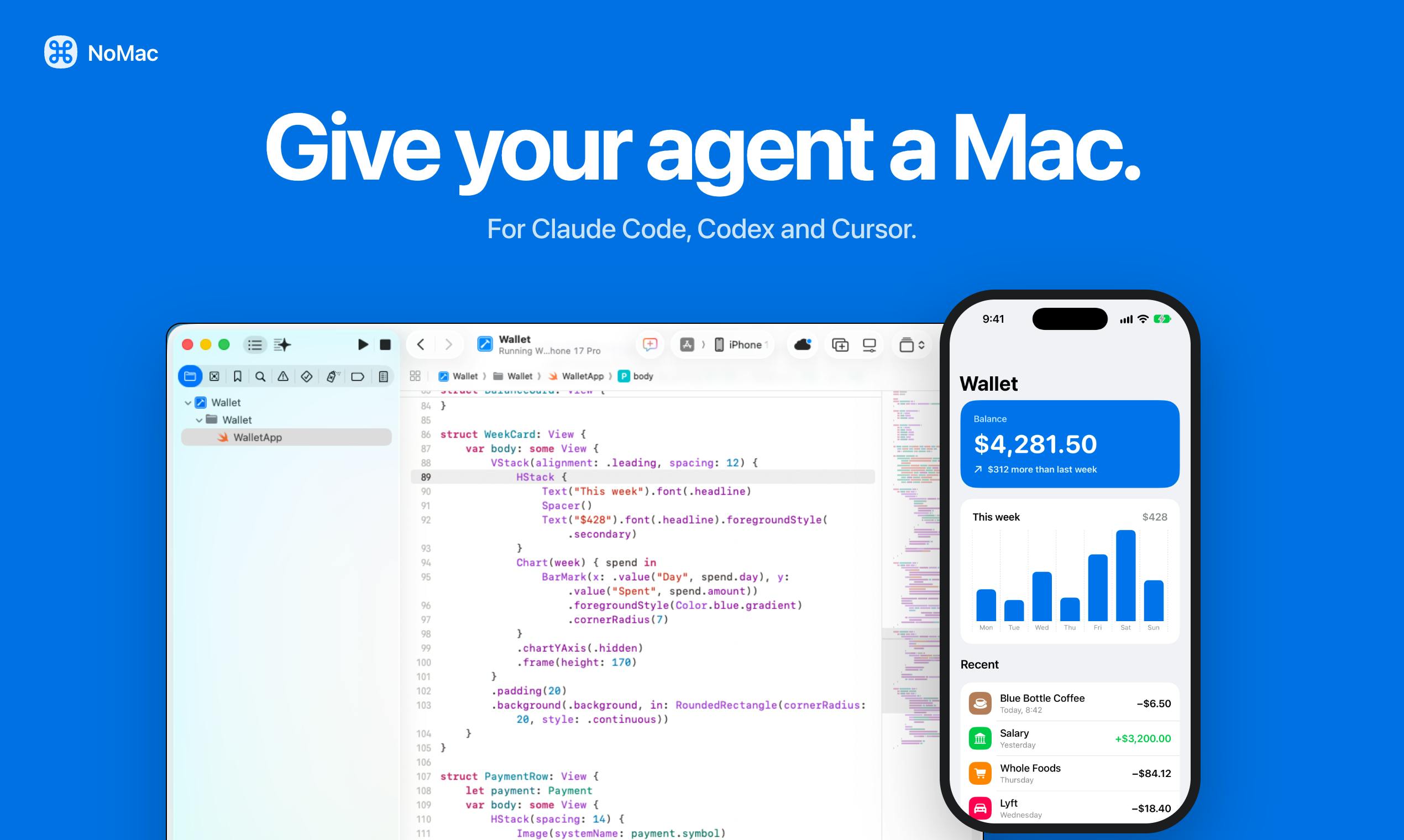
NoMac offers AI coding agents a per-minute cloud Mac to solve iOS build verification.
NoMac is a Product Hunt product that gives AI coding agents like Claude Code, Codex, and Cursor a dedicated cloud Apple silicon Mac with Xcode preinstalled, ready in about 30 seconds and auto-shut down when done. It targets the pain point that agents can change code but cannot verify iOS builds: they can compile in the cloud, run apps in an iPhone simulator with live viewing, and push to TestFlight and the App Store. Billing is prepaid by the minute with no subscription, reportedly a few cents per full build. Unlike GitHub Actions macOS runners or traditional cloud Mac rentals, NoMac is explicitly agent-focused, emphasizing fast startup, shutdown when done, and visual supervision. It's still early stage, with pricing, concurrency limits, and credential security not yet public.
AI coding assistants are getting better and better at writing code, but the moment you need to run iOS builds, spin up a simulator, or upload to TestFlight, the whole flow gets stuck on a local Mac. A product called NoMac has appeared on Product Hunt with a straightforward idea: give coding agents like Claude Code, Codex, or Cursor their own dedicated cloud Mac, billed by the minute, shut down when done.
What problem NoMac solves
The trouble with local iOS development is the heavy environment. Xcode is bulky, simulators eat memory, and setting up CI/CD pipelines isn't easy either. When developers hand off the coding work to AI agents, the agents can change code but can't verify build results themselves—they need a real macOS environment that can run Xcode.
NoMac turns this environment into an on-demand cloud service: Apple silicon hardware, pre-installed Xcode, ready in about 30 seconds. Agents compile the app in this environment, run it in an iPhone simulator, developers can watch the simulator screen in real time, and once everything checks out, push directly to TestFlight and the App Store. When the task is done, the Mac shuts down automatically and billing stops.
This design turns the "environment" from a long-term occupied asset into an on-demand consumable resource.
The closed nature of Xcode and the iOS build chain: Apple's iOS app builds have long been tied to macOS, and the core toolchain, Xcode, only runs on Mac. Compiling, signing, packaging the IPA, and uploading to App Store Connect all depend on it. This means any automation flow—including AI agents—must land on a real Mac and cannot run in a Linux container like a backend service. Cloud Macs are therefore the only realistic path to moving iOS builds off local machines, but they come with inherent problems: large image sizes, slow startup, and expensive hourly billing. NoMac's "ready in 30 seconds + per-minute billing" is precisely a trade-off aimed at these pain points.
What per-minute billing means
NoMac clearly takes the route of prepaid credits with per-minute charges, with no subscription fee. The official claim is that a complete build costs just a few cents.
This pricing structure is especially well suited to AI agent scenarios. Agents work in bursts—they might run several builds in a day, or sit idle for a week. Subscription-based cloud Macs are poor value under this usage pattern, while per-minute billing aligns cost with actual usage. Prepaid credits also avoid the risk of runaway bills, which is friendlier to individual developers and small teams.
Compared with self-hosted setups, where a constantly running Mac mini or cloud Mac instance carries the time cost of maintenance, system updates, and Xcode upgrades, a per-minute cloud environment has a clear advantage in low-frequency build scenarios.
How it differs from existing options
There are already macOS runners on GitHub Actions and various cloud Mac rental services on the market. NoMac's differentiator is that it is explicitly aimed at AI agents rather than human developers: the environment is designed for agent automation flows, boots fast, shuts down when done, and has fine-grained billing.
Another difference is visibility. When an agent runs an app in the simulator, developers can see the live screen, which turns "the agent verifying the UI itself" from a black box into a supervisable process. For teams delegating builds and tests to AI, this observability has real value.
How GitHub Actions' macOS runners differ from cloud Mac rentals: GitHub Actions provides hosted macOS virtual machines, suitable for triggering builds in CI pipelines, but it operates on a per-job basis, driven by code pushes or PR events, with startup and queue times measured in minutes, a limited free tier, and high per-minute charges for macOS. Traditional cloud Mac rentals (such as MacStadium) provide whole machines or VMs for long-term occupation, billed monthly or hourly, aimed at human users who need a persistent graphical interface or remote work. NoMac sits between the two: it is neither event-driven CI nor long-term rental, but rather lets AI agents "spin up a Mac on demand, run it, and shut it down," with billing granularity and usage patterns designed around agents' bursty workflows.
Things to note
The product currently has 84 upvotes and 6 comments on Product Hunt, ranking 5th, so it's still early stage. Details such as the exact per-minute price, free credits, and concurrency limits are not elaborated in the public description. The security of code and signing credentials on cloud Macs, and the boundaries of agent permissions over Xcode, are also questions that need to be confirmed before actual use.
In addition, NoMac addresses the build and distribution stage; the app's own logic design and UI decisions still need human oversight. It's more like a piece of the puzzle that pushes AI agents from "only able to write code" to "able to verify and deliver on their own."
For developers who frequently have Cursor or Claude Code write iOS code but get stuck at the build verification stage, NoMac offers a low-commitment way to try: pay by the minute, run a build to see how it goes, and the cost is only a few cents.
Security boundaries of code signing and credential management: iOS builds cannot do without Apple developer certificates, provisioning profiles, and App Store Connect API keys. Once these credentials leak, apps could be signed under someone else's name or accounts abused. When the build environment is placed in the cloud and handed to AI agents for automatic operation, how credentials are injected, whether they are stored in isolation, and whether agents can read or export them are all permission design questions that must be clarified. Common practices include short-lived tokens, restricted service accounts, and environment variable injection, plus destroying the instance after the task ends. The article notes that these details have not yet been made public; before choosing a solution, you should confirm with the vendor how credentials are stored, what access logs exist, and the scope of agent write permissions over the Xcode project and signing configuration.
One-line Summary
NoMac provides AI coding agents with a per-minute cloud Mac, solving the iOS build verification challenge.
Paragraph Summary
NoMac is a product that appeared on Product Hunt. Its core idea is to give AI coding agents like Claude Code, Codex, and Cursor their own dedicated cloud Apple silicon Mac, pre-installed with Xcode, ready in about 30 seconds, and automatically shut down when the task is done. It targets the pain point that AI agents can change code but cannot verify iOS builds themselves: agents can compile apps in the cloud and run them in an iPhone simulator, developers can watch the live screen, and after confirming, push to TestFlight and the App Store. Billing uses prepaid credits charged by the minute, with no subscription; the official claim is that a complete build costs only a few cents, suited to agents' bursty usage patterns. Compared with GitHub Actions' macOS runners and traditional cloud Mac rentals, NoMac is explicitly aimed at agents rather than humans, emphasizing fast startup, shutdown when done, and visual supervision. The product is still early stage, and details such as unit price, concurrency limits, and credential security have not yet been made public.
Related articles
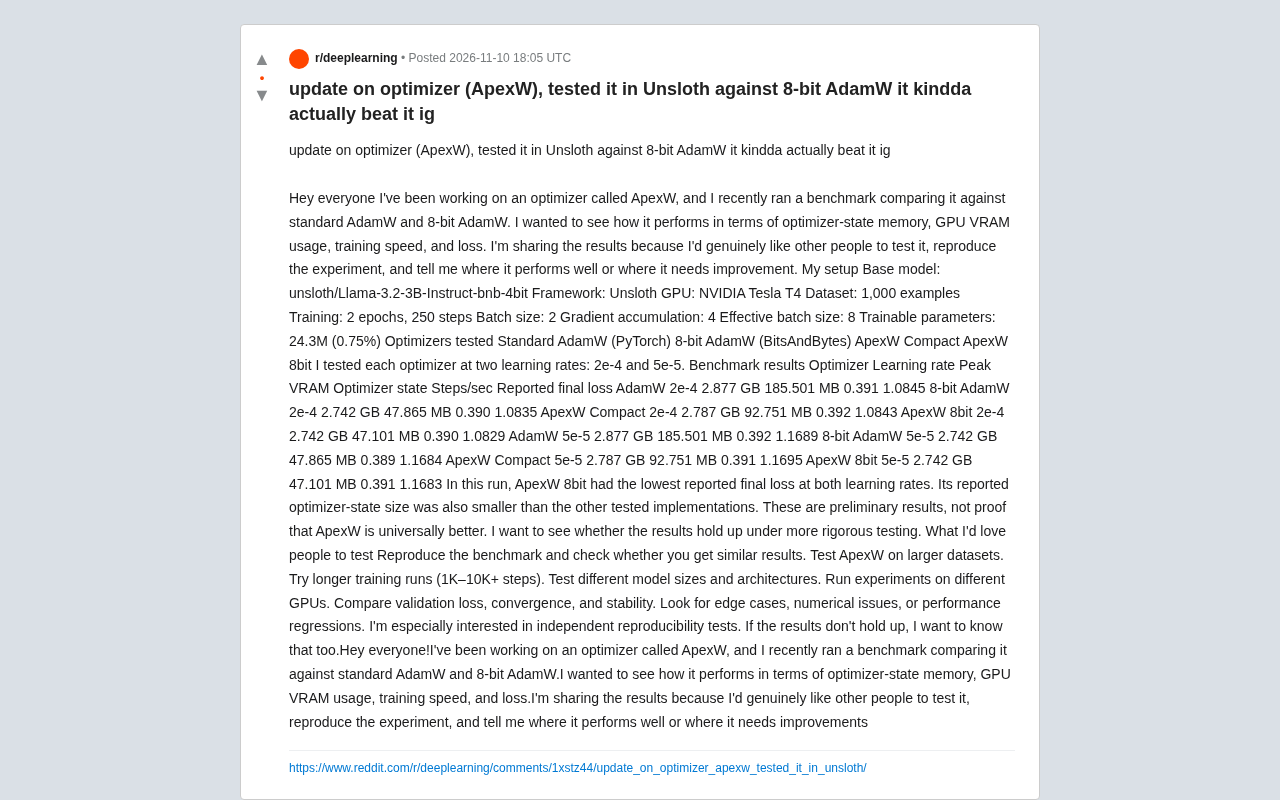
ApexW Optimizer Benchmark: Matches 8-bit AdamW in Unsloth with Lower Memory Usage
Developer shares benchmark of ApexW optimizer in Unsloth: ApexW 8bit has lower optimizer state memory (47.101 MB) and slightly better final loss than 8-bit AdamW, but similar speed. Needs independent reproduction.

US Computer Science Enrollment Drops 12.4% — Is CS Still Worth Studying?
CS enrollment fell 12.4% while health majors grew 6.2%. A CS master's grad explains why the degree's real value isn't coding but systems thinking.

Training 15+ Models on Your Own Data to Predict Blood Glucose: A Personal Health Data Modeling Case Study
A Reddit user trained 15+ machine learning models on personal blood glucose and metabolic data, revealing the technical challenges, overfitting risks, and implications for personal AI health apps.