NVIDIA NV-Reason-CT: An Open-Source 3D CT Vision-Language Model

NVIDIA open-sources NV-Reason-CT, the first 3D CT vision-language model with Chain-of-Thought reasoning.
NVIDIA has released NV-Reason-CT, an open-source 3D CT vision-language model that addresses a long-standing gap in medical imaging AI. Unlike conventional 2D-focused models, it processes volumetric data from hundreds of CT slices and incorporates radiologist-style Chain-of-Thought reasoning — explicitly outputting step-by-step inference alongside diagnostic conclusions so clinicians can verify its logic. This directly tackles the core barrier to medical AI adoption: lack of interpretability. The open-source approach also lowers the barrier for smaller institutions, enables on-premises deployment for privacy compliance, and invites community participation in bias detection and safety evaluation.
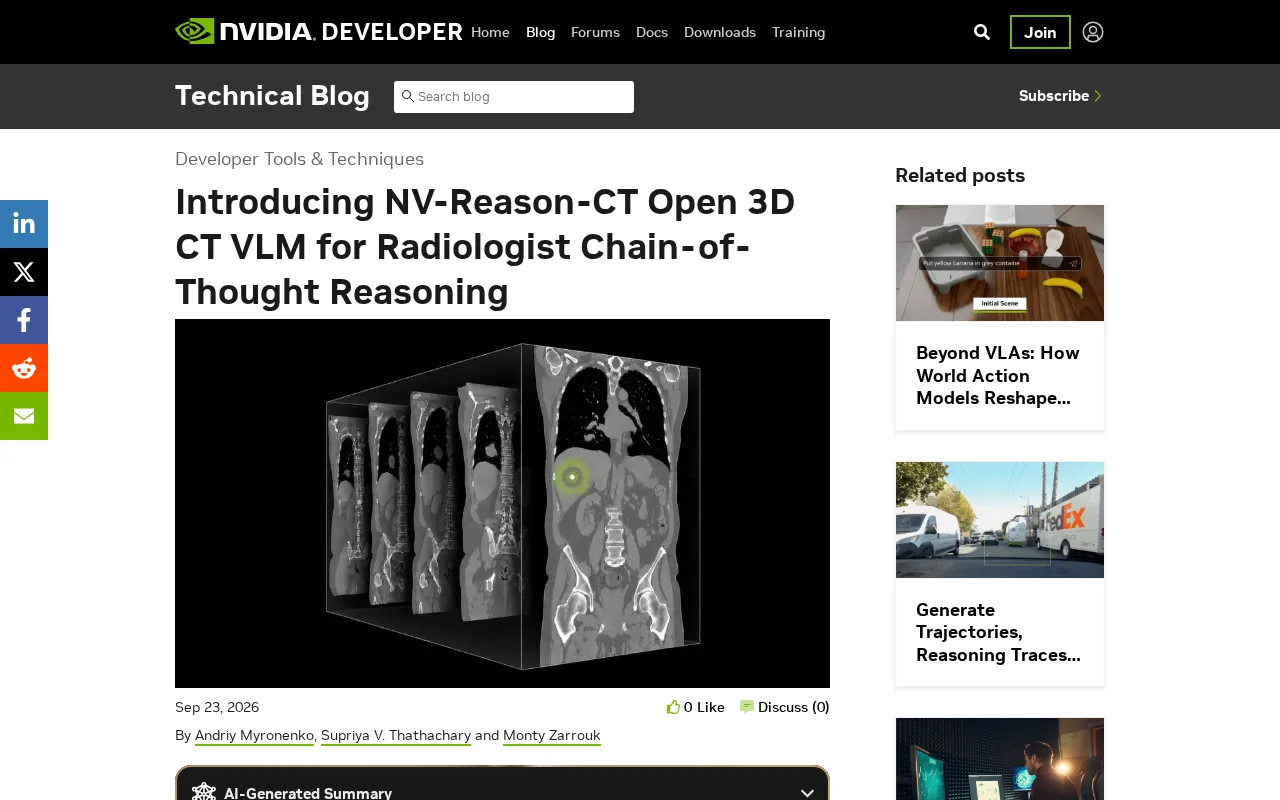
Radiology AI has made impressive strides in anomaly detection for chest X-rays, pathology slides, and 2D scans — but 3D CT imaging, which holds the greatest clinical value, has long been a stubborn challenge. NVIDIA's newly released NV-Reason-CT takes direct aim at this gap: an open-source 3D CT vision-language model (VLM) that supports radiologist-style Chain-of-Thought (CoT) reasoning.
Why 3D CT Is Such a Hard Problem
Most medical imaging AI focuses on 2D images — the data structures are simpler, annotation costs are manageable, and mature natural image model architectures can be directly borrowed. CT scans, however, are fundamentally volumetric: three-dimensional data composed of hundreds of stacked cross-sectional slices. When reading a CT, physicians scroll up and down through these layers, integrating spatial continuity to assess lesion morphology, boundaries, and extent.
This kind of cross-slice spatial reasoning is precisely what conventional 2D models cannot handle. Flattening 3D information into 2D discards critical depth cues, while processing volumetric data directly places far greater demands on a model's computational and representational capacity. This is why, even as radiology AI has advanced rapidly, intelligent analysis of 3D CT remains comparatively underdeveloped.
From a technical standpoint, processing 3D CT volumes runs into hard constraints on GPU memory and compute. A standard chest CT scan typically contains 300 to 500 axial slices at resolutions of up to 512×512 pixels, with the full uncompressed volume reaching hundreds of megabytes. Feeding the entire volume into a Transformer-based architecture means the self-attention mechanism scales quadratically with sequence length — far beyond what typical medical-grade GPUs can handle. Common strategies in the field include proportional downsampling, patch-based processing with feature aggregation, and using 3D convolutional networks to extract spatial representations before feeding them into a language model. Each approach involves trade-offs between preserving spatial detail and computational feasibility, which is why 3D CT VLMs differ fundamentally in architecture from their 2D counterparts.
The Clinical Value of Chain-of-Thought Reasoning
The defining feature of NV-Reason-CT is its radiologist-style Chain-of-Thought reasoning mechanism. Rather than producing conclusions like a black-box model, CoT enables the model to simulate a physician's step-by-step diagnostic process: first observing imaging features, then associating them with potential pathologies, and finally presenting the reasoning behind its judgment.
This design is especially valuable in clinical settings. Radiological diagnosis is not just about reaching a conclusion — it requires a reasoning path that is interpretable and verifiable. When a model can show a chain like "because feature X was observed at location Y, the finding is consistent with Z," clinicians can quickly check whether the logic holds, building genuine trust for clinical decision-making. The lack of interpretability has long been one of the biggest barriers to real-world medical AI deployment, and Chain-of-Thought is a targeted solution.
Chain-of-Thought (CoT) reasoning was originally proposed by Google Brain in 2022 to improve large language model performance on complex reasoning tasks. The core idea is to guide the model to explicitly output intermediate reasoning steps before generating a final answer, converting what would otherwise be implicit "intuitive leaps" into inspectable step-by-step inferences. In medical imaging, this mechanism delivers value beyond accuracy improvements: it allows clinical staff to review the model's decision process step by step, aligning with the requirements of informed consent and traceability in medical practice. Some regulators — such as the FDA in its classification review of AI-assisted diagnostic devices — are increasingly emphasizing algorithm interpretability documentation, and CoT reasoning can, to some extent, provide native reasoning records to support compliance review.
The Industry Value of Open-Sourcing
NVIDIA's decision to release NV-Reason-CT as open source carries significant weight for the broader medical imaging research community. Medical AI has long been constrained by data silos and steep development costs, making it difficult for smaller research institutions and hospitals to build high-quality 3D imaging models from scratch.
An open-source 3D CT VLM foundation means researchers can fine-tune, validate, and build on top of it — accelerating the path from research to clinical application. Open-sourcing also promotes transparent model auditing, enabling more teams to contribute to bias detection, safety evaluation, and localization — all of which are particularly critical in the tightly regulated medical domain.
In the medical AI space, open-sourcing also carries implications for data privacy and on-premises deployment. Many hospitals are unable to upload patient imaging data to third-party cloud inference services due to data protection regulations such as the EU's GDPR or China's Personal Information Protection Law. Open-source models allow institutions to download model weights and run them on internal private servers, completing inference without ever transmitting raw data. For healthcare organizations that want to adopt AI-assisted diagnosis but face compliance constraints, this capability is often a prerequisite for real-world deployment. NVIDIA's open-source decision therefore represents not only academic openness, but also a commercially and regulatorily significant pathway to practical adoption.
Observations and Outlook
NV-Reason-CT reflects a broader shift in medical imaging AI from "detection" toward "reasoning." From simply identifying anomalies, to explaining diagnostic logic and handling complex volumetric data, models are gradually taking on the role of clinical collaborators rather than simple detection tools.
Of course, as a newly released model, its real-world clinical performance still needs to be validated on multi-center, multi-disease datasets, and the accuracy and reliability of its Chain-of-Thought outputs will require rigorous clinical evaluation. But regardless, an open-source CT VLM that supports 3D reasoning and emphasizes interpretability opens up new possibilities for the next phase of radiology AI development.
Related articles

Fifty Years Studying Power: Robert Caro's Writing and Insights on Power
Robert Caro reflects on 50 years studying power: Lyndon Johnson's persuasion and leverage, Robert Moses's transformation from idealist to ruthless builder, the dilemmas of large-scale construction, and his methods of compressing themes and solitary focus in biography writing.

Can a $20,000 Robot Do Your Chores? The Test Results Are Surprising
A YouTube test video shows how a $20,000 robot responds to commands like washing dishes, turning off lights, taking out trash, and feeding the dog. This article analyzes its real capability boundaries, the state of voice interaction technology, and how far household robots are from mainstream adoption.
The Complete Guide to Running AI Models Locally: Inference Engines and Tool Stack Explained
A systematic breakdown of the complete local LLM tool stack: from PyTorch and GGML compute libraries to llama.cpp, vLLM, SGLang inference engines and Ollama, LM Studio wrapper layers, with benchmark data on performance differences and selection logic.