Off Grid AI: Private AI on Your Phone and Computer, Works Offline, Open Source and Free

Off Grid AI is an open-source, free local AI assistant that runs offline and supports cross-device collaboration, with privacy at its core.
Off Grid AI is an open-source project that earned 86 votes on Product Hunt. Its core selling points are privacy and offline capability — models run directly on users' existing phones and computers, enabling chat, document reading, photo recognition, voice conversation, and image generation even without internet, all without requiring account registration. The desktop version acts as a personal memory assistant with meeting transcription, cited answers, and a "draft first, confirm later" mechanism. Its standout feature lets phones connect directly to Macs to call larger models, with data flowing only between local devices. The project covers iOS, Android, macOS, Windows, and Linux, and is open source and free, though real-world performance and usability remain to be proven.
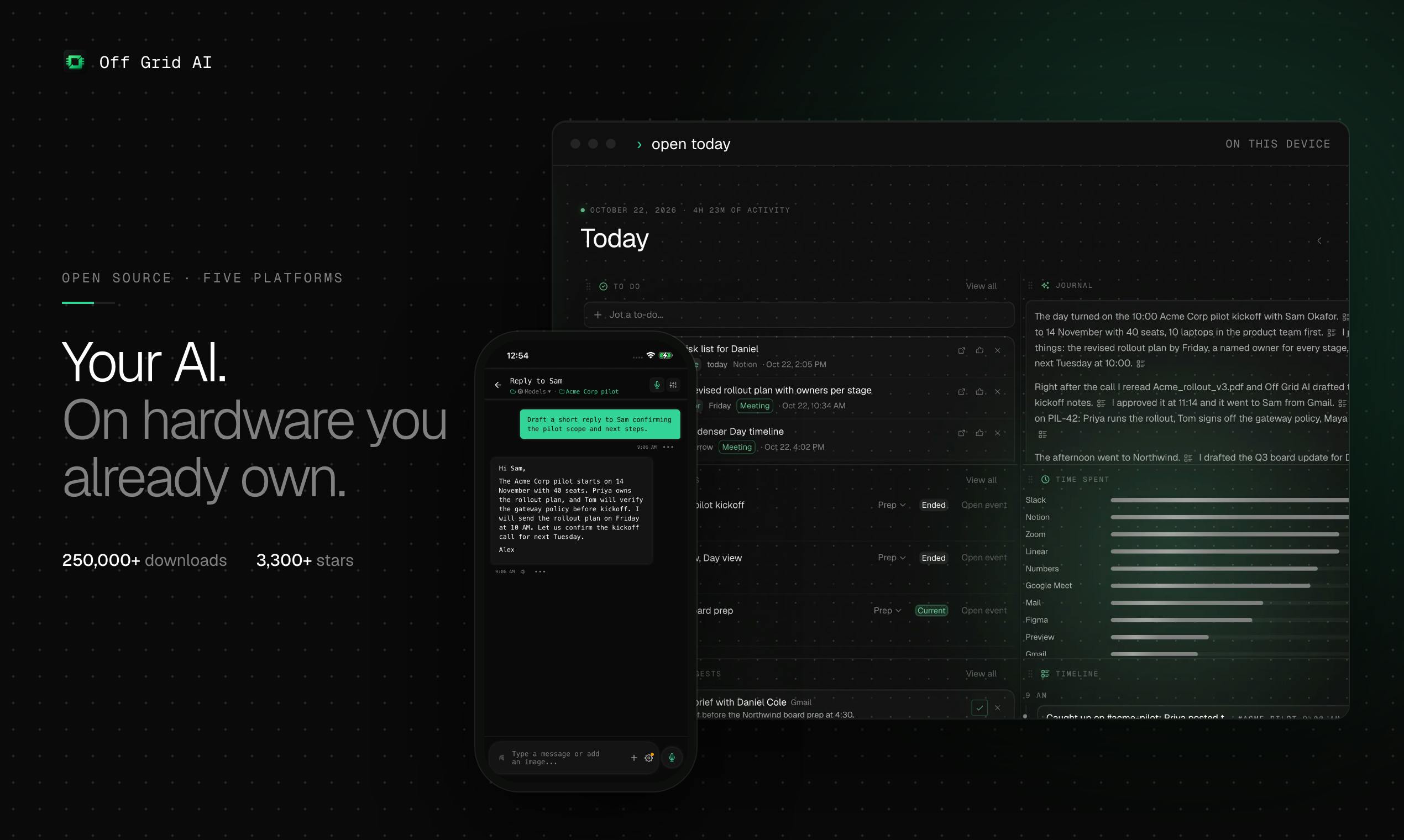
While most AI assistants rely on the cloud and user accounts, Off Grid AI has chosen a different path: running models directly on the phones and computers you already own, working even without an internet connection, and requiring no sign-up. It earned 86 votes and ranked 11th on Product Hunt. Today we're taking a look at this open-source project.
Core Features: No Internet, No Sign-Up — AI Right on Your Device
The core selling point of Off Grid AI is privacy and offline capability. According to the official description, you can chat, read documents, ask about the contents of photos, have voice conversations, and even generate images with Wi-Fi turned off — all without creating an account.
This means your data is never uploaded to any server; all processing happens locally. For privacy-conscious users, this is undoubtedly an attractive proposition. It also supports iOS, Android, macOS, Windows, and Linux, covering all the major platforms.
Local inference refers to deploying trained AI models directly on user devices (such as phones and computers) to run, rather than sending requests to cloud servers for processing. The core technical challenge lies in model compression: through quantization (reducing model parameters from 32-bit floating point to 8-bit or 4-bit integers), pruning (removing redundant weights), and knowledge distillation (training small models with large models), models that originally required tens of GB of VRAM are compressed to a few GB or even hundreds of MB, making them runnable on mobile chips. This requires devices to have sufficient RAM and compute power, typically relying on the NPU (Neural Processing Unit) or GPU acceleration in phone SoCs. The advantages of local inference are privacy (data never leaves the device), offline availability, and low latency; the trade-off is that model capabilities are usually weaker than cloud-based large models.
The Desktop Memory Assistant: Transcription, Source Attribution, and Draft Confirmation
On desktop, Off Grid AI functions more like a personal memory assistant. It can transcribe your day's meetings — no bot needs to be placed in the call — and provide answers with cited sources. Even more notably, it drafts replies but only sends them after you confirm.
This "draft first, confirm later" mechanism reflects respect for user control and avoids the awkwardness of AI sending messages by mistake. The source citation feature also enhances the credibility of answers by letting you know where the information comes from.
Phone-Computer Collaboration: Direct Device-to-Device Calls to Large Models
An interesting feature: your phone can call larger models on your Mac through a direct device-to-device connection. This solves the problem of limited phone compute power while maintaining local privacy — data only flows between your devices, never through cloud servers.
This collaboration approach is similar to Apple's Continuity, but focused on AI model inference. According to the Product Hunt page, it uses the local network for device-to-device communication without requiring the internet.
Device-to-Device (D2D) communication refers to two devices directly establishing a connection and exchanging data within the same local network (such as a Wi-Fi LAN), without going through the internet or a central server for relay. Common implementations include service discovery based on mDNS/Bonjour (automatically finding peer devices on the LAN) and data transmission via WebRTC or custom TCP/UDP protocols. In AI scenarios, the phone acts as a lightweight client sending inference requests, while the Mac acts as a compute node returning results, with data flowing only within the local network. This approach requires both devices to be on the same network and needs to handle security concerns such as device discovery, identity authentication, and connection encryption, but offers lower latency and stronger privacy compared to cloud relay.
Open Source and Free: The Potential of an Open Ecosystem
Off Grid AI adopts an open-source model, provides code on GitHub, and is completely free. Open source means transparency — users can review the code to ensure there is no hidden data collection; it also means the community can contribute and improve it.
Currently the project has received 86 votes and 2 comments. While not particularly popular, the direction is worth watching. Amid the growing centralization of AI, Off Grid AI offers another possibility: decentralized, private, and user-controlled.
Open-source licenses determine how others can use, modify, and distribute a project's code. Common licenses fall into two categories: permissive (such as MIT, Apache 2.0), which allow commercial use and closed-source distribution while only requiring retention of copyright notices; and copyleft (such as GPL, AGPL), which require derivative works to also be released as open source. For AI tools that tout privacy, license choice is especially important — users can use it to review whether the code contains any data-reporting behavior. Additionally, "open source" and "free" are not equivalent: a project may be open source but offer paid hosting services, or be free but not disclose its code. When evaluating such projects, you should confirm the license type of its code repository, update frequency, and community activity.
Hands-On Experience and Outlook
Since we haven't tested it ourselves, we cannot evaluate its performance. But based on the description, it can run AI models on phones, likely relying on optimized lightweight models. Running voice conversations and image generation locally places certain demands on hardware, and actual results may vary by device.
Privacy protection is its biggest advantage, but feature completeness and ease of use still need to be tested by the market. If you're interested in local AI, you might want to keep an eye on this open-source project — perhaps it could become your privacy-first AI assistant.
For more information, visit the official website or GitHub repository (links on the Product Hunt page).
One-line Summary
Off Grid AI is an open-source, free local AI assistant that supports offline operation and cross-device collaboration, with a focus on privacy protection.
Paragraph Summary
Off Grid AI is an open-source project that earned 86 votes on Product Hunt. Its core selling points are privacy and offline capability — models run directly on users' existing phones and computers, enabling chat, document reading, photo recognition, voice conversation, and image generation even without internet, all without requiring account registration. The desktop version acts as a personal memory assistant that can transcribe meetings, provide answers with cited sources, and employs a "draft first, confirm later" sending mechanism. Its standout feature is that phones can directly connect to Macs to call larger models, with data flowing only between local devices. The project covers five major platforms — iOS, Android, macOS, Windows, and Linux — and is open source and free, though actual performance and ease of use remain to be tested by the market.
Related articles

iPhone Duo Transformed into a Windows 98 Gaming PC: Hands-On Test and Experience
XDA tests turning the iPhone Duo foldable into a Windows 98 gaming PC using RetroArch and DOSBox Pure with virtual 3DFX, running Unreal Tournament, Half-Life, and Quake 3, plus Windows XP feasibility and limits.

Type-Safe Keep Rules in R8 and DEX Optimization in Practice
Google Play requires over 25% DEX optimization. This article explains the R8 configuration analyzer, Jetpack Keep type-safe annotations, and the Android CLI validation tool to help Android developers narrow keep rules, improve shrinking/optimization/obfuscation, and reduce ANRs.

Why Are Old Buildings More Beautiful Than New Ones? Pulitzer Prize-Winning Author Reveals an Overlooked Economic Truth
Pulitzer Prize-winning author Robert Caro found that poorer countries built more beautiful buildings. He reveals how cheap skilled craftsmen created the intricate details of old New York architecture, and how rising labor costs changed architectural aesthetics.