Offline Survival Assistant on a USB Drive: Local LLM + Kiwix Hands-On

Hacker News' offline survival assistant packs a local LLM and Kiwix onto a USB drive for offline Q&A and retrieval.
The project packs a local LLM and the Kiwix offline knowledge base onto a USB drive, providing intelligent Q&A and information retrieval without a network on any computer. The article analyzes its two-layer structure: the model explains and reasons, while Kiwix offers authoritative entries for verification, reducing hallucination risk. Technically feasible but limited by USB speed, target hardware, and model size, it's closer to a proof of concept—valuable as a cloud-independent fallback for disasters, fieldwork, and privacy-sensitive scenarios, and a sign of AI moving from always-online to portable.
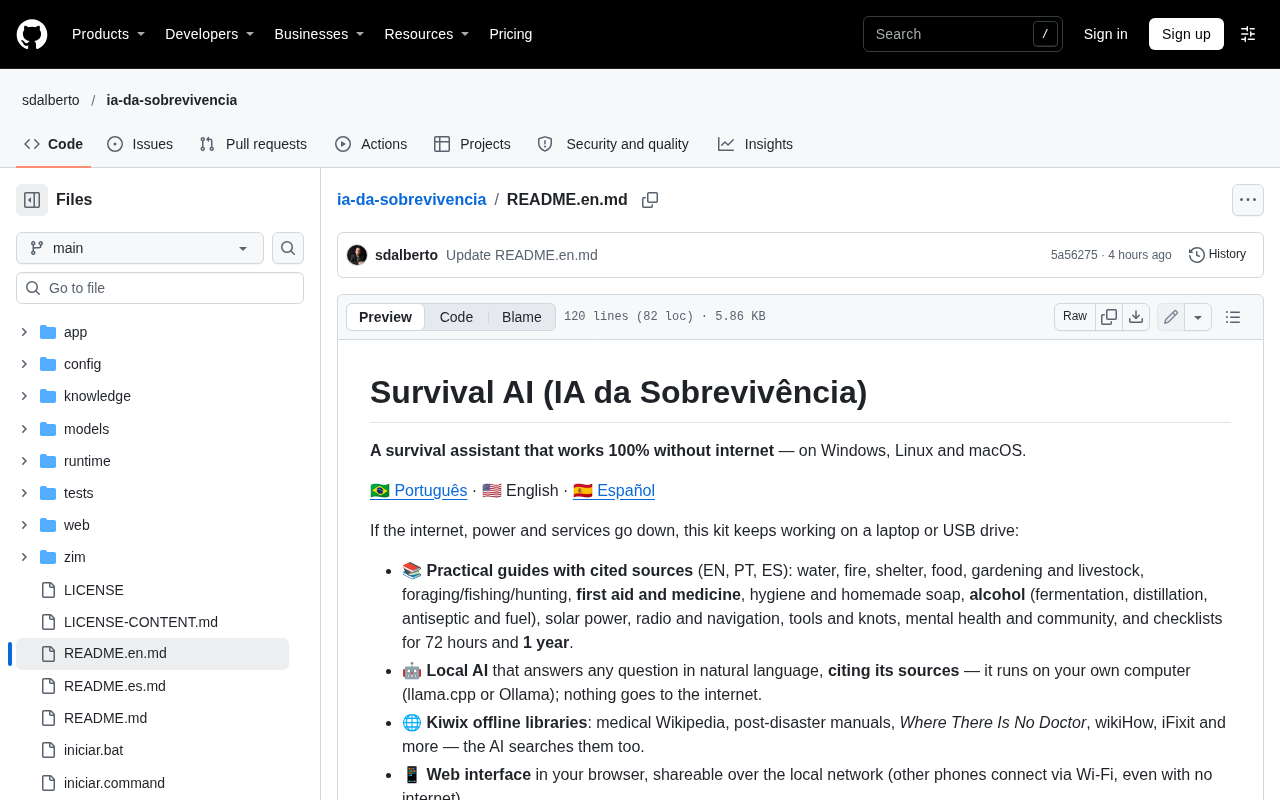
When network outages become the norm, an offline AI assistant that fits on a USB drive may be more reliable than cloud services. The "Offline Survival Assistant" project recently discussed on Hacker News packages a local large language model together with the Kiwix offline knowledge base onto a USB device, aiming to provide usable intelligent Q&A and information retrieval in no-network environments.
Why We Need an Offline AI Assistant
The convenience of cloud AI services rests on a stable network. In scenarios such as disasters, travel, or remote fieldwork, the network may be unavailable for extended periods, and an assistant that depends on APIs will simply fail. This project puts both model inference and the knowledge base locally, so the USB drive can be plugged into any computer and started up without relying on an external server.
This idea isn't entirely new, but combining a local LLM with Kiwix (a reader for offline content such as Wikipedia) to form a two-layer "Q&A + lookup" structure is a fairly practical design. The local model handles instant explanation and reasoning, while Kiwix provides authoritative entries as a supplement—the two complement each other.
Technical Composition: Local Model and Offline Knowledge Base
According to the Hacker News discussion, the assistant runs on a USB drive, with its core consisting of local LLM inference and Kiwix content packs. Choosing a local model requires balancing size, speed, and answer quality—larger models perform better but demand more from hardware; Kiwix, meanwhile, carries offline materials such as Wikipedia, with controllable size and mature content.
The clever part of this combination is the division of labor: the model handles natural-language questions and explanatory answers, while Kiwix is responsible for precise retrieval. When the model is uncertain, users can turn to Kiwix to check the original text, reducing the risk posed by model hallucinations.
Local large language model inference refers to running model weights directly on the user's own hardware to generate answers, rather than sending requests to a remote server. A common approach is to use quantized model files (such as 4-bit or 8-bit quantization), compressing weights that would otherwise be tens of GB down to a few GB so they fit on a USB drive and can be loaded on an ordinary laptop. Inference frameworks typically use lightweight solutions such as llama.cpp and Ollama, which are optimized for CPU inference and do not strictly require a discrete GPU. The cost is a limited model scale: the fewer parameters, the faster the loading and the lower the hardware threshold, but the coherence of complex reasoning and long answers declines. As a result, offline assistants tend to choose small models under 7B and focus primarily on explanatory, short Q&A tasks.
Kiwix is an open-source offline content reader whose core is the ZIM format: it packages sites such as Wikipedia, Wiktionary, and Project Gutenberg into a single compressed file containing an index, supports full-text search, and can be browsed without an internet connection. ZIM files come in tiers by content size—the complete English Wikipedia can reach tens of GB, while abridged versions or topic-specific packs can be kept between a few hundred MB and a few GB, making them easy to distribute alongside a USB drive. Kiwix's built-in reader runs across Windows, macOS, Linux, and mobile, which aligns perfectly with the cross-platform portability emphasized by the USB drive approach.
Practical Usability and Limitations
The comment section has only 5 discussions, so information is limited, but it's enough to see that the focus is on hardware compatibility and startup experience. The advantage of the USB drive approach is portability; the disadvantage is that read/write speeds are far lower than an internal hard drive, so large models may load slowly. In addition, differences in the configuration of the target computer directly affect inference speed, and the experience on older devices may degrade noticeably.
The project is currently more like a proof of concept: it demonstrates that an offline AI assistant is technically feasible, but it is still some distance from "plug in and use." Model quantization, startup script optimization, and cross-platform compatibility are all areas that need continuous refinement.
Model hallucination refers to a large language model generating content that seems plausible but is factually wrong or fabricated—a problem that local small models especially need to guard against. The smaller the model and the narrower its training data coverage, the higher the probability of hallucination, and models often output incorrect information in a confident tone, making it hard for users to judge truth from wording alone. Placing Kiwix alongside as a searchable authoritative source is in effect a "human-machine mutual verification" design: the model provides direction and explanation, and users can return to the original offline encyclopedia text to verify key facts. This division of labor does not eliminate hallucinations, but it provides a verifiable fallback for high-risk scenarios, and it is the key to how offline assistants differentiate themselves from pure chatbots in terms of reliability.
Use Cases and Takeaways
For emergency-preparedness enthusiasts, field workers, and privacy-sensitive users, such tools offer an alternative path that doesn't depend on the cloud. It also hints at a broader trend: as small models grow more capable, AI is moving from "must be online" to "can be carried with you."
What needs to be viewed rationally is that an offline assistant's knowledge is frozen at the moment of packaging, cannot access the latest information, and its answer quality is limited by the size of the local model. It supplements rather than replaces online services, and only with a clear positioning can it deliver value.
One-line Summary
Hacker News discusses an offline survival assistant that packages a local LLM and Kiwix onto a USB drive for offline Q&A and retrieval.
Paragraph Summary
The project packs a local large language model together with the Kiwix offline knowledge base onto a USB drive, so that plugging it into any computer provides intelligent Q&A and information retrieval in no-network environments. The article analyzes its two-layer structure: the model handles explanation and reasoning, while Kiwix provides authoritative entries for verification, thereby reducing hallucination risk. The project is technically feasible, but limited by USB read/write speed, the target computer's configuration, and model scale, so loading and inference experiences vary widely, making it closer to a proof of concept for now. Its value lies in offering a cloud-independent alternative for disasters, fieldwork, and privacy-sensitive scenarios, and it also reflects the trend of AI evolving from requiring connectivity to being portable.
Related articles
 Tech Frontiers
Stylome Bot Slammed as Useless Junk: Why Do AI Detection Tools Keep Failing?
Reddit users test the Stylome AI detection bot: Gemini-rewritten text judged human-written, consistently low confidence. An analysis of AI text detection's technical dilemmas, privacy concerns, and credibility crisis in community governance.
 Tech Frontiers
When AI Becomes a Productivity Divide: Clarity or "AI Psychosis"?
A civil engineer's deep use of agentic AI boosted efficiency but bred contempt for peers who refuse to learn. Is this clarity or AI psychosis? An analysis of the cognitive and psychological challenges behind the AI productivity divide.
 Tech Frontiers
Opus 5.5 Benchmark Scores Climb, Community Says Its "Weights Are Blessed"
Reddit community discusses Opus 5.5's rising scores on the Benchmaxxing Bench, with users describing its performance as "weights are blessed." This article interprets the community reaction and cautions against conflating benchmark scores with real capability.