Ollama v0.40.13-rc0 Released: llama.cpp Core Upgraded
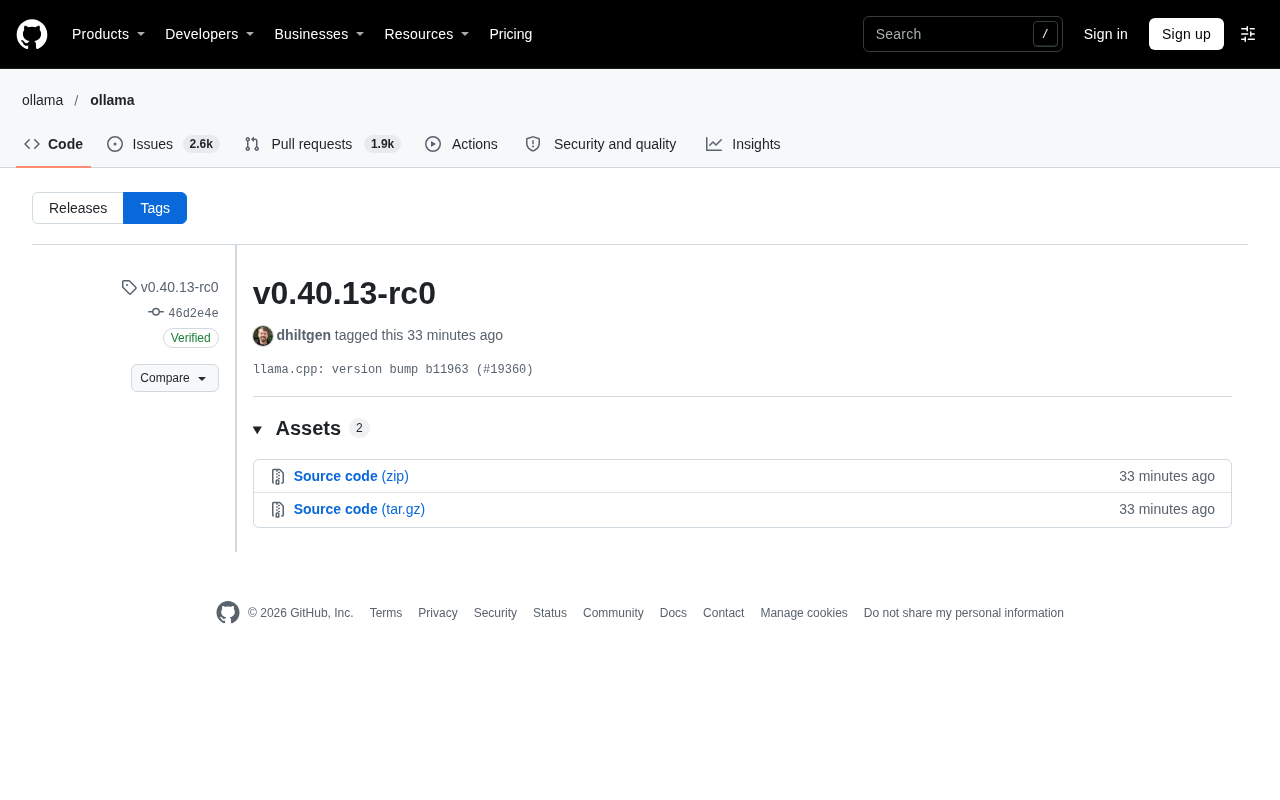
Ollama releases v0.40.13-rc0, with the core change being llama.cpp upgraded to b11963.
Ollama pushed the v0.40.13-rc0 pre-release on GitHub, commit 46d2e4e, with a GitHub verified signature, tagged by maintainer dhiltgen. The only substantive change is upgrading the llama.cpp inference backend to build b11963 (#19360), a maintenance-oriented core follow-up rather than a major feature overhaul. The article notes that llama.cpp is the most actively updated project in the local inference ecosystem, where GGUF quantization evolution, new model architecture adaptation, and CPU/GPU backend optimizations land first; Ollama as a distribution layer must follow upstream to ensure new models load and old models run faster. rc0 is a candidate version suitable for teams to verify compatibility with their own models and workflows in advance, while production environments should still wait for the official release; verification should focus on model loading, quantization file recognition, and inference speed and stability.
Ollama has pushed the v0.40.13-rc0 pre-release to GitHub, and this update has just one core change: aligning the llama.cpp inference backend to a newer version, with the commit message reading "llama.cpp: version bump b11963 (#19360)". For a tool that already handles a large share of local LLM workloads, this kind of seemingly mundane core-version follow-up is often more noteworthy than it appears.
A "one-line change" version iteration
The information visible on the release page is highly concentrated: the tag is v0.40.13-rc0, corresponding to commit 46d2e4e, carrying a GitHub verified signature, tagged by maintainer dhiltgen, and only two asset files are attached. The rc0 naming means it is first released as a candidate version and has not yet entered the official release channel.
The version number continues its small increment within 0.40.x, indicating this is a maintenance update rather than a major feature overhaul. The real change is buried in the dependency layer: llama.cpp has been upgraded to build b11963. Ollama's model loading, quantization format support, and inference performance are largely determined by this upstream project.
Why watch the llama.cpp version number
llama.cpp is one of the most actively updated projects in the local inference ecosystem. The evolution of the GGUF quantization format, adaptation to new model architectures, and optimization of CPU and GPU backends all essentially land here first. As a distribution layer aimed at ordinary users, Ollama needs to continuously track upstream so that new models can run and old models run faster.
This is also why community feedback like "a certain model fails to load on Ollama, and upgrading fixed it" appears frequently. The version bump itself is not a selling point, but it determines whether Ollama can promptly benefit from upstream fixes and optimizations. For developers who use Ollama as their daily inference entry point, following these rc versions is a low-cost way to verify compatibility in advance.
GGUF and quantization formats: GGUF is a model file container format introduced by the llama.cpp project to replace earlier formats such as GGML/GGMLv3, and it has now become one of the de facto standards in the local inference ecosystem. It packages model weights, tokenizer configuration, and metadata (such as architecture type, context length, and quantization type) into a single binary file, so inference programs do not need additional configuration files when reading it. Quantization, meanwhile, compresses the original FP16/FP32 weights into lower-precision representations such as 4-bit, 5-bit, or 8-bit with almost no loss of accuracy, thereby greatly reducing VRAM and memory usage. Different quantization types (such as Q4_K_M and Q8_0) each trade off size, speed, and quality, and the introduction of new quantization methods and backward-compatible recognition of older quantization types must first be implemented on the llama.cpp side, after which Ollama inherits these capabilities by upgrading the dependency. This explains why a change in an upstream build number can directly affect whether an Ollama user can load a certain model or whether precision anomalies occur.
CPU/GPU acceleration in the inference backend: llama.cpp is not limited to running on CPU; it provides operator implementations for multiple hardware backends, including CUDA (NVIDIA), ROCm/HIP (AMD), Metal (Apple Silicon), Vulkan, SYCL, and others, and supports offloading some layers to the GPU to strike a balance on devices with limited VRAM. Upstream version updates often include kernel optimizations for specific backends, new hardware support, or numerical precision fixes. Because Ollama does not rewrite these low-level operators itself but compiles them into release packages as dependencies, the llama.cpp version number effectively represents the upper limit of the hardware acceleration capabilities Ollama can obtain. For users with specific GPUs or operating systems, a version bump may mean that a device that previously could not enable GPU acceleration is finally usable, or that inference speed on a certain backend improves noticeably.
How to use rc versions
Pre-release versions suit two kinds of people: teams that need to confirm before the official release whether the new llama.cpp affects their own models or workflows, and contributors who intend to report issues upstream. For ordinary production environments, it is still advisable to wait for the official release to avoid unknown regressions in candidate versions.
For this particular update, verification can focus on whether model loading works normally, whether existing quantization files are still recognized, and whether inference speed and stability meet expectations. Since the official release notes do not elaborate on details, actual behavior should be judged by local testing.
rc and version-number semantics: rc stands for release candidate, and rc0 indicates the first candidate version before the official release. Under common semantic versioning conventions, an increment in the third digit of 0.40.x usually corresponds to backward-compatible maintenance changes such as bug fixes and dependency updates, rather than new APIs or breaking changes. The pre-release tag means the version has passed basic build and signature verification but has not yet received the endorsement of the official release channel, and may still contain insufficiently tested regressions. It is therefore suitable as a canary verification target, but should not directly replace a stable version handling critical tasks in a production environment.
Conclusion
Ollama v0.40.13-rc0 is a typical core follow-up update, with llama.cpp b11963 as the main character. It offers no new interface or new features, yet it determines whether local inference capabilities can stay in sync with upstream. For those focused on putting local LLMs into practice, the value of such minor versions lies precisely in "not causing problems" and "getting fixes earlier".
One-line Summary
Ollama releases v0.40.13-rc0, with the core change being llama.cpp upgraded to b11963.
Paragraph Summary
Ollama pushed the v0.40.13-rc0 pre-release on GitHub, commit 46d2e4e, with a GitHub verified signature, tagged by maintainer dhiltgen. The only substantive change this time is upgrading the llama.cpp inference backend to build b11963 (#19360), a maintenance-oriented core follow-up rather than a major feature overhaul. The article notes that llama.cpp is the most actively updated project in the local inference ecosystem, where GGUF quantization format evolution, adaptation to new model architectures, and CPU/GPU backend optimizations all land first; as a distribution layer, Ollama must continuously follow upstream to ensure new models can load and old models run faster. rc0 is a candidate version suitable for teams to verify compatibility with their own models and workflows in advance, while production environments should still wait for the official release; verification should focus on model loading, quantization file recognition, and inference speed and stability.
Related articles

Gemini 4 Carbon Tops Global Rankings as AI Productivity and Open-Source Ecosystems Surge
Google DeepMind's Gemini 4 Carbon tops global benchmarks, built for complex agents and system security. ByteDance launches Doubao Work integrated with Feishu, Anthropic's AI autonomously breaches 5 system-level attack chains, and ModelBest and Fudan open-source on-device multimodal and image generation models.

Overseas Creator Breaks Down N8n AI Agent Business Playbook: From Tooling to Monetization
An overseas creator breaks down the N8n AI agent business playbook: comparing Zapier, Make, and N8n, detailing four monetizable automation categories—lead capture, WhatsApp follow-up, booking, and content pipelines—plus agency pricing and a sales playbook.

Empacer: The Voice-First AI Assistant for Small Business Owners That Topped Product Hunt
Empacer is a voice-first AI assistant for small business owners: three-question setup, voice requests turned into customer replies, social posts, and invoices—all owner-approved. It won #1 Product of the Day on Product Hunt with 231 upvotes and 47 comments.