Once We Gave the Robot a Mouth, It Started Roasting Its Boss
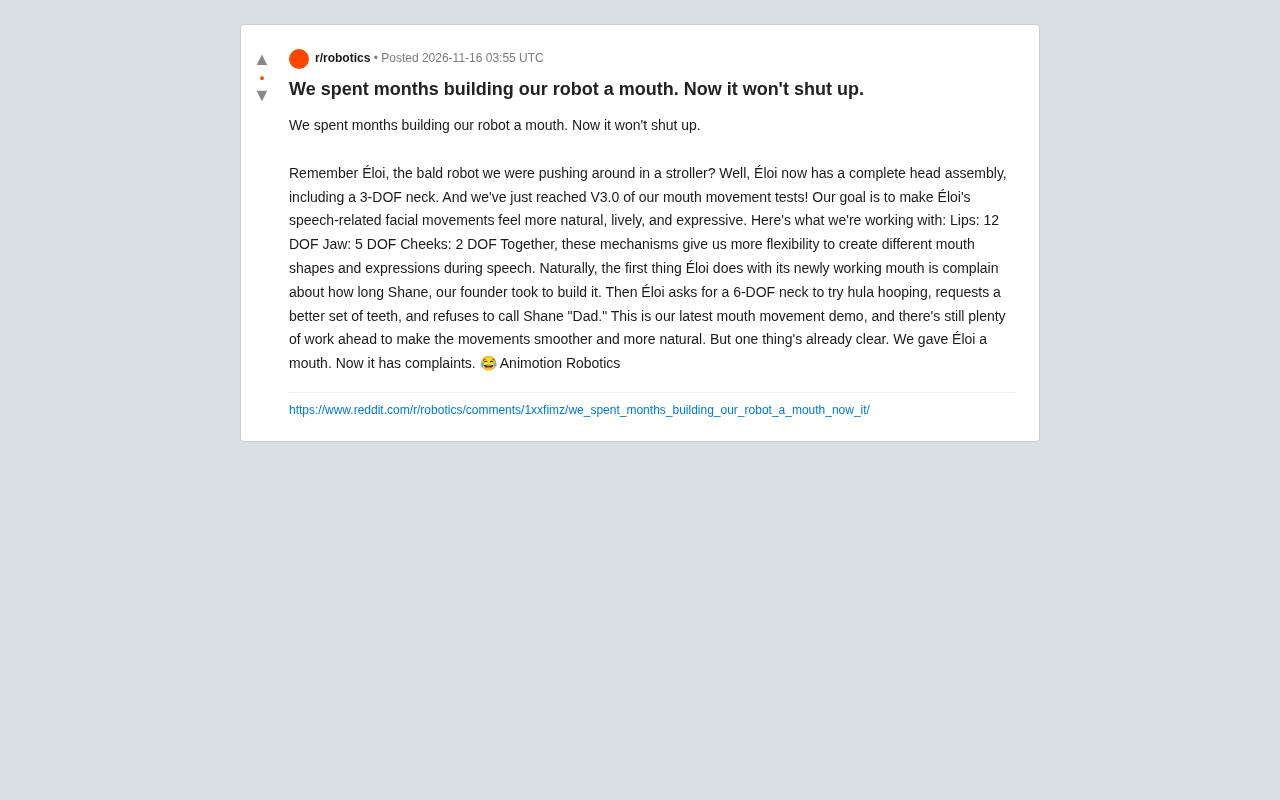
Animotion Robotics gave robot Éloi a 19-DoF mouth to make facial expression more natural.
Animotion Robotics completed a full head assembly for robot Éloi, including a 3-DoF neck, and advanced mouth-movement testing to V3.0. Éloi's mouth system comprises 12-DoF lips, a 5-DoF jaw, and 2-DoF cheeks — 19 degrees of freedom in total — aimed at making speech-time facial movements more natural, lively, and expressive. The team admits there is still plenty of room to improve smoothness and naturalness. In the demo, Éloi roasts its founder and demands a 6-DoF neck and better teeth, reflecting an anthropomorphic interaction approach. The article notes that speech is no longer the humanoid robot's weak point — facial expression is the key bottleneck, and coordinated multi-DoF control is the core difficulty.
In robotics circles, getting a machine to "speak" is never just about speech synthesis. The real challenge is the face it speaks with — how the lips open and close, how the jaw moves up and down, how the cheeks follow along, so that a mechanical face can look natural, lively, and expressive.
The progress shared by the Animotion Robotics team on Reddit lays out this challenge in concrete terms: they spent months building a mouth for their robot Éloi.
From a Bald Robot in a Stroller to a Complete Head
If you remember Éloi as that bald-headed robot being pushed around in a stroller, it has now been upgraded. The team has fitted it with a complete head assembly, including a 3-DoF neck structure.
That alone marks a milestone: the head is no longer a fixed, motionless shell. The neck can turn, nod, and tilt, providing the foundation for facial expression. And their latest progress is that mouth-movement testing has advanced to the V3.0 version.
The team's goal is clear — to make Éloi's speech-related facial movements more natural, more lively, and more expressive. That sounds simple, but in engineering terms it means a large number of degrees of freedom must be controlled in coordination.
Neck degrees of freedom are equally critical for humanoid robot interaction. A 3-DoF neck typically implements three rotational axes: yaw (turning left and right), pitch (nodding/bowing), and roll (tilting), with some designs adding translation or extra rotation. Neck DoF directly determines whether the robot's head can perform social actions like gazing, nodding, and head-tilting — nonverbal cues that carry important emotional and attentional signaling in human-robot dialogue. Compared with a fixed head, a movable neck lets the robot better mimic the natural head movements of human conversation, but it also introduces engineering challenges such as center-of-gravity shifts, cable routing, and kinematic coupling, all of which require coordinated control with the rest of the body.
One Mouth, 19 Degrees of Freedom
Éloi's mouth system consists of three parts:
- Lips: 12 DoF
- Jaw: 5 DoF
- Cheeks: 2 DoF
Altogether, the mouth region alone has 19 degrees of freedom. In the humanoid robotics field, that is a fairly fine-grained configuration — many robot faces only perform a few coarse open-and-close motions, whereas 12-DoF lips mean the team can combine many lip shapes, such as rounded, spread, closed, and slightly open, to match different phonemes and emotions during speech.
The jaw's 5 DoF handle the overall trajectory of the lower jaw, while the cheeks' 2 DoF create subtle tugs of facial muscle. Only with all three working together is it possible to break out of the "mechanical open-and-close" look and produce expression changes closer to those of a human speaking.
Of course, more degrees of freedom also mean exponentially greater control difficulty. The team openly admits in the original post that there is still a lot of work to do to make the motions smoother and more natural.
Degrees of Freedom (DoF) in robotics refers to the number of parameters a system can move independently. For articulated robots specifically, one degree of freedom usually corresponds to one independently controllable axis of motion, such as rotation, translation, or bending. The more degrees of freedom, the larger the pose space the mechanism can achieve — but it also means more actuators (such as servos or pneumatic muscles), higher-dimensional control algorithms, and system complexity and cost that grow exponentially. Taking humanoid robot faces as an example, the human face has roughly 40+ expression muscles, and engineering typically approximates this with a few dozen degrees of freedom, while most commercial robot faces contain only 5–10 DoF and can produce only coarse expressions. Éloi stacks 19 degrees of freedom in the mouth alone — a fine-grained design aimed at highly expressive interaction. The difficulty lies not in the precision of any single joint but in coordinated multi-DoF control: how to make 19 motors work together within millisecond-level timing to produce smooth, coordinated mouth movements that follow the rhythm of speech.
Once It Had a Mouth, the First Thing It Did Was Complain
Beyond the technology, the most interesting part of this share is the team's sense of humor.
As soon as Éloi's mouth worked, the first thing it did was complain that founder Shane took too long to build it. It then asked for a 6-DoF neck so it could try hula hooping; it also demanded better teeth and refused to call Shane "Dad."
These lines were of course written by the team, but they reveal a genuine product perspective: once a robot has a movable face, human-machine interaction gains an extra layer of emotional projection. A mouth that moves and "talks back" creates a stronger sense of communication than a row of blinking LEDs.
Judging from the demo, this direction holds up. The team frames this content as the latest mouth-movement demo rather than a final product, which also shows they remain clear-eyed about the current level of naturalness.
Why the "Mouth" Is the Hard Nut for Humanoid Robots
From an industry perspective, Éloi's progress highlights a key bottleneck in humanoid robot interaction: speech capability is no longer the weak link — facial expression is.
Large language models can make conversational content fluent enough, but a stiff face instantly breaks the illusion. Lips need to align precisely with speech in time, with different phonemes corresponding to different lip shapes; expression changes must match semantics and emotion, or you get the jarring disconnect of "an agitated tone with a face that doesn't move a muscle." All of this requires tight coordination among mechanical structure, actuation control, and content generation.
By betting 19 degrees of freedom on mouth detail, Éloi is essentially laying the groundwork for "believable expression." How natural the final result will be still depends on iterations beyond V3.0.
At least one thing is certain now: they gave Éloi a mouth, and it already has opinions.
One-line Summary
Animotion Robotics built a 19-DoF mouth for robot Éloi to make facial expression more natural.
Paragraph Summary
The Animotion Robotics team completed a full head assembly for robot Éloi, including a 3-DoF neck, and advanced mouth-movement testing to V3.0. Éloi's mouth system comprises 12-DoF lips, a 5-DoF jaw, and 2-DoF cheeks — 19 degrees of freedom in total — aimed at making speech-time facial movements more natural, lively, and expressive. The team admits there is still plenty of room to improve smoothness and naturalness. In the demo, Éloi roasts its founder, demands a 6-DoF neck and better teeth, reflecting an anthropomorphic interaction approach. The article notes that speech is no longer the humanoid robot's weak point — facial expression is the key bottleneck, and coordinated multi-DoF control is the core difficulty.
Related articles
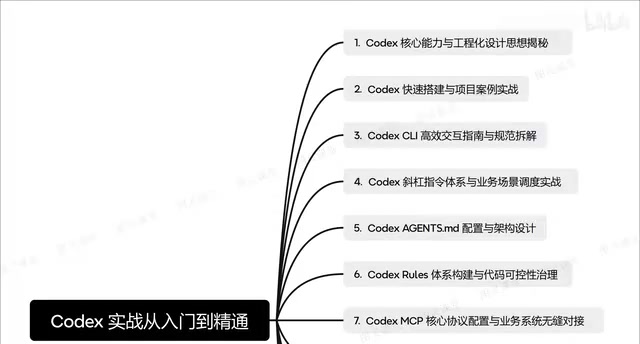
Codex in Practice: From Installation and Configuration to Multi-Agent Collaboration
Based on a Bilibili Codex course overview, this guide maps the full path of AI coding assistants from installation and agents.md context design to CLI commands, MCP integration, and multi-agent collaboration.

Claude Code Installation and Model Switching Guide for Users in China
How can developers in China install Claude Code reliably? This article compiles a Bilibili creator's hands-on solution: install via NPM, skip official login, use CC Switch to configure API Keys and freely switch between DeepSeek, Kimi, and other models to avoid account bans.

AI Supply Chain Security: What Canary Tokens Reveal
Starting from a Hacker News discussion, this article analyzes the role of canary tokens in AI supply chain security: how they detect abnormal access to model weights, training data, and credentials, as well as coverage blind spots and cost constraints during implementation.