Open-Source AI Desktop Pet Astra Pet: Tsundere, Wall-Climbing, and Ready to Chat

Open-source AI desktop pet Astra Pet: a whale girl with emotions and a life, LLM chat, and custom character generation from one description.
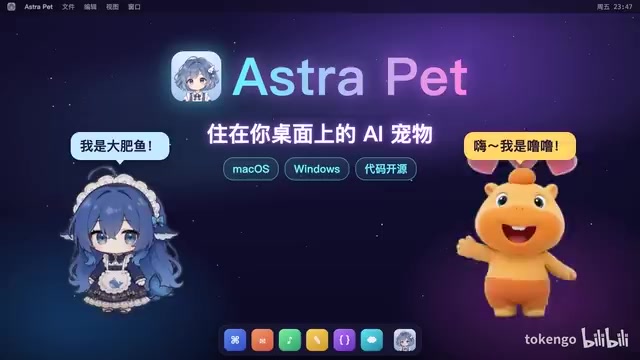
Astra Pet is an open-source desktop AI pet project. A Bilibili video of a "whale girl" pet showcases its core features: it reacts with tsundere, flustered, wall-climbing, and zoning-out behaviors, plus autonomous life rhythms like eating and sleeping, turning it from a desktop accessory into a digital life form with personality. With LLM integration, it chats, reminds you to drink water, and prompts you to move. The biggest draw is open-source customization: a single text description lets AI generate an action video, auto-matte it, and export it with one click as a new pet.
Having an AI pet on your desktop that acts coy, gets angry, and even reminds you to drink water sounds like something out of a sci-fi movie. But the open-source project Astra Pet makes it a reality. Recently, a video on Bilibili showcasing a "whale girl" desktop pet drew attention—this little creature doesn't just live on your desktop; it has its own little moods and daily life.
A Day in the Life of a Whale Girl: Tsundere, Flustered, and Zoning Out
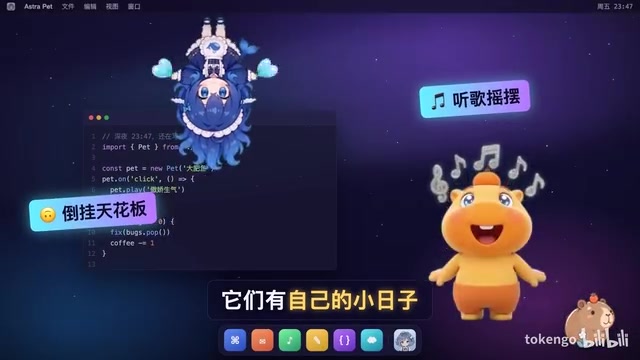
The core charm of Astra Pet lies in its sense of being "alive." According to the video, if you tap it, it acts tsundere; if you pick it up, it gets flustered. It can also climb walls, hang upside down, or just sit by the window zoning out. These behaviors aren't just a pile of random animations—they're anthropomorphic reactions built around a character设定.
More importantly, it has its own rhythm of life. The video mentions "they have their own little days," meaning the desktop pet isn't just passively responding to clicks—it proactively does things like eating when hungry or sleeping when tired. This autonomy transforms the desktop pet from a "desktop accessory" into a digital life form with a bit of personality.
Connecting to an LLM: From Cute to Conversational
If it were just animated interactions, Astra Pet might still be stuck in the "cute but useless" phase. Another highlight is its support for connecting to large language models. Once connected, the pet will chat with you and remind you to drink water or get up and move around.

This is actually a clever product idea: packaging the conversational abilities of an LLM into a tangible character, giving the AI assistant a "personality" and "presence." You don't need to open a chat window—the pet is just there, interacting with you in its own way. Features like water reminders are simple, but paired with a tsundere tone and animations, the experience is completely different.
DIY: Generate Your Own Pet from a Single Description
The most appealing aspect of Astra Pet is its open-source and customizable nature. The video demonstrates a workflow: "write a description to generate an AI action video, auto-matting, one-click export." In other words, you don't need to know how to draw or animate—just describe the pet you want in words, and AI will generate an action video, automatically matte it, and export it with one click to become a new character on your desktop.
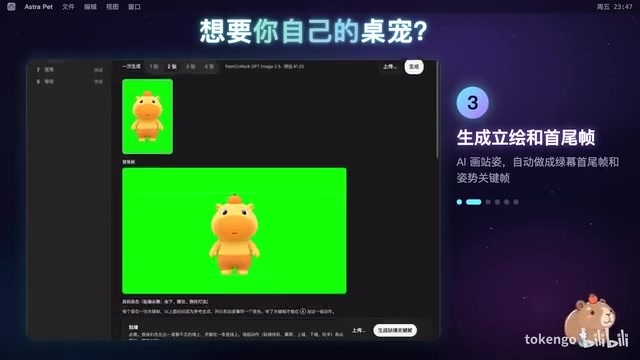
"Lulu" in the video was created exactly this way. This process dramatically lowers the barrier to creation, allowing ordinary users to have a unique desktop pet. Open source means the technical details are public, so developers can modify behavior logic, connect different LLMs, or even train new actions.
Auto-matting is the key step that makes the generation workflow truly usable. AI-generated videos often come with extraneous backgrounds and can't be directly placed on the desktop as transparent characters. Matting is the task of separating the subject from the background and outputting layers with an alpha channel frame by frame. Traditional green-screen matting relies on solid-color backgrounds, but matting for arbitrary generated videos (such as depth-guided RVM, MatteFormer, etc.) needs to handle hair strands, semi-transparent edges, and motion blur. Astra Pet encapsulates this step into "one-click export," meaning users receive a set of action frame sequences with transparent backgrounds that can be played on loop—this is the technical prerequisite for the pet to naturally overlay on the desktop.
New Possibilities for Desktop AI Pets
Astra Pet represents a rising category of projects: embedding AI capabilities into everyday desktop environments and replacing traditional utility interfaces with character-based interaction. It doesn't pursue the efficiency of productivity tools but offers emotional value and companionship. For open-source community users who love to tinker, it provides a highly playable framework; for ordinary users, adopting a ready-made pet is enough to have fun.
The video ends with "scan the QR code to join the group and adopt your desktop pet," indicating the project already has an active community. If you're interested in desktop pets or AI character interaction, this open-source project is worth checking out.
One-line Summary
Open-source AI desktop pet Astra Pet: a whale girl with emotions and a life, connects to LLMs for chat, and generates a custom character from a single description.
Paragraph Summary
Astra Pet is an open-source desktop AI pet project. A Bilibili video of a "whale girl" pet showcases its core features. The pet doesn't just passively respond to clicks—it has anthropomorphic reactions like being tsundere, flustered, climbing walls, hanging upside down, and zoning out, plus autonomous life rhythms like eating and sleeping, upgrading it from a "desktop accessory" to a digital life form with personality. When connected to an LLM, it can chat, remind you to drink water, and prompt you to stand up and move, packaging conversational abilities into a tangible character to give the AI assistant personality and presence. The project's biggest draw is being open-source and customizable: users only need a one-sentence text description, and AI can generate an action video, automatically matte it, and export it with one click as a new pet, greatly lowering the creative barrier. Developers can also modify behavior logic, swap models, or train new actions.
Related articles
 Tech Frontiers
Coldframe: A Honeypot Disguised as a Supermarket Freezer Controller
Coldframe is a honeypot disguised as Danfoss AK-SM 800A and Dixell XWEB freezer controllers, built as a single Python file that detects CVE-2025-41450 attempts and is identified as real devices on Shodan.
 Tech Frontiers
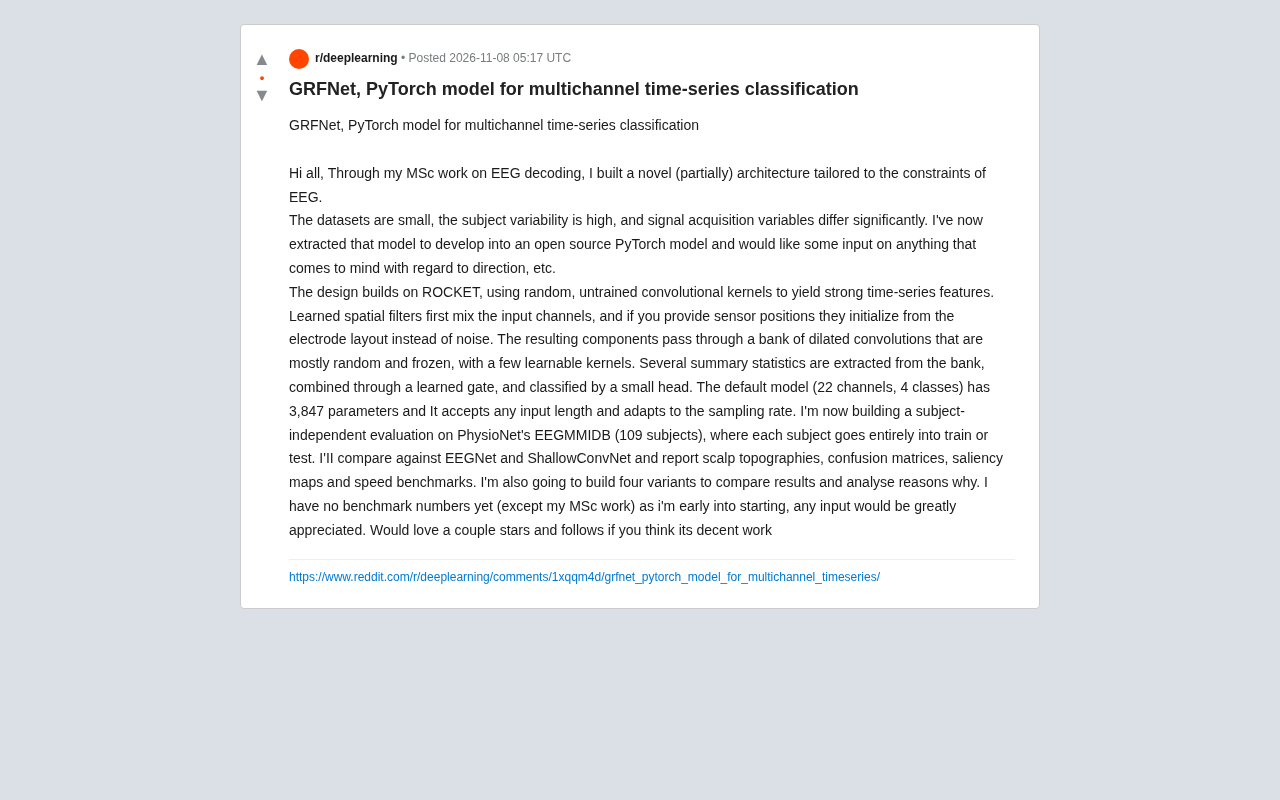
GRFNet: A Lightweight PyTorch Model Designed for Multichannel Time-Series Classification
GRFNet is a lightweight PyTorch model for multichannel time-series classification, originating from EEG decoding research. With only 3,847 parameters, it is based on the ROCKET architecture, combining random convolution kernels with learnable spatial filters, supports arbitrary input lengths, and will soon be evaluated on the PhysioNet dataset.
 Tech Frontiers
CUDA-Accelerated Rocket League Simulator: A Player-Made Hardcore Experiment
A Reddit post shows a "100% Accurate" Rocket League simulator accelerated with CUDA. We analyze its technical context, CUDA's value in game physics simulation, and the significance and limitations of such community projects.