Open-Source Hack Unlocks Nvidia GPU Compute: 4090 AI Performance Nearly Doubles, Qwen 4.0 Debuts This Week

Compute cracks and extreme quantization lower local barriers, while top vendors push deeper into foundations and benchmarks.
The article rounds up four AI developments from the same day: an open-source project rewrites registers via a Linux kernel module to bypass Nvidia's consumer GPU compute limits, pushing the 4090 past 330 TFLOPS in half precision; a European team uses non-uniform quantization to compress the 763B-parameter DeepSeek to 1.75 bits, enabling local inference on a single 12GB GPU plus system memory; Alibaba teases a suspected Qwen 4.0 launch at the Amsterdam summit and open-sources the 3D creation agent benchmark Blender World; a Twitter-affiliated team releases DESA, a speech model trained without text pretraining that supports full-duplex interruption and runs locally on an Apple computer. Additionally, Manus launches in-house foundation development after a $500M raise. The article argues the industry shows two main threads: steadily lowering local deployment barriers, and leading players pushing deeper into foundation capabilities and evaluation standards.
A "Second Spring" for Consumer GPUs: Kernel-Level Hack Doubles 4090 Compute
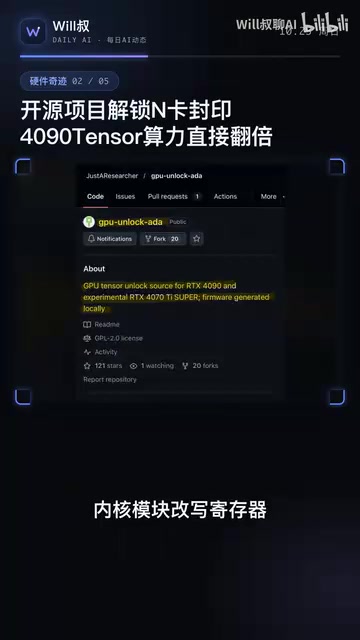
NVIDIA's compute lock on consumer GPUs has been cracked open by an open-source project. According to the daily AI news roundup by Bilibili creator Will Shu, an open-source project bypassed Nvidia's long-standing restrictions on consumer graphics cards simply by rewriting registers through a Linux kernel module — pushing the 4090's half-precision compute past 330 TFLOPS, nearly doubling its performance.
What's more important is how "lightweight" the operation is: no driver modifications, no BIOS flashing, no vBIOS changes — it talks directly to the hardware at the system level. This means the crack path avoids Nvidia's multiple layers of firmware and driver verification, turning "using consumer cards as professional cards" from insider rumor into a reproducible technical approach. For individual developers and small teams long constrained by VRAM and compute quotas, this is undoubtedly a loosening of the cost structure.
That said, a sober view is needed: rewriting registers via kernel module is a system-level operation, and users must bear the risks to stability, thermals, and warranty themselves. The possibility that Nvidia tightens things through driver or firmware policies later cannot be ruled out. It suits experimental users with Linux expertise, not an out-of-the-box production solution.
Compute Locks and Register Rewriting
NVIDIA has long drawn an artificial line between consumer (GeForce) and professional (Quadro/data center) product lines: the same-generation GPU chip on consumer cards is often locked to lower FP16/BF16 throughput, restricted memory bandwidth, or disabled ECC, in order to protect the pricing of professional cards. These limits are typically written into the GPU's hardware registers and vBIOS configuration, read and applied by the driver during initialization.
The kernel-module register-rewriting approach maps the GPU's PCI configuration space and memory-mapped regions directly in Linux kernel mode, modifying specific register values before and after the driver completes initialization — thereby changing frequencies, power limits, or compute-unit scheduling. Because it doesn't modify the driver binary or flash the vBIOS, it bypasses signature verification and firmware integrity checks, which is why the method is called "lightweight." The cost is losing vendor-level stability guarantees: kernel or driver updates can cause it to fail or even crash the system.
DeepSeek Extreme Quantization: 763 Billion Parameters Compressed to 1.75 Bits, Runnable on 12GB VRAM
If the compute crack is "open-source hardware," then the DeepSeekAd extreme-quantized version released by a European team is the counterbalance on the "open-source model" side. Based on a non-uniform quantization algorithm, the scheme compresses a massive 763-billion-parameter model to 1.75 bits with near-zero loss on mainstream benchmarks.
What truly changes the game is the deployment threshold: a single 12GB-VRAM GPU plus system memory is enough to run it locally. Models of this scale used to require multi-GPU clusters; now a single consumer-grade machine can host one, significantly pushing back the boundary of local inference. The non-uniform quantization approach is also worth noting — it doesn't crudely truncate precision but dynamically allocates bits based on weight distribution, which is the technical prerequisite for "high compression with small loss."
Of course, the actual inference speed, long-context performance, and robustness across different tasks of 1.75-bit quantization still need more community testing to verify. After quantizing to extremely low bits, model degradation on sensitive tasks like mathematical reasoning and code generation tends to be more pronounced than on general benchmarks — a dimension readers should pay close attention to when trying it out.

Non-Uniform Quantization and the Cost of Low Bit-Width
Conventional quantization (such as INT8 or 4-bit GPTQ) uses a uniform bit width and linear scaling for all weights — simple to implement but unfriendly to outliers in the weight distribution. Non-uniform quantization dynamically allocates bits based on the actual weight distribution: high-frequency, important weights retain more precision, while long-tail weights are compressed to extremely low bits, thereby keeping error small even at very low average bit width. 1.75 bits is an average figure, meaning some weights are actually stored at 1 bit or even binary form.
The main risk of extremely low-bit quantization lies not in general benchmarks but in tasks sensitive to numerical precision: mathematical reasoning depends on precise intermediate calculations, code generation demands high token-level accuracy, and long contexts amplify error accumulation. In addition, low-bit-width weights usually require matching dequantization kernels to execute efficiently on GPUs — actual inference speed depends on whether operators optimized for that bit width exist, not on parameter count itself.
Qwen 4.0 Teaser: Amsterdam Summit and a 3D Creation Benchmark
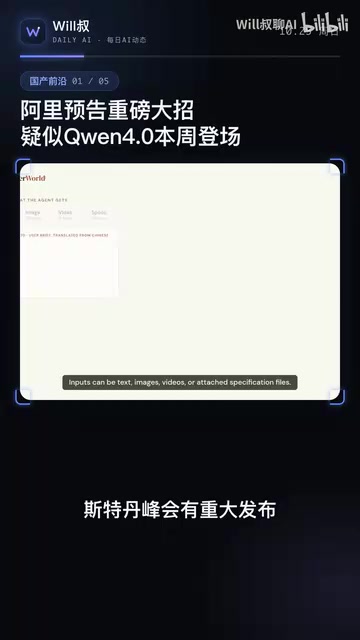
Alibaba's Tongyi Qianwen has dropped a signal. The official teaser points to a major release at the Amsterdam summit on the 29th of this month, with widespread speculation that Qwen 4.0 will launch immediately.
Equally noteworthy as the version number is that Tongyi simultaneously open-sourced Blender World, the first 3D creation agent benchmark, and delivered editable project files directly. The intent is clear: pushing agent evaluation from text Q&A to high-complexity, tool-dependent scenarios like 3D creation. Delivering editable projects also makes the benchmark more than a "scorer" — it becomes reusable, reproducible creative infrastructure.
For large-model vendors, benchmarks mean discourse power. Whoever defines the evaluation dimensions partly defines the capability narrative. By staking an early claim in the relatively blank track of 3D creation agents, Qwen is pointing to the next competitive focus: multimodal and tool-calling capabilities.
Speech Model DESA: No Text Pretraining, Learning to Speak from Real Conversations
The speech model DESA, released by a Twitter-affiliated team, takes a different path: it learns to speak entirely by listening to real human conversations without any text pretraining, featuring supernaturally natural full-duplex interruption, breathing, and laughter.
This contrasts with the mainstream cascaded approach of "speech-to-text then text-to-speech." Skipping the text intermediate layer means the model can directly model prosody, pauses, and non-linguistic information in conversation — precisely what cascaded solutions lose most easily. Running locally on a single Apple computer also indicates that its parameter count and engineering optimizations target on-device scenarios.
Its limitations are equally obvious: lacking the semantic grounding of text pretraining, its reliability on knowledge-intensive tasks remains to be tested. It is a path to "speaking like a human," not "thinking like a human."
Full-Duplex Speech and Semantic Grounding
Traditional voice interaction uses a cascaded architecture: ASR converts speech to text, an LLM processes the text, and TTS synthesizes speech. This pipeline inherently stacks latency and discards paralinguistic information such as intonation, pauses, breathing, and laughter. Full-duplex speech models instead process input and output streams within the same model, enabling listening while speaking and instant interruption — much closer to the rhythm of human conversation.
The direct consequence of skipping text pretraining is a lack of semantic grounding: the model learns acoustic and conversational patterns rather than the world knowledge and logical relationships carried by text. This makes it natural in chit-chat and companion scenarios but insufficiently reliable for tasks requiring factual accuracy or complex reasoning. To compensate, one typically needs to introduce text pretraining, multimodal alignment, or retrieval augmentation — which in turn partially offsets the advantages of its architectural simplicity.
Manus Strategic Pivot: From Orchestrating External Models to Building Its Own Foundation
Chinese agent unicorn Manus has made a major strategic pivot. Fresh off raising over $500 million at a $4 billion valuation, it has officially launched in-house foundation model development, shifting from merely orchestrating external models to controlling its own core base.
This pivot reflects the collective anxiety of the agent sector: an orchestration layer alone offers too shallow a moat and can be covered at any time by native agent capabilities from foundation model vendors. Moving upstream to control the foundation is the inevitable choice for converting "orchestration advantage" into "capability assets." But in-house foundation development means an all-out race in capital expenditure, talent density, and data flywheels — whether a $4 billion valuation can support this asset-heavy path will be the most closely watched variable going forward.

Four Signal Lines in a Single Day
Placing these four developments side by side, two main threads in the AI industry are quite clear: on one end, compute and model efficiency keep pushing downward, steadily lowering the barrier to local deployment; on the other, leading players are pushing deeper into foundation capabilities and evaluation standards. The former benefits individual developers, while the latter determines the competitive landscape. Open-source cracks and extreme quantization bring "personal compute freedom" one step closer, while Qwen's benchmark positioning and Manus's in-house foundation remind us: what's truly scarce has never been compute, but the right to define the boundaries of capability.
Related articles

T3 Code: The Open-Source AI Coding Assistant's Comeback Story
T3 Code is an open-source AI coding assistant that unifies subscriptions like Codex and Claude, with powerful remote control and parallel task management.

Never Elected, Yet Ruled New York for 30 Years: The Ultimate Case Study in the Mechanics of Power
Robert Caro's biographies reveal how unelected Robert Moses ruled New York for 30 years through legal drafting and public authorities, and how Lyndon Johnson built leverage as a "powerless" Senate Majority Leader. Unpacking the underlying logic of accumulating and sustaining power.

The CPython 3.10 Recursion Trap and Synthetic Recovery in TokenGuard, an LLM Circuit Breaker
TokenGuard's author recounts a recursion crash caused by OrderedDict.pop in CPython 3.10 and introduces v0.3.0's Loop Nudge synthetic recovery, inline DLP scanning, and other new LLM agent circuit-breaker capabilities.