OpenAI Gives ChatGPT Pro and Business Subscribers Up to $500/Month in API Credits

OpenAI gives Pro and Business subscribers up to $500/month in API credits, sparking community debate on ecosystem strategy.
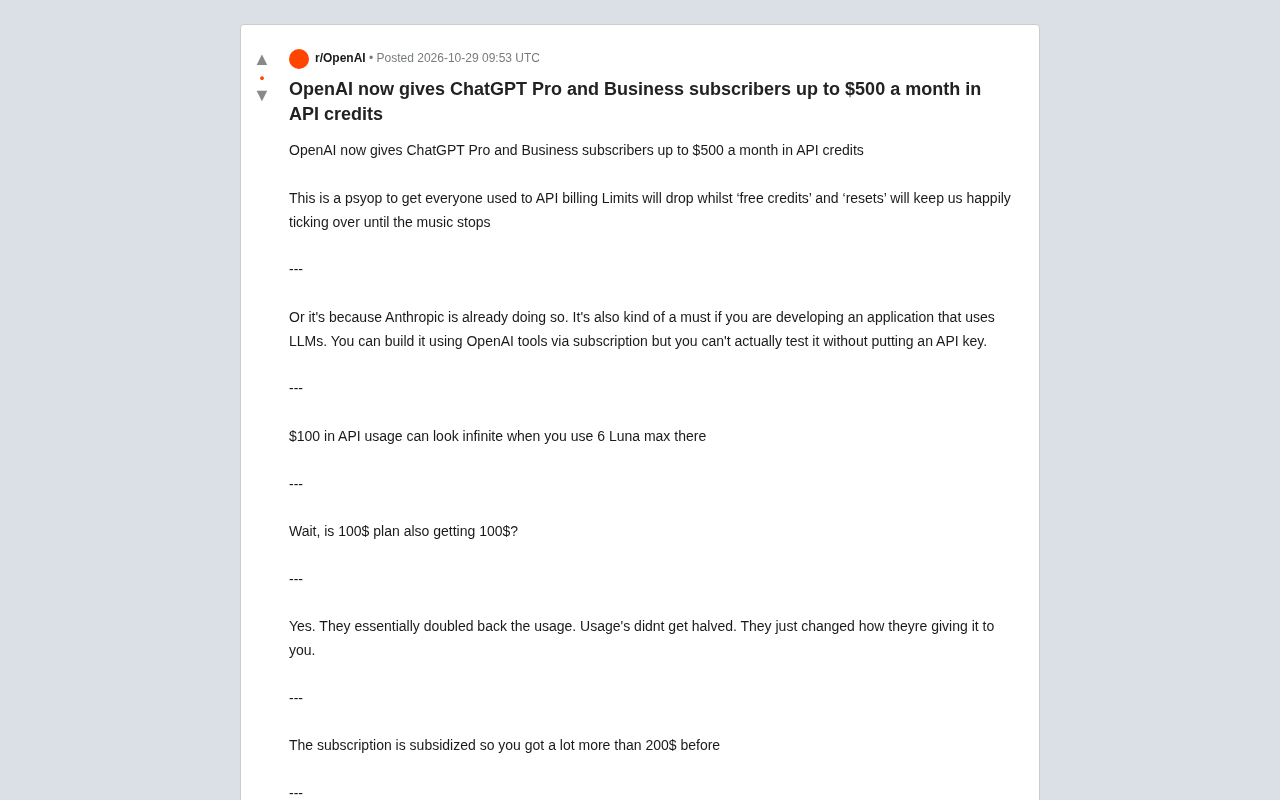
OpenAI recently adjusted its subscription policy: ChatGPT Pro and Business users can receive up to $500 per month in API call credits, with the $100 tier also increased. Reddit reactions are divided: some see it as a "boiling frog" strategy to cultivate API billing habits, others view it as a competitive response to Anthropic's enterprise plan including API usage. For developers, the policy closes the loop from prototyping to API testing, lowering early experimentation barriers; but from a marginal profit perspective, OpenAI is not heavily subsidizing—the credit boost is more about user retention under competitive pressure. The policy quietly took effect via the subscription interface, blurring the line between consumer products and developer platforms.
OpenAI recently adjusted its subscription policy: ChatGPT Pro and Business users can now receive up to $500 per month in API call credits. This news has sparked heated discussion in the Reddit community, where users see both development convenience and a hint of platform ecosystem strategy.
Policy Details: Credits Doubled, But Not a Simple Add-On
According to Reddit discussions, OpenAI is returning the API usage originally included in subscriptions in a new form—Pro users can receive up to $500 per month, and the $100 tier subscription also gets a corresponding increase. One user pointed out: "They essentially doubled the usage, didn't halve the original quota, just changed the way it's given."
This means users gain greater flexibility in practice. One user vividly compared: "When you run tasks with 6 Luna max models, $100 of API usage looks almost infinite." However, the credit cap is strongly correlated with model choice, and the actual consumption rate still depends on the usage scenario.
Difference Between API Credits and API Keys:
The "API credits" mentioned in the original text refer to usage quotas denominated in dollars, which users can view in the usage dashboard of the OpenAI developer platform; while "API keys" are identity credentials for calling the interface. The credits included in subscriptions are usually bound to the account, but in actual development, you still need to generate an independent API key and ensure the call source complies with OpenAI's usage policies. Credits reset monthly, and unused portions generally do not accumulate. Different models (such as GPT-4o, o series) have different pricing rates, so the actual number of tokens corresponding to "$500" will fluctuate with model choice. When planning experiments, developers should prioritize referring to the official pricing page's per-million-token unit price to estimate consumption.
Luna max model:
The "Luna max" mentioned by users in the text is not an official OpenAI model name, but a community nickname for a high-throughput or long-context variant (possibly corresponding to an internal codename or third-party wrapper). In Reddit discussions, such nicknames are often used to refer to model configurations with extremely low unit cost and suitable for batch tasks. Its appearance shows that the community is accustomed to viewing credits from the perspective of "running tasks": when the cost per call is low enough, $100 of credits feels almost "infinite," but is actually still constrained by rate limits (RPM/TPM). Developers need to distinguish between two different interruption causes: "credit exhaustion" and "rate limit hit."
Community Reaction: Benefit or "Boiling Frog"?
There are two distinct views on Reddit. Some users are wary, believing this is a "psychological war" aimed at getting users accustomed to API billing models—"limits will gradually tighten, and 'free credits' and 'resets' will keep us willingly using it until the music stops."
Another camp interprets it from a competitive angle. One comment noted that Anthropic already offers $40 of API usage per seat for enterprise plans, and OpenAI's move may be a direct response to competitors. "If you want to develop an app with LLMs, you can build with OpenAI tools within the subscription, but without an API key you can't really test." A developer explained the rationale this way.
Anthropic Enterprise Plan API Usage:
The original text mentions "Anthropic already offers $40 of API usage per seat for enterprise plans," which refers to Anthropic's Claude for Enterprise solution packaging a certain amount of API call credits into seat subscriptions, making it convenient for enterprises to complete both chat interface usage and API development under the same contract. This "subscription includes credits" model directly benchmarks against OpenAI's new policy: both are incorporating developer consumption into subscription revenue rather than separate pay-as-you-go API bills. For enterprise procurement, this means improved budget predictability, but may also bring differences in overage billing rules after credits are exhausted. Before purchasing, it is necessary to check the overage unit price and whether credits can be shared across seats.
Developer Perspective: Testing Loop Closed
For application developers, the API credits included in subscriptions solve a long-standing pain point. Previously, although subscribers could use models through the ChatGPT interface, development testing required purchasing API credits separately. The new policy allows prototype validation and lightweight production calls to be completed under the same subscription.
However, some users pointed out that from a marginal profit perspective, OpenAI is not heavily subsidizing—"they actually lowered their profit margin." This means the credit increase may be more of a user retention strategy under competitive pressure rather than pure generosity.
Marginal Profit and API Subsidies:
The judgment that "from a marginal profit perspective, OpenAI is not heavily subsidizing" involves the cost structure of large model services. The marginal cost of API calls mainly includes inference computing power, bandwidth, and operations allocation, which is usually far below the list price, so giving credits does not equal giving up revenue at list price. But giving credits will crowd out API revenue that might otherwise be paid, creating opportunity costs. The community's statement that "they actually lowered their profit margin" is more accurately understood as: OpenAI uses subscription revenue to cross-subsidize API consumption in exchange for user retention and ecosystem lock-in, rather than losing money on individual calls. For developers, this means credits are "conditional subsidies," and once exceeded or policies adjusted, costs will quickly return to pay-as-you-go levels.
Ecosystem Game: The Boundary Between Subscriptions and APIs Is Blurring
By embedding API credits into the subscription system, OpenAI is essentially blurring the boundary between "consumer products" and "developer platforms." For individual developers and small teams, this lowers the barrier to multi-model experimentation; for OpenAI, it can lock in developers' tech stack choices earlier.
One user mentioned that this adjustment was not announced loudly by OpenAI executives on social media, but quietly took effect through the subscription interface, which differs from the previous "month of improvements" style of promotion. This low profile may suggest the policy is still in a dynamic adjustment period.
Regardless of the motivation, for users who have already subscribed to Pro or Business, the substantial monthly API credits are real resources. The key is the pace of use—if viewed as a development subsidy rather than unlimited credits, it can indeed significantly reduce early experimentation costs.
One-line Summary
OpenAI provides Pro and Business subscribers with up to $500 per month in API credits, sparking community discussion about ecosystem strategy.
Paragraph Summary
OpenAI recently adjusted its subscription policy: ChatGPT Pro and Business users can receive up to $500 per month in API call credits, with the $100 tier subscription also increased. The Reddit community has mixed reactions: some see it as a "boiling frog" strategy to cultivate users' API billing habits, while others view it as a competitive move against Anthropic's enterprise plan that includes API usage. For developers, the new policy closes the loop from prototype building to API testing, lowering the barrier to early experimentation; but from a marginal profit perspective, OpenAI is not heavily subsidizing, and the credit increase is more like a user retention tactic under competitive pressure. The policy quietly took effect through the subscription interface, blurring the boundary between consumer products and developer platforms.
Related articles

Why Does Self-Play AI Always Get Crushed by Cheap Units? An RTS Developer's Account of the Dilemma
An independent developer trained an RTS commander AI with pure self-play, only to find it dominated historical versions but was crushed by human players using cheap tier-1 units. This article analyzes the causes of self-play strategy collapse, explores solutions such as exploiters, diversity rewards, and reward design, and introduces the open Bot Kit and AI league plan.
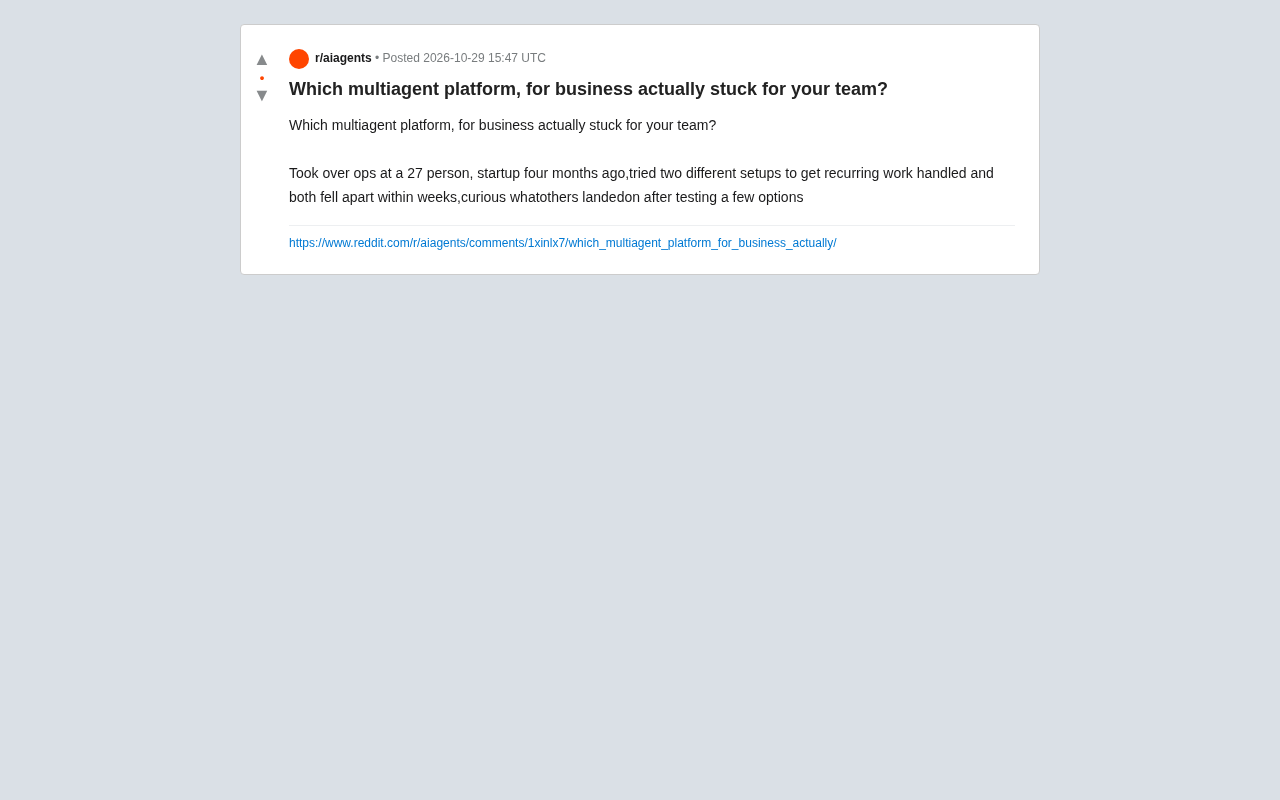
Which Multi-Agent Platform Wins? A Small Team's Battle Scars and Selection Considerations
A 27-person startup's ops lead tried two multi-agent platforms in four months and both failed. This article analyzes why small-team deployments break down, and offers selection guidance on integration depth, observability, and progressive rollout.

Thrive Holdings Takes ADT Private in $7.6 Billion Deal
Thrive Holdings acquires ADT for $7.6 billion in an all-cash take-private deal expected to close in Q1 2027. Analysis of the deal structure, ADT's asset value, and impact on the smart home security industry.