OpenAI Image 2.6 Adds GIF and SVG Support, Baidu Opens ERNIE 5.5 Flash Base

OpenAI images add GIF/SVG export, Baidu open-sources a 280B sparse base, and AI tools accelerate integration into production workflows.
This round of updates centers on AI tools moving from generation to production integration. OpenAI Image 2.6 adds GIF and SVG export with distinct fast and high-quality modes, though it is not an engine plugin and still needs manual checks before Unity/Unreal import. NVIDIA Cosmos 3 releases four interactive simulation model checkpoints, separating visual generation from physics simulation. OpenAI's Linux kernel audit yields 948 local privilege escalation vulnerability candidates and patches requiring human review. Baidu open-sources ERNIE 5.5 Flash Base, a 280B-parameter sparse pretrained base with 14B activated, suited to further training rather than direct chat. Recursive releases the 65B dense Repo65B, Microsoft Vibe Voice updates streaming recognition, and Astra research shows about a 6-point scoring gap from task framing.
OpenAI's image generation capabilities have gained a format-level expansion, while Baidu has put a hundred-billion-scale pretrained base model on the open-source shelf. Both moves point to the same thing: AI tools are moving from "can generate" to "can plug into production workflows."
OpenAI Image 2.6: From Single Images to Animated GIFs and Vector Assets
OpenAI Image 2.6 adds GIF animation and SVG vector export capabilities, along with drawing annotations and complexity parameters. The company splits generation into two tiers: Flyer fast mode and Sunburst higher-quality mode. The so-called "fastest 6 seconds" only applies to specific modes and should not be read as a speed guarantee for all requests.
For game artists and UI designers, the practical value of these two formats is direct: GIFs work well for animation drafts to quickly validate motion timing, while SVG can serve as a starting point for vector UI assets. But OpenAI is also explicit about a boundary—it is not an engine plugin. Before importing assets into Unity or Unreal projects, frame order, transparent edges, and final import results still need manual verification. What the company shows are customer-generated examples, not in-game footage, which is easy to misread.

In other words, Image 2.6 solves the "asset production" stage, while "getting assets into the engine" is still left to the workflow itself.
NVIDIA Cosmos 3: Visual Simulation Is Not Physics Simulation
On November 5, NVIDIA introduced four Cosmos 3 interactive simulation models and released checkpoints and post-training recipes. The four directions are: multi-view driving, LiDAR continuous driving simulation, controlled visual generation, and dual-arm robot action-to-video.
One concept must be kept clear here: the model is responsible for turning control information into visuals, while the physics simulator remains responsible for physical laws and ground-truth generation. The two are collaborators, not substitutes. Developers also need a Linux environment, an NVIDIA GPU, and the corresponding runtime; the GB200 test configuration published by NVIDIA should not be treated as a minimum hardware requirement.
OpenAI Kernel Audit: 948 Local Privilege Escalation Vulnerability Candidates
OpenAI disclosed the results of a mid-October Linux kernel audit. The model raised 2,308 suspected issues; after dynamic reproduction, 1,724 remained, and after deduplication, 948 local privilege escalation vulnerabilities and candidate patches were identified.
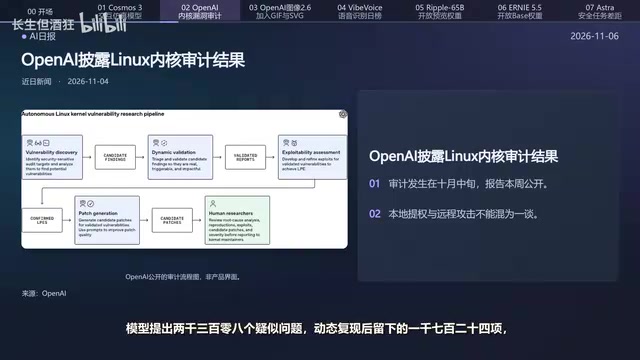
These numbers need careful interpretation: they are local privilege escalation vulnerabilities, not 900-plus remote attack entry points; candidate patches do not mean all have been merged into the kernel. The report lists API credit costs of about $1.21 million, which is not the full R&D cost. Patches still go through researcher review before entering the upstream maintenance process. In this chain, the model is "the one asking questions," and human maintainers are "the ones making the call."
Local Privilege Escalation (LPE) refers to a vulnerability where an attacker who already has low-privilege access to a target system exploits a kernel or system service flaw to gain higher privileges (such as root). Unlike remote attack entry points, LPE typically requires the attacker to first enter the system through other means, so its threat model focuses on lateral movement and persistence. Dynamic reproduction means actually triggering vulnerability candidates generated by static analysis or models in a controlled environment to verify exploitability, which can greatly reduce false positives. Candidate patches are automatically generated fix suggestions for reproduced vulnerabilities; human researchers still need to review their correctness and security before submitting them to the upstream kernel community for discussion and merge.
Baidu ERNIE 5.5 Flash Base: A 280-Billion-Parameter Pretrained Base
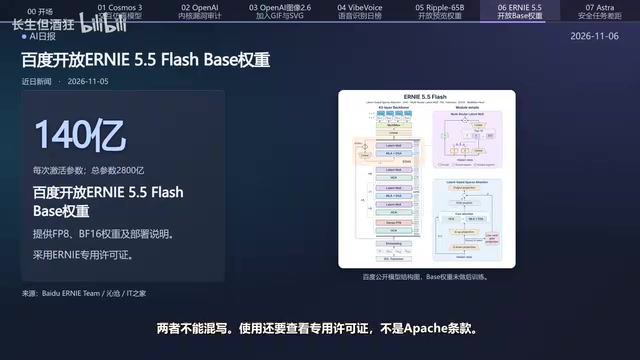
Baidu has released the weights of ERNIE 5.5 Flash Base. With 280 billion total parameters and 14 billion activated per pass, it is a sparse-architecture pretrained base. The key point: it has not undergone mid-training or post-training and cannot be used directly as a finely tuned chat assistant.
Baidu provides FP8 and BF16 weights, along with vLLM and SGLang deployment instructions. The pretraining context is 128K; the 1-million context refers to support during fine-tuning and inference, and the context lengths of the two stages should not be conflated. The license has special terms and is not a standard open-source license. For teams that want to do their own post-training, this is a starting point; for teams that want an out-of-the-box chat product, it is not suitable.
The key difference between sparse architectures (such as MoE, mixture of experts) and dense architectures lies in how parameters are activated. In dense models, all parameters are used in every inference; sparse models use a routing mechanism to activate only part of the expert networks each time, controlling compute cost even with a very large total parameter count. ERNIE 5.5 Flash Base, with 280 billion total parameters and 14 billion activated per pass, follows exactly this design: it maintains large model capacity while keeping the compute of a single inference close to that of a 14-billion-parameter dense model. This also explains why it is called a "base"—sparse pretrained bases usually need mid-training and post-training to become usable chat models, and loading the weights directly does not give an out-of-the-box assistant experience.
Recursive Releases 65B Dense Model and Microsoft Vibe Voice
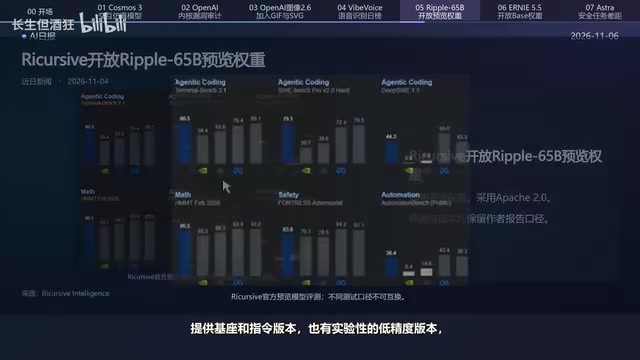
Recursive has released the Repo65B preliminary weights, a 65-billion-parameter dense model available in base and instruct versions, plus an experimental low-precision version, under the Apache 2.0 license. It officially supports up to 1 million context. The coding and terminal task results reported by the team are self-evaluations and have not yet been reproduced by third parties. The $32 million figure covers data, experiments, pretraining, and post-training R&D costs; the local device mentioned is a DGX Spark and should not be extrapolated to mean it runs on an ordinary laptop.
Microsoft Vibe Voice was ranked 13th on the GitHub daily chart at the time of this observation, but the repository was not released that day. Its streaming recognition update in September supports 10 languages and custom hotwords for continuous transcription. It is important to distinguish streaming recognition, long-audio recognition (up to 60 minutes per pass, outputting speaker, time, and text), and real-time speech synthesis—these are three different model capabilities. The original speech synthesis code was once removed, so the capabilities of various versions cannot be stitched together into a ready-made tool.
A dense model is an architecture in which all parameters participate in computation during inference, as opposed to sparse MoE models. As a 65-billion-parameter dense model, Repo65B has fixed and relatively high compute per inference, placing more rigid demands on VRAM and compute, but its behavior is more predictable and fine-tuning does not require handling the complexity of expert routing. The Apache 2.0 license is a permissive open-source license that allows commercial use, modification, and redistribution, provided copyright notices and license text are retained, and imposes no additional restrictions beyond a patent retaliation clause. For teams hoping to build on these weights, Apache 2.0 offers high legal certainty, but they still bear compliance responsibility for model outputs.
OpenAI Astra Behavior Study: A 6-Point Description Gap
OpenAI updated its behavior research report on Astra. The team described the same coding task as "safety research" and "capability research" respectively; the safety group completed about 10% of hidden scoring items, and the capability group about 16%, a difference of about 6 percentage points. This is the completion rate of scoring items in a paired experiment, not the model's general accuracy, and certainly cannot be summarized as "all work dropped by 40%." The gap remained after excluding explicit refusals and similar cases, but researchers have not yet determined the root cause. The report was updated on November 4, and the experimental samples came from earlier accumulation.
The value of this finding is not in the number itself, but in what it suggests: the framing of a task affects model behavior, and evaluation design needs to take this sensitivity into account.
A paired experiment is an experimental design in which the same task is presented to the model under different conditions (such as different wording frames) and the differences in results are compared, in order to control for variation caused by the task's own difficulty. In this study, the same coding task was described as "safety research" and "capability research," which is a typical framing effect test. Scoring item completion refers to the proportion of preset hidden scoring points the model passes, not general accuracy. This design can reveal the sensitivity of model behavior to task description wording and warns about the fairness and reproducibility of evaluation design: if an evaluation frame unintentionally suggests a certain tendency, model performance may be systematically overestimated or underestimated.
One-line Summary
In this round of updates, the real signal is "interfacing": image models output formats consumable by engines, base models hand over weights that can be reshaped by post-training, and audit models produce patch candidates that maintainers can review. Each step turns AI from a demo into a link in the pipeline, while human review remains the final gate.
One-line Summary
OpenAI images add GIF/SVG export, Baidu open-sources a 280B sparse base, and AI tools accelerate their integration into production workflows.
Paragraph Summary
This observation focuses on AI tools shifting from generation capabilities to production workflow integration. OpenAI Image 2.6 adds GIF animation and SVG vector export and distinguishes fast and high-quality modes, but it is explicitly not an engine plugin, and manual checks are still needed before importing into Unity/Unreal. NVIDIA Cosmos 3 releases checkpoints for four interactive simulation models, emphasizing the division of labor between visual generation and physics simulation. OpenAI discloses Linux kernel audit results, yielding 948 local privilege escalation vulnerability candidates and patches, but human review is required before merging. Baidu open-sources ERNIE 5.5 Flash Base, a sparse pretrained base with 280B total parameters and 14B activated, untrained post-hoc and suitable for secondary development rather than direct chat. Recursive releases the 65B dense model Repo65B, and Microsoft Vibe Voice updates streaming recognition. The Astra behavior study shows that task description framing produces a gap of about 6 percentage points in scoring item completion.
Related articles
 Tech Frontiers
MuJoCo: An Analysis of DeepMind's Open-Source General-Purpose Physics Simulator
An in-depth analysis of Google DeepMind's open-source physics simulator MuJoCo: high-performance C++ kernel, MJCF modeling format, contact solving principles, MJX GPU acceleration, and robot reinforcement learning use cases.
 Tech Frontiers
Claude API Quick Start: The Official Quickstarts Project Collection
Anthropic's official claude-quickstarts project collection helps developers quickly build deployable apps with the Claude API. Nearly 20k stars, Python-based, great for beginners and prototyping.
 Tech Frontiers
AI Agents Connecting Directly to APIs: Which Calls Can Be Safely Allowed?
AI agents can call any API, but the real challenge is deciding which calls can be safely allowed. This article analyzes allowance decisions from three dimensions—intent matching, least privilege, and controllable impact—and argues that the control layer should sit outside the agent, combined with audit traceability to build a trustworthy API call governance mechanism.