OpenAI President Brockman: Company May Be IPO-Ready by 2027

OpenAI's president says the company may be IPO-ready by 2027, with accelerating enterprise revenue as the key support.
OpenAI President Greg Brockman publicly said the company may be ready to go public by 2027, the most direct statement management has made about its capital-markets path. He cited accelerating enterprise revenue growth and improved overall fundamentals, with stable enterprise subscription revenue seen as the core argument for proving sustainability to public markets. However, no specific revenue figures were disclosed. An IPO still faces structural obstacles including governance, profit arrangements with investors such as Microsoft, the restructuring process, and high AI capex. If it proceeds on schedule, it would provide a public-market reference for AI industry valuations, but the remarks should be read as a directional signal rather than a firm commitment.
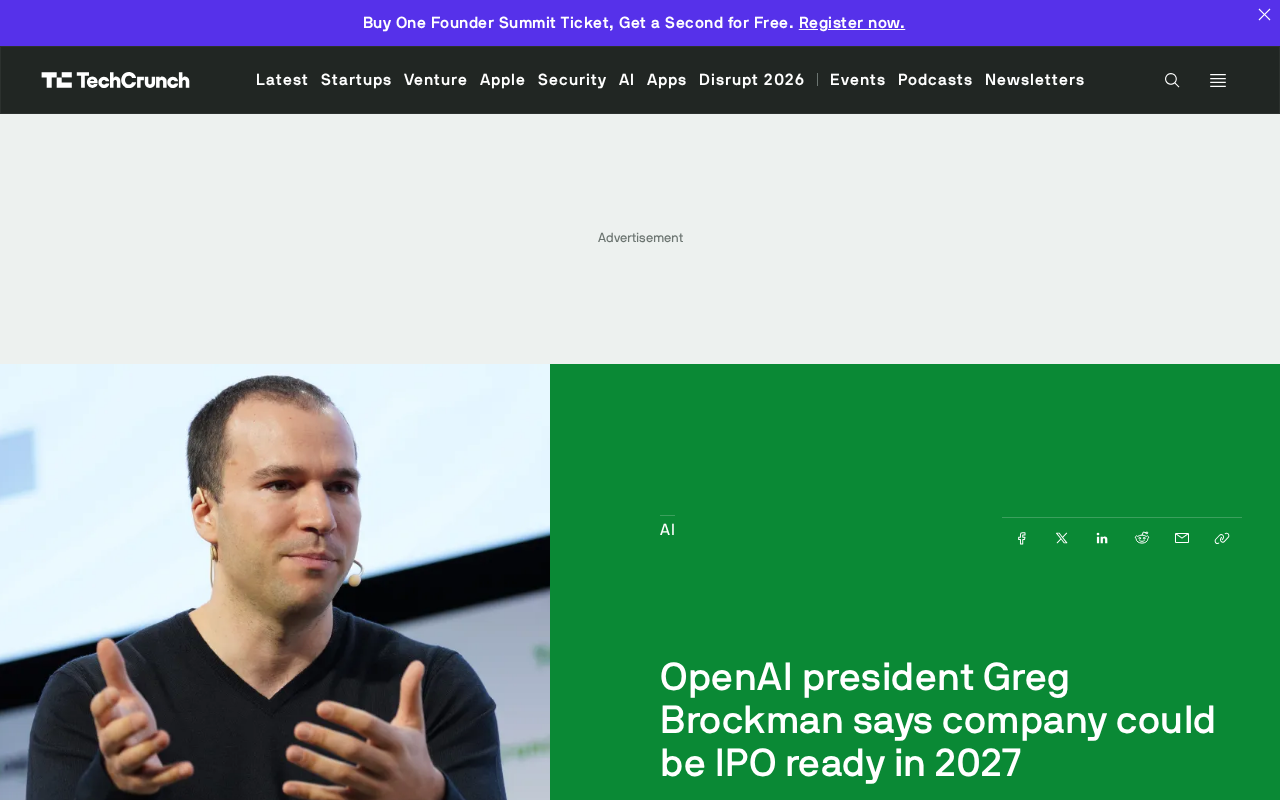
OpenAI President Greg Brockman recently said the company may be ready to go public by 2027. The remark points to accelerating revenue growth in the enterprise business and an overall improvement in the company's operations.
IPO timeline clarified for the first time
Brockman publicly gave a relatively specific time window: 2027. For an AI company that started with a nonprofit structure and has raised capital at a rapid pace, this is the most direct statement management has made about its path to the public markets.
It should be noted that Brockman's wording was "may be ready," not a confirmation of a listing. This preserves flexibility while also suggesting that the company has already incorporated an IPO into its medium-term plans.
Enterprise revenue becomes a key pillar
The core support for this judgment is the acceleration in enterprise business revenue that Brockman mentioned, along with the improvement in the company's overall fundamentals.
For OpenAI, enterprise customers mean more stable subscription revenue and higher average revenue per customer. Compared with the more volatile consumer subscriptions, the enterprise business is better able to prove revenue sustainability to public-market investors. Brockman's use of enterprise revenue as his main argument shows that this business line is becoming the centerpiece of the company's financial narrative.
However, the original information did not disclose specific revenue figures or growth rates, so outsiders cannot yet quantify the extent of the "acceleration."
A listing still faces structural obstacles
An IPO is not just a revenue issue. OpenAI's unusual governance structure, its profit arrangements with investors such as Microsoft, and the pace of its restructuring process are all matters that must be clarified before a listing. Brockman's remarks did not address these details, but they will actually determine whether the timeline can be met.
Another variable is capital expenditure in the AI industry. Training and inference costs remain high, and public markets will scrutinize AI companies' path to profitability more strictly, which will also affect the choice of listing timing.
OpenAI's unusual governance structure stems from its history as a nonprofit research organization founded in 2015. In 2019, to bring in outside capital, the company established a capped-profit entity, OpenAI LP, controlled by the nonprofit parent OpenAI Nonprofit, with limits on investor returns. After the 2023 incident in which the board removed the CEO, governance problems were further exposed, and the company subsequently pushed forward with a restructuring. It plans to transfer control to a new public benefit corporation (PBC) structure while allowing the nonprofit foundation to retain significant interests. This restructuring involves equity and profit-sharing arrangements with Microsoft (which has invested about $13 billion cumulatively), SoftBank, and others, and requires approval from regulators and each investor. For public-market investors, a clear equity structure and governance rules are preconditions for a listing, and OpenAI's structure has no precedent among large global technology companies. Whether its restructuring can be completed before 2027 is one of the biggest uncertainties in the IPO timeline.
What it means for the industry
If OpenAI moves toward a listing around 2027, it will be an important calibration of the AI industry's valuation system. It would provide a public-market reference point for high private-market valuations and would also affect the fundraising and exit pace of other AI companies.
In the absence of specific financial data, Brockman's remarks should be understood more as a directional signal than as a firm timing commitment. Whether the IPO proceeds on schedule depends on whether enterprise revenue growth can continue and whether governance and restructuring issues can be resolved within the window.
Private-market valuation refers to the valuation that unlisted companies receive in private financing. OpenAI's valuation has risen to the hundreds of billions of dollars in multiple funding rounds in 2024 and 2025, and peers such as Anthropic and xAI are also at high levels. Such valuations lack the test of public trading prices and rely mainly on investment institutions' expectations for future revenue. The significance of an IPO is that it places the company under the public market's continuous pricing mechanism: quarterly financial disclosures, analyst coverage, short-selling mechanisms, and index inclusion will all create stricter value calibration. If OpenAI's post-IPO valuation is significantly lower than its last private round, it would directly compress other AI companies' fundraising space and exit expectations; conversely, it could reinforce the valuation anchor for the entire industry. Therefore, this potential IPO is not only about OpenAI itself but is also a key window for observing whether the AI bubble thesis or the fundamentals thesis prevails.
One-line Summary
OpenAI's president says the company may be IPO-ready by 2027, with accelerating enterprise revenue as the key support.
Paragraph Summary
OpenAI President Greg Brockman publicly said the company may be ready to go public by 2027, the most direct statement management has made about its path to the capital markets. His judgment is based on accelerating enterprise business revenue growth and an overall improvement in the company's fundamentals, with stable subscription revenue from enterprise customers seen as the core argument for proving sustainability to public markets. But the original information did not disclose specific revenue figures. An IPO still faces structural obstacles such as governance structure, profit arrangements with investors including Microsoft, the restructuring process, and high AI capital expenditure. If it proceeds on schedule, it would provide a public-market reference for the AI industry's valuation system, but the current remarks should be understood as a directional signal rather than a firm commitment.
Related articles
 Tech Frontiers
Coldframe: A Honeypot Disguised as a Supermarket Freezer Controller
Coldframe is a honeypot disguised as Danfoss AK-SM 800A and Dixell XWEB freezer controllers, built as a single Python file that detects CVE-2025-41450 attempts and is identified as real devices on Shodan.
 Tech Frontiers
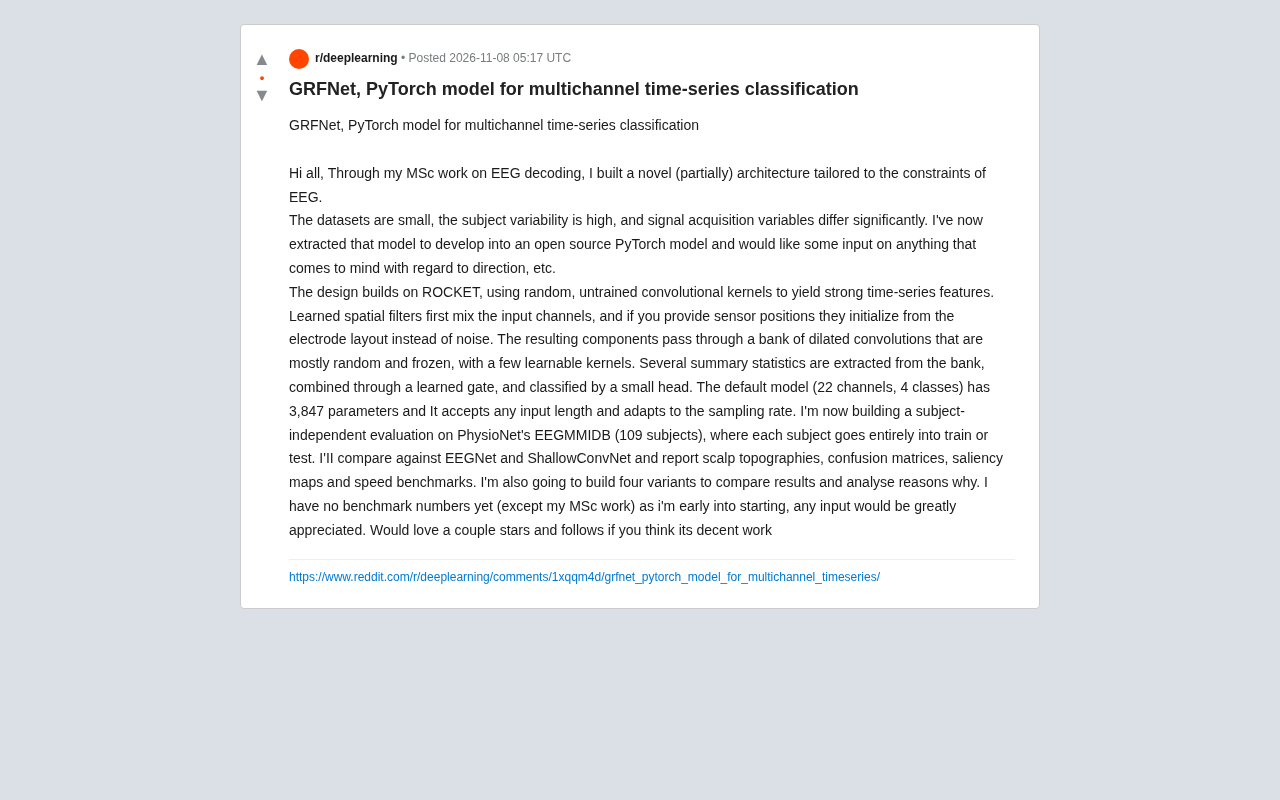
GRFNet: A Lightweight PyTorch Model Designed for Multichannel Time-Series Classification
GRFNet is a lightweight PyTorch model for multichannel time-series classification, originating from EEG decoding research. With only 3,847 parameters, it is based on the ROCKET architecture, combining random convolution kernels with learnable spatial filters, supports arbitrary input lengths, and will soon be evaluated on the PhysioNet dataset.
 Tech Frontiers
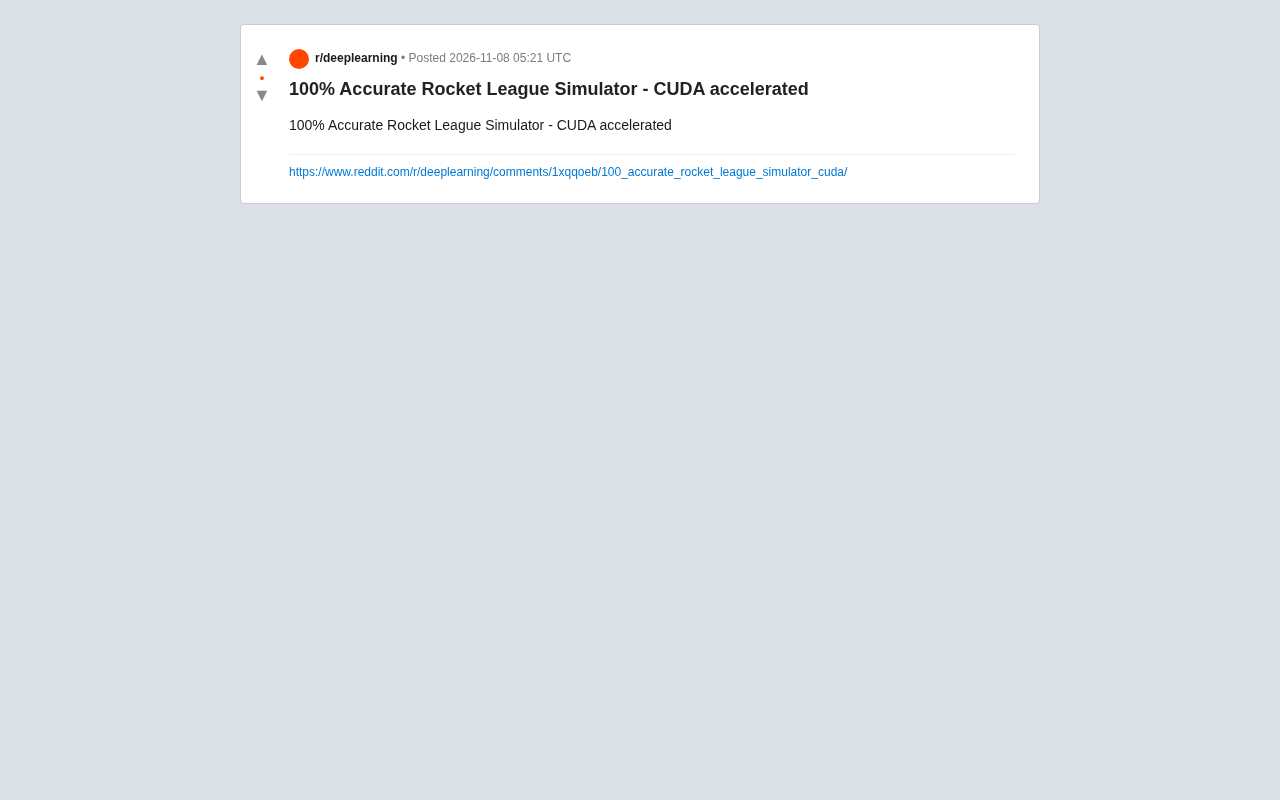
CUDA-Accelerated Rocket League Simulator: A Player-Made Hardcore Experiment
A Reddit post shows a "100% Accurate" Rocket League simulator accelerated with CUDA. We analyze its technical context, CUDA's value in game physics simulation, and the significance and limitations of such community projects.